
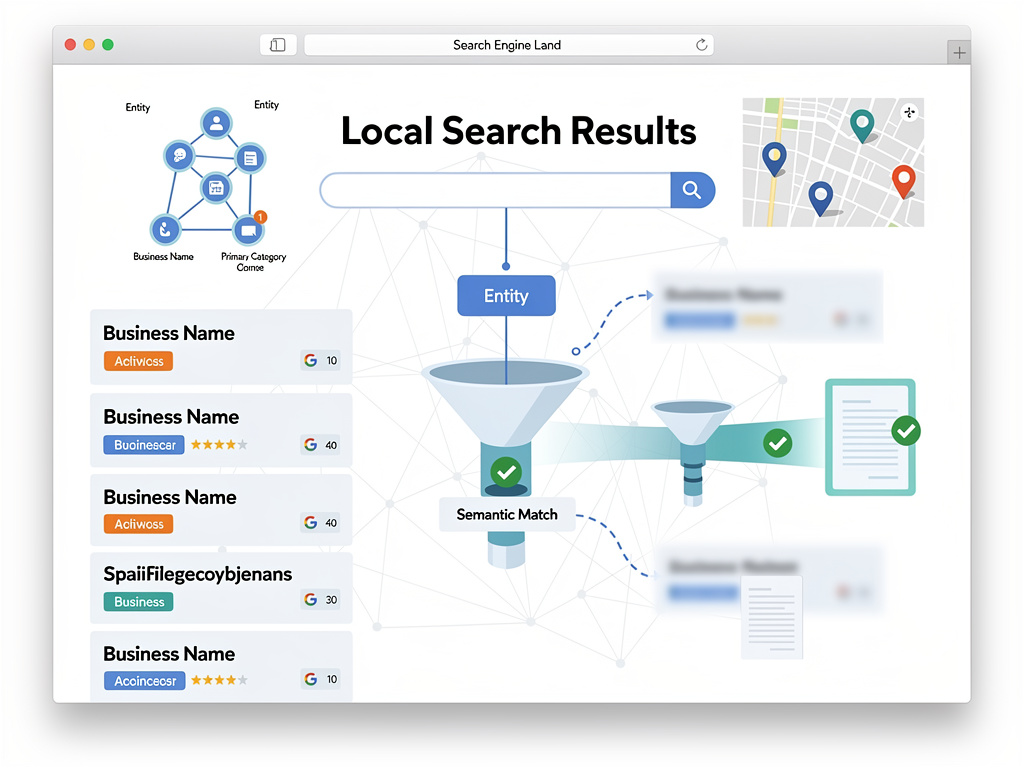
In the high-stakes arena of local search, Google’s algorithms act as an unyielding sentinel, rejecting businesses it cannot precisely identify. A recent analysis reveals that business names and primary categories serve as the foundational signals determining eligibility for local rankings, often overriding traditional factors like reviews or proximity. “Google decides what you are before it decides how relevant you are,” writes Claudia Tomina in Search Engine Land.
Insights from the Google Content Warehouse API leak expose the `NlpSemanticParsingLocalBusinessType` machine-learning classifier as the core mechanism filtering out semantically mismatched entities. This upstream process evaluates the business name and primary category as a unified ‘locationElement,’ ignoring secondary signals if confidence is low. For niche queries, Google demands near-exact matches; broader intents allow flexibility but still hinge on this entity boundary.
Business names contribute semantic tokens—words that infer niche, scope, and intent—while primary categories provide structured Google Category IDs (GCIDs) from the `LocalCategoryReliable` grammar. Misalignments here create narrow boundaries, limiting visibility. As of early 2026, Google maintains over 4,000 categories, updated frequently, with experts noting additions like ‘Probate attorney’ in 2025 and removals such as ‘Swimming Basin,’ per Sterling Sky.
Tokenized Identities Shape Search Fate
Specific tokens in business names act as anchors. Take ‘Tropical Sips & Smoothies,’ a cafe offering sandwiches and salads but tokenized as beverage-focused, dominating ‘smoothie near me’ yet requiring validation for ‘lunch near me.’ Similarly, ‘Smokey’s Smoke & Smoothie’—a smoke shop—ranks for smoothies due to name signals overpowering its category. Tomina notes, “Business names aren’t just labels. They’re tokenized identity signals.”
For service-area businesses (SABs), name qualifiers like ‘kids’ in ‘Tippi Toes Dance Company’ enable rankings for ‘kids dance lessons Palm Beach’ but not broader ‘dance lessons.’ This query-specific eligibility underscores that “eligibility isn’t universal. It’s query by query,” as Tomina emphasizes. Google’s official guidelines reinforce this: select categories completing ‘This business IS a…’ not ‘HAS a…,’ per Local Dominator.
Primary categories dictate scope. A ‘steakhouse’ lacks the broader reach of ‘_restaurant’ variants, as seen in a case where a venue with robust halal signals—website content, attributes, reviews—remained invisible for ‘halal restaurant’ until switching primaries, vaulting to No. 1. Categories unlock features like booking buttons, with one primary and up to nine secondaries advised, though experts debate dilution risks.
Validation Beyond the Gate
Passing the semantic filter triggers validation via `visitHistory` foot traffic, `clickRadius50Percent` geographic signals, and NavBoost from quality clicks. These behavioral proofs can expand narrow boundaries, but only post-eligibility. Recent X discussions highlight primary category as a top ranking factor, with practitioners like @pogrebisskiy stating, “Choosing the Right PRIMARY CATEGORY on Google Maps Matters More Than Your WEBSITE.”
Google’s support documentation mandates NAP consistency across signage, websites, and profiles, warning against keyword-stuffed names. Violations risk suspensions, especially amid 2026’s stricter enforcement. Tools like Semrush Listing Management aid NAP audits, while category research via extensions reveals competitors’ choices, as noted in Accentuate Agency.
Multi-location brands must ensure distinct profiles with precise NAP, avoiding generic names. X user @noelcetaSEO outlines GBP optimization: complete sections, weekly posts, review responses—yet stresses NAP audits first. As of February 2026, 4,102 categories exist, per Circleboom, emphasizing timely updates.
Realigning for 2026 Dominance
Tomina’s 2026 strategy urges ‘re-anchoring’ entities: align primary categories for core scope, use secondaries for niches, bolster with website service pages and branded behavioral signals. Avoid mismatched optimization; pivot to ads or PR for non-aligned queries. “If you don’t pass this semantic filter, your 500 five-star reviews don’t even get looked at,” she warns.
Industry voices on X, like @boringlocalseo, advocate schema, NAP footers, and local content alongside categories. @irentdumpsters recommends GBP audits via tools like GMB Everywhere for category insights. Google prioritizes verified, complete profiles feeding AI Overviews, per Trebletree.
For SABs, name tokens enable intent-specific wins, but broad queries demand category breadth. HVAC firms might swap ‘Furnace Repair Service’ seasonally, per Olly Olly. Entity clarity now underpins local SEO amid AI shifts, demanding precision over volume.
Query-Specific Battles Ahead
Niche dominance requires 1:1 alignment; broad plays leverage validation layers. Recent updates, like 2025’s ‘Ice hockey rink’ rename, signal ongoing taxonomy evolution, per Sterling Sky. Practitioners report rapid ranking lifts from category tweaks, but reverifications loom for major edits.
X threads from @growwithkhan stress fundamentals: exact NAP, city-specific pages, fresh reviews with keywords. @jasminelocalseo warns against outdated tactics, prioritizing GBP completeness. As local search integrates AI, entity signals gain primacy, per OWDT: “Google must recognize your business as a real entity.”
Businesses must audit entities rigorously—names as semantic anchors, categories as structured keys—before chasing prominence. In 2026, this firewall separates contenders from the invisible.


 WebProNews is an iEntry Publication