
Google’s upcoming Pixel 10a represents more than just another iteration in the company’s budget smartphone lineup—it signals a fundamental transformation in how the tech giant approaches mid-range devices. As the company prepares to potentially unveil its next A-series phone, industry insiders are closely examining leaked specifications and strategic decisions that could reshape the competitive dynamics of the affordable smartphone market.
According to Android Central, the Pixel 10a is expected to feature significant upgrades over its predecessor, the Pixel 9a, particularly in processing power and camera capabilities. While the Pixel 9a currently serves as Google’s entry point into its smartphone ecosystem at $499, the forthcoming 10a model appears poised to leverage the company’s new Tensor G5 chip, marking a departure from previous A-series devices that typically launched with year-old processors.
The timing of this development comes at a critical juncture for Google’s hardware ambitions. The company has struggled to gain substantial market share in the smartphone sector, consistently ranking behind Samsung and Apple in most global markets. The A-series phones, however, have emerged as a bright spot, offering consumers premium features at accessible price points and serving as a gateway to Google’s broader ecosystem of services and artificial intelligence capabilities.
The Tensor G5 Gambit: Processing Power Meets Efficiency
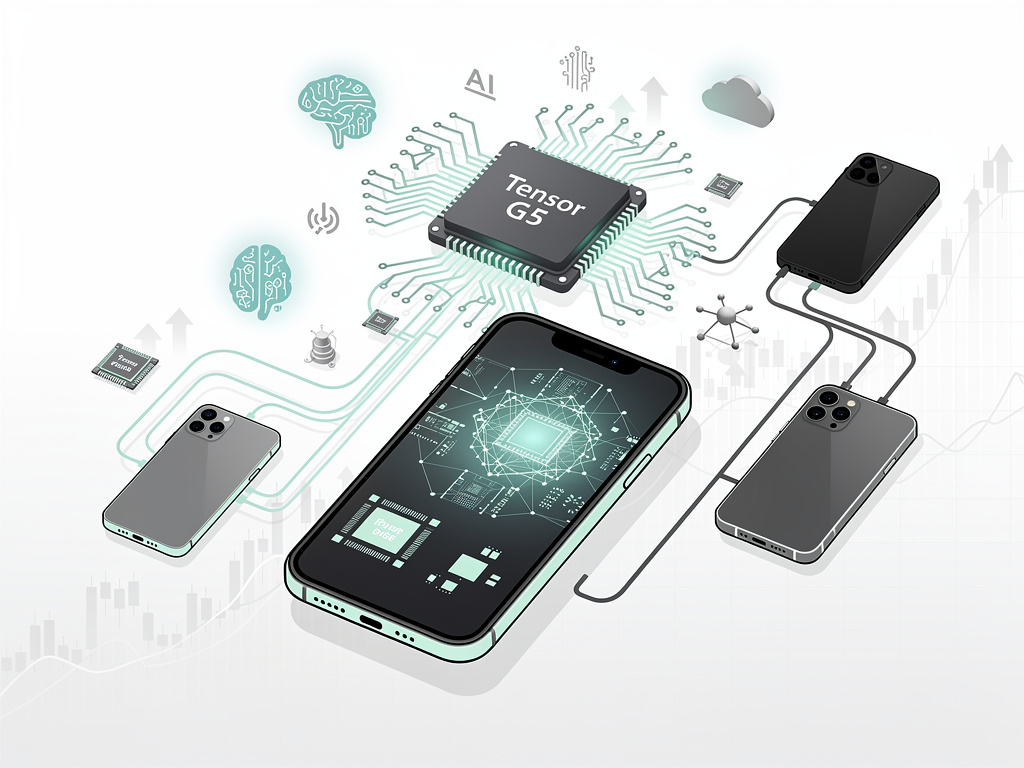
The decision to equip the Pixel 10a with the Tensor G5 chip represents a strategic shift that could have far-reaching implications. Unlike previous A-series models that utilized processors from the prior year’s flagship devices, the 10a may launch with Google’s latest silicon, potentially narrowing the performance gap between budget and premium offerings. This chip, manufactured using TSMC’s advanced 3-nanometer process technology, promises significant improvements in both computational efficiency and thermal management compared to the Samsung-manufactured Tensor G4 found in the Pixel 9a.
Industry analysts suggest this move reflects Google’s increasing confidence in its custom silicon strategy. The Tensor line has evolved from its initial focus on machine learning tasks to becoming a more well-rounded processor capable of handling demanding computational workloads. By incorporating the G5 into the budget-friendly 10a, Google appears to be betting that consumers will increasingly value AI-powered features and computational photography capabilities over traditional hardware specifications like maximum clock speeds or benchmark scores.
The implications extend beyond mere performance metrics. The Tensor G5’s enhanced neural processing unit could enable advanced AI features previously reserved for flagship devices, including more sophisticated real-time language translation, improved voice recognition, and enhanced computational photography algorithms. These capabilities align with Google’s broader strategy of differentiating its hardware through software and AI integration rather than competing solely on traditional specifications.
Camera Technology: Bridging the Gap Between Budget and Premium
Camera performance has long been a hallmark of Google’s Pixel lineup, and the 10a appears set to continue this tradition while potentially introducing notable improvements. The Pixel 9a features a capable dual-camera system with a 64-megapixel main sensor and a 13-megapixel ultrawide lens, delivering image quality that often rivals more expensive competitors. Early indications suggest the Pixel 10a may retain a similar hardware configuration while leveraging the Tensor G5’s enhanced image processing capabilities to deliver superior results.
The computational photography advantages offered by the new chip could prove particularly significant in challenging lighting conditions and when processing video content. Google’s camera algorithms have historically excelled at extracting maximum detail from relatively modest hardware, and the additional processing headroom provided by the Tensor G5 could enable features like improved night mode performance, faster HDR processing, and more sophisticated subject tracking during video recording.
What remains unclear is whether Google will introduce any new camera hardware alongside the improved processing capabilities. Some industry observers speculate that the company might upgrade the front-facing camera or add additional computational photography features that leverage the Tensor G5’s machine learning capabilities, such as more advanced portrait mode effects or real-time video enhancement.
Design Philosophy and Market Positioning
The Pixel A-series has traditionally occupied a unique position in the smartphone market, offering a design aesthetic that closely mirrors Google’s flagship devices while making strategic compromises to achieve lower price points. The Pixel 9a introduced a refined design language with smoother edges and a more integrated camera bar, moving away from the prominent camera bump that characterized earlier models. The Pixel 10a is expected to build upon this foundation, potentially introducing subtle refinements while maintaining the recognizable Pixel identity.
Display technology represents another area where the 10a might see incremental improvements. The Pixel 9a features a 6.3-inch OLED display with a 120Hz refresh rate and peak brightness of 2,700 nits, specifications that were once exclusive to premium devices. The 10a could maintain these display characteristics while potentially improving color accuracy or introducing enhanced durability features, though significant display upgrades seem unlikely given the need to maintain competitive pricing.
Battery capacity and charging speeds remain critical considerations for budget-conscious consumers. The Pixel 9a’s 5,000mAh battery provides solid all-day performance, and the 10a is expected to offer similar or slightly improved battery life, potentially enhanced by the Tensor G5’s superior power efficiency. However, charging speeds may remain a relative weakness, as Google has historically been conservative in this area compared to competitors who offer faster charging solutions even in budget devices.
Software Support and Long-Term Value Proposition
One of Google’s most compelling value propositions for the Pixel A-series has been its commitment to extended software support. The company has promised seven years of OS updates for recent Pixel devices, a policy that dramatically extends the useful lifespan of these phones compared to most competitors in the budget segment. This commitment transforms the value equation for consumers, as a device purchased today could theoretically receive Android updates through 2031 or beyond.
This extended support window has significant implications for both consumers and Google’s business strategy. For users, it means their investment remains protected against security vulnerabilities and continues to receive new features for years after purchase. For Google, it represents an opportunity to maintain long-term engagement with users, ensuring they remain within the company’s ecosystem and continue utilizing its services and AI features as they evolve.
The Pixel 10a’s launch with the latest Tensor chip could make it an even more attractive option for consumers prioritizing longevity, as the device would begin its lifecycle with Google’s most advanced silicon, potentially ensuring better performance throughout its extended support period. This approach contrasts sharply with competitors who may offer cheaper devices but provide minimal software support, leaving users vulnerable to security risks or forcing them to upgrade more frequently.
Competitive Dynamics in the Mid-Range Market
The mid-range smartphone segment has become increasingly competitive, with manufacturers like Samsung, OnePlus, and Motorola offering feature-rich devices at attractive price points. Samsung’s Galaxy A-series, in particular, has found success by offering diverse options across various price tiers, while Chinese manufacturers have pushed the boundaries of what’s possible at budget price points in markets outside North America.
Google’s strategy with the Pixel A-series differs fundamentally from these competitors. Rather than competing primarily on specifications or offering numerous models across different price points, Google has focused on delivering a refined, cohesive experience that emphasizes software integration, AI capabilities, and computational photography. This approach has resonated with a specific segment of consumers who value software quality and camera performance over raw hardware specifications or feature abundance.
The Pixel 10a’s success will likely depend on Google’s ability to maintain this differentiation while addressing areas where competitors have traditionally held advantages, such as charging speed, storage options, and display technology. The company must also navigate pricing carefully, as the budget segment is particularly price-sensitive, and even small increases could push potential customers toward alternatives.
Manufacturing and Supply Chain Considerations
The transition to TSMC for Tensor G5 production represents a significant shift in Google’s supply chain strategy. Previous Tensor chips were manufactured by Samsung using its foundry services, but reports suggest Google has moved to TSMC for the G5, likely seeking the improved yields, power efficiency, and performance characteristics associated with TSMC’s advanced manufacturing processes. This decision could have implications for production costs, availability, and ultimately the retail pricing of devices like the Pixel 10a.
The relationship between manufacturing costs and retail pricing will be crucial for the Pixel 10a’s market positioning. While the Tensor G5’s advanced manufacturing process might increase per-unit costs, improved yields and Google’s growing scale in hardware production could help offset these expenses. The company must balance the desire to include cutting-edge technology with the need to maintain accessible pricing that defines the A-series.
The Broader Implications for Google’s Hardware Ambitions
The Pixel 10a represents more than just another product launch—it serves as a testing ground for Google’s evolving hardware strategy and its ability to compete in a market dominated by established players. The company’s decision to potentially equip its budget device with flagship-level silicon suggests a recognition that differentiation in the smartphone market increasingly depends on software capabilities and AI integration rather than traditional hardware specifications.
As Google continues to develop its custom silicon capabilities and deepen the integration between hardware and software, devices like the Pixel 10a become crucial touchpoints for introducing consumers to the company’s vision of AI-enhanced mobile computing. The success or failure of this approach will likely influence Google’s hardware strategy for years to come, potentially affecting decisions about pricing, feature prioritization, and market positioning across its entire product lineup.
The smartphone industry watches with interest as Google prepares to unveil its next budget offering. Whether the Pixel 10a can successfully balance cutting-edge technology with accessible pricing while maintaining the qualities that have made the A-series successful remains to be seen. What seems certain is that Google’s approach to the mid-range market continues to evolve, potentially reshaping consumer expectations about what budget smartphones can deliver.


 WebProNews is an iEntry Publication