
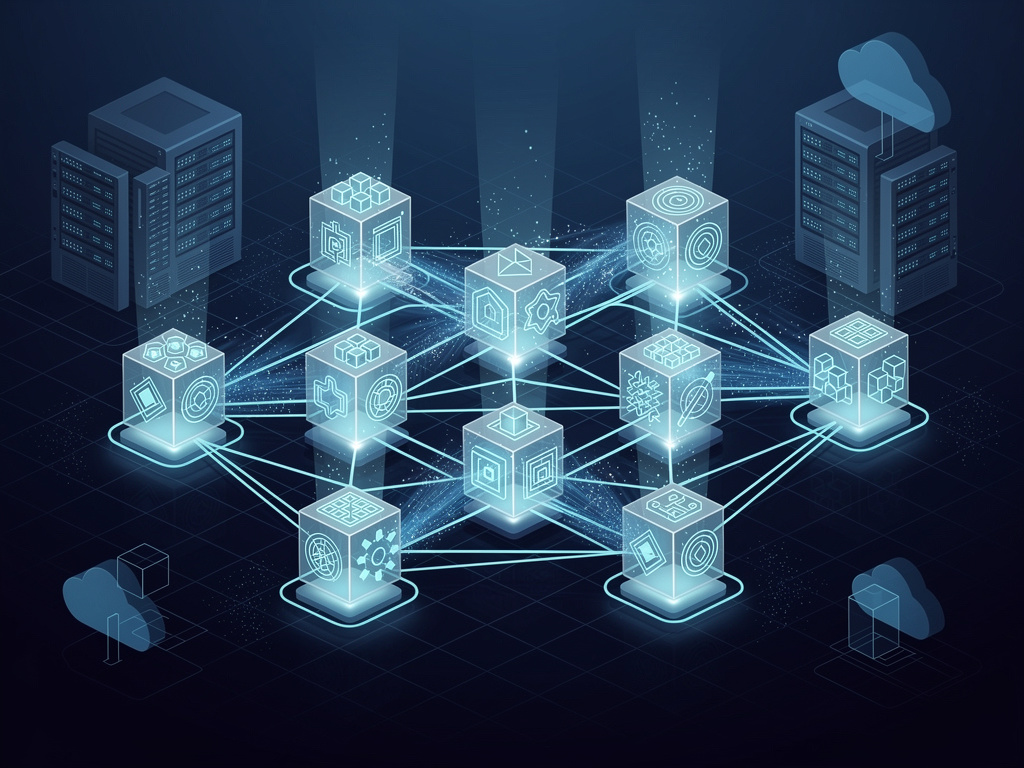
The age of the single, all-knowing AI agent is already ending before it truly began. What’s replacing it is something far more complex, far more interesting, and far more likely to actually work in production: networks of specialized AI agents that communicate, coordinate, and delegate tasks among themselves like teams of human workers. Google Cloud recently published a detailed technical framework for building exactly this kind of system, and the implications for enterprise software architecture are enormous.
The Google Cloud blog post lays out a vision where multiple AI agents — each with distinct capabilities, tools, and memory — operate as a distributed system rather than a monolithic one. Think of it less like a single brilliant employee and more like a well-run department. One agent handles customer data retrieval. Another manages scheduling. A third synthesizes information and drafts responses. They pass context between each other, negotiate handoffs, and maintain shared state. The whole thing runs on infrastructure patterns borrowed directly from distributed computing, a field with decades of hard-won engineering wisdom behind it.
This isn’t theoretical. Google’s framework builds on its Agent Development Kit (ADK) and integrates with Agent2Agent (A2A), an open protocol the company introduced earlier this year for inter-agent communication. The A2A protocol is designed to let agents built on different frameworks — not just Google’s — discover each other’s capabilities and collaborate on tasks. It’s an explicit bet that the future won’t be dominated by any single vendor’s agent platform, but rather by interoperable agents that can work across organizational and technical boundaries.
The timing matters. Across the industry, the conversation around AI agents has shifted dramatically in the first half of 2025. OpenAI, Microsoft, Anthropic, and a growing number of startups are all racing to build agentic systems that go beyond simple chatbot interactions. But most current implementations hit a wall when they try to scale. A single agent tasked with too many responsibilities becomes slow, unreliable, and difficult to debug. It’s the same problem that plagued monolithic software architectures in the early 2000s — and the solution is the same too. Break it apart.
Google’s approach draws heavily on microservices patterns. Each agent in the distributed system is treated as an independent service with a well-defined interface. Agents communicate through structured messages rather than shared memory, which makes the system more resilient to individual failures. If the scheduling agent goes down, the customer-facing agent can still operate — it just can’t book meetings until the scheduler recovers. This kind of graceful degradation is standard practice in cloud-native applications, but it’s relatively new thinking in the AI agent world.
The technical architecture described in the Google Cloud post centers on several key components. First, there’s a coordination layer that manages task routing and agent discovery. This layer decides which agent should handle a given subtask based on the agent’s declared capabilities and current availability. Second, there’s a shared context store — essentially a distributed memory system that allows agents to access relevant information without having to pass entire conversation histories back and forth. Third, there are observation and tracing tools that let developers see exactly what happened when a multi-agent workflow produces an unexpected result.
That last piece — observability — may be the most important for enterprise adoption. One of the biggest objections CIOs and engineering leaders raise about AI agents is the black-box problem. When a single agent makes a mistake, it’s hard enough to figure out why. When a network of agents collaborates on a task and something goes wrong, the debugging challenge multiplies. Google’s framework addresses this by treating agent interactions like distributed traces in a microservices architecture, using correlation IDs and structured logging to reconstruct the chain of decisions that led to any given outcome.
And the stakes are real. Enterprise deployments of AI agents are accelerating. According to recent reporting from Reuters, major financial institutions and healthcare organizations are piloting multi-agent systems for everything from claims processing to regulatory compliance. The appeal is obvious: agents that can autonomously handle complex, multi-step workflows promise massive efficiency gains. But the risk of cascading failures in poorly designed agent networks is equally obvious.
Google isn’t the only company thinking about this problem. Microsoft’s AutoGen framework, now in active development, takes a similar multi-agent approach. Anthropic has published research on agent coordination and safety. CrewAI, an open-source framework, has gained significant traction among developers building multi-agent applications. But Google’s contribution is notable for its explicit grounding in distributed systems engineering — treating the problem not as a novel AI challenge but as a well-understood infrastructure challenge with AI-specific wrinkles.
The A2A protocol deserves particular attention. Announced in April 2025, it defines a standard way for agents to advertise their capabilities through “agent cards” — JSON documents that describe what an agent can do, what inputs it expects, and what outputs it produces. When one agent needs help with a subtask, it can query a registry of available agents, find one with the right capabilities, and initiate a collaboration session. The protocol handles authentication, capability negotiation, and task lifecycle management. It’s REST-based and designed to work across different cloud providers and on-premises environments.
So what does this mean in practice? Consider a supply chain management scenario. A procurement agent receives a request for raw materials. It checks inventory by querying a warehouse agent. It consults a pricing agent that monitors commodity markets in real time. It negotiates with a supplier-facing agent that has access to vendor contracts and relationship history. Finally, it routes the purchase order through a compliance agent that checks against regulatory requirements and internal policies. Each of these agents is a specialist. None of them needs to understand the full complexity of the others’ domains. They just need to speak the same protocol.
This is a fundamentally different model from the “super-agent” approach that dominated early AI agent development, where a single large language model was given a massive system prompt and a long list of tools. That approach works for demos. It breaks in production. The context window fills up. The model loses track of instructions. Tool calls conflict with each other. Error handling becomes a nightmare. Distributed agent architectures solve these problems by constraining each agent’s scope and responsibility — the same principle that made microservices successful in traditional software.
But distributed systems bring their own problems. Coordination overhead. Network latency. Partial failures. Consensus challenges. The Google Cloud framework acknowledges these tradeoffs explicitly. It recommends starting with simple agent topologies — a primary agent that delegates to a small number of specialists — before moving to more complex mesh architectures where agents can communicate peer-to-peer. It also emphasizes the importance of idempotent operations (tasks that produce the same result even if executed multiple times) and circuit breakers (mechanisms that prevent cascading failures when one agent becomes unresponsive).
The security implications are significant too. When agents can discover and communicate with each other dynamically, the attack surface expands. A malicious agent could advertise false capabilities, intercept sensitive data during handoffs, or manipulate shared context stores. Google’s framework includes authentication and authorization mechanisms at the protocol level, but security researchers have already flagged multi-agent systems as a growing area of concern. The OWASP Foundation recently updated its guidance on AI security to include specific recommendations for agent-to-agent communication.
For enterprise architects, the message from Google’s framework is clear: treat AI agents like you treat any other distributed service. Version their APIs. Monitor their performance. Test their failure modes. Document their interfaces. Don’t let the “AI” label trick you into thinking the normal rules of software engineering don’t apply. If anything, they apply more, because the nondeterministic nature of large language models adds a layer of unpredictability that traditional services don’t have.
The developer experience question looms large. Building distributed systems is hard. Building distributed AI agent systems is harder. Google’s ADK aims to abstract away some of the complexity, providing pre-built components for common patterns like sequential task chains, parallel execution, and hierarchical delegation. But abstraction has limits. Developers still need to understand the underlying mechanics — how context propagates, how errors cascade, how agents negotiate when they disagree about the right course of action.
There’s a workforce dimension here too. The skills required to build and maintain distributed AI agent systems sit at the intersection of machine learning engineering, distributed systems design, and traditional software development. That Venn diagram doesn’t have a huge overlap right now. Companies that invest early in building this cross-functional expertise will have a significant advantage as agent architectures become standard.
One thing Google’s framework makes abundantly clear: the single-agent paradigm was always a stepping stone. The real value of AI agents comes when they work together, each contributing specialized capabilities to solve problems that no single agent could handle alone. It’s the same insight that drove the evolution from mainframes to client-server to microservices. The pattern repeats. The technology changes. The architecture principles endure.
Whether Google’s specific implementation becomes the standard or simply one of several competing approaches remains to be seen. But the direction is unmistakable. The future of enterprise AI isn’t one agent doing everything. It’s many agents, each doing one thing well, connected by protocols and infrastructure patterns that the software industry has been refining for decades. The companies that understand this — and start building for it now — will be the ones that actually deliver on the promise that AI agents have been making for the past two years.


 WebProNews is an iEntry Publication