
Alphabet Inc.’s fourth-quarter earnings report has silenced skeptics who questioned whether the search giant could maintain its dominance in an era of artificial intelligence disruption. The company’s strategic pivot toward AI-powered products, particularly its Gemini platform and enhanced search capabilities, has driven revenue growth that exceeded Wall Street’s most optimistic projections, according to The New York Times.
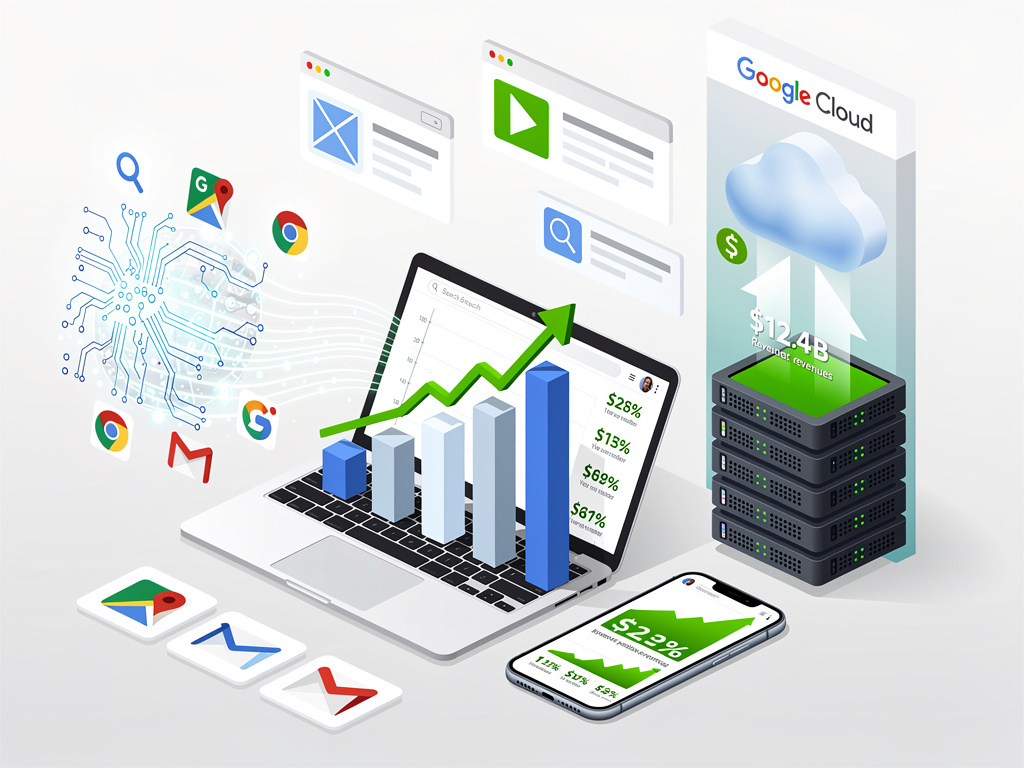
The Mountain View-based technology behemoth reported quarterly revenue of $96.2 billion, representing a 15% year-over-year increase that marks one of the strongest growth periods in the company’s recent history. More significantly, the company’s cloud computing division, which houses much of its AI infrastructure, posted revenue of $12.4 billion, a 28% jump from the previous year. These figures suggest that Google’s massive investments in artificial intelligence—estimated at over $50 billion annually—are beginning to generate substantial returns for shareholders who had grown increasingly anxious about the company’s ability to compete with rivals like Microsoft and OpenAI.
The AI Arms Race Intensifies Amid Market Skepticism
Chief Executive Sundar Pichai emphasized during the earnings call that the company’s AI initiatives have fundamentally transformed how users interact with Google’s core products. The integration of Gemini into Search has resulted in what Pichai described as “more helpful and comprehensive answers” that keep users engaged longer on Google properties. This strategic enhancement addresses one of the primary concerns that emerged when ChatGPT burst onto the scene in late 2022: that conversational AI could render traditional search engines obsolete.
The competitive dynamics of the AI sector have created what industry analysts describe as a winner-take-most environment, where companies with the deepest pockets and most sophisticated infrastructure stand to capture disproportionate market share. Google’s advantage lies not only in its technical capabilities but also in its unparalleled access to user data and its established relationships with millions of advertisers worldwide. These structural advantages have proven more durable than many observers initially predicted when generative AI first threatened to upend the search advertising business model.
Advertising Revenue Defies Disruption Predictions
Perhaps most striking in the quarterly results was the resilience of Google’s advertising business, which generated $79.1 billion in revenue—a 13% increase that contradicts predictions that AI-powered chatbots would cannibalize traditional search advertising. The company has successfully integrated AI-generated summaries and enhanced results into its search interface while maintaining, and in some cases improving, ad placement effectiveness. This delicate balance between user experience and monetization represents a crucial validation of Google’s product strategy.
Ruth Porat, Alphabet’s Chief Financial Officer, noted that the company’s advertising business benefited from improved ad targeting capabilities powered by machine learning algorithms. These systems can now predict user intent with greater accuracy, leading to higher conversion rates for advertisers and justifying premium pricing. The retail sector, in particular, has increased spending on Google’s advertising platforms, with e-commerce clients reporting improved return on ad spend metrics compared to previous quarters.
Cloud Computing Emerges as Growth Engine
Google Cloud’s performance has emerged as a critical component of the company’s growth narrative, with the division not only expanding revenue but also improving profitability margins. The cloud segment posted operating income of $1.9 billion, more than doubling from the same period last year. This profitability milestone is particularly significant given that Google Cloud has historically lagged behind Amazon Web Services and Microsoft Azure in both market share and financial performance.
The cloud division’s success stems largely from enterprise customers adopting Google’s AI and machine learning tools, which are deeply integrated into the Google Cloud Platform. Companies ranging from financial services firms to healthcare providers are utilizing Google’s Vertex AI platform to build custom applications, creating sticky customer relationships that generate recurring revenue streams. Thomas Kurian, CEO of Google Cloud, indicated during the earnings presentation that the pipeline of enterprise deals remains robust, with particular strength in AI-related services.
Investment Strategy Raises Questions About Capital Allocation
Despite the positive financial results, Alphabet’s announcement that it plans to increase capital expenditures to approximately $75 billion in the coming year has generated mixed reactions from investors. The company intends to deploy this capital primarily toward expanding its AI infrastructure, including data centers equipped with specialized processors designed for machine learning workloads. While such investments are necessary to maintain competitive parity with Microsoft and Amazon, some shareholders question whether the returns will justify the massive outlays.
The capital intensity of the AI race has created what some analysts describe as a “Red Queen’s Race,” where companies must run faster and faster simply to maintain their relative positions. Google’s competitors are making similarly large investments: Microsoft has committed to spending over $80 billion on AI infrastructure, while Amazon has announced plans for $100 billion in capital expenditures over the next decade. This arms race dynamic raises fundamental questions about whether any company can achieve sustainable competitive advantages or whether the industry is headed toward commoditization.
Regulatory Headwinds Loom Over Future Prospects
The earnings report arrives as Google faces intensifying regulatory scrutiny on multiple fronts. The U.S. Department of Justice’s antitrust case against the company, which focuses on alleged monopolistic practices in search and advertising, could result in structural remedies that fundamentally alter Google’s business model. Additionally, European regulators continue to impose restrictions on how the company can operate, with recent rulings limiting certain data collection practices and requiring greater transparency in algorithmic decision-making.
These regulatory challenges create uncertainty around Google’s ability to maintain its current growth trajectory. If regulators force the company to divest certain assets or limit its ability to integrate services across its product portfolio, the synergies that currently drive profitability could diminish. Legal experts suggest that any significant regulatory action remains years away due to the appeals process, but the mere possibility of structural changes has introduced a risk premium into Alphabet’s valuation.
Market Position Strengthens Despite Emerging Threats
The earnings results demonstrate that Google has successfully navigated the initial phase of the generative AI revolution without suffering the existential damage that some predicted. The company’s search market share has remained stable at approximately 90% globally, while its advertising business continues to generate cash flows that fund ongoing AI development. This virtuous cycle—where existing businesses finance innovation that protects those same businesses—has proven more sustainable than alternative models pursued by pure-play AI companies that lack comparable revenue streams.
However, emerging competitors pose longer-term threats that may not yet be reflected in current financial results. Perplexity AI and other AI-native search engines are attracting venture capital funding and user attention, particularly among younger demographics who may develop different search habits than previous generations. Additionally, social media platforms like TikTok and Instagram increasingly serve search-like functions for certain queries, fragmenting the information discovery market in ways that could gradually erode Google’s centrality.
Strategic Positioning for an Uncertain Future
Google’s product roadmap emphasizes the continued integration of AI capabilities across its entire suite of services, from Gmail and Google Workspace to YouTube and Android. The company has announced plans to introduce more sophisticated AI agents that can complete complex tasks on behalf of users, moving beyond simple information retrieval toward action-oriented assistance. These ambient computing experiences represent Google’s vision for how AI will transform daily life, creating new opportunities for monetization while potentially disrupting existing revenue streams.
The financial markets’ reaction to the earnings report—Alphabet shares rose 7% in after-hours trading—suggests that investors believe Google has successfully threaded the needle between investing aggressively in AI while maintaining the profitability of its core businesses. This confidence reflects not only the strong quarterly numbers but also management’s articulation of a coherent strategy for the AI era. Whether this optimism proves justified will depend on Google’s ability to continue innovating while managing the considerable risks inherent in technological disruption, regulatory intervention, and intensifying competition.
The company’s performance establishes a benchmark for how incumbent technology giants can respond to potentially disruptive innovations. Rather than allowing new entrants to define the AI revolution on their own terms, Google has leveraged its existing assets—distribution, data, and capital—to remain at the center of the transformation. This approach carries significant costs, as evidenced by the massive capital expenditure plans, but the alternative of ceding ground to competitors could prove far more expensive in the long run. As the AI era continues to unfold, Google’s ability to balance innovation with profitability will serve as a crucial test case for the entire technology sector.


 WebProNews is an iEntry Publication