
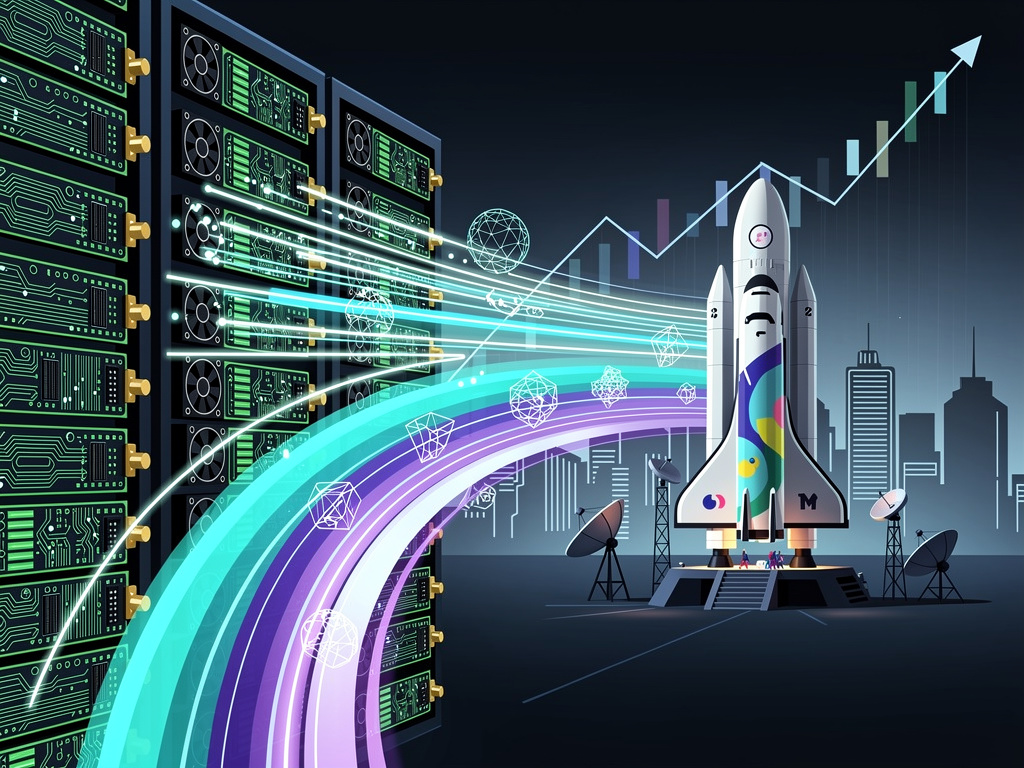
Google has agreed to pay SpaceX $920 million every month for access to massive AI computing power. The deal runs from October 2026 through June 2029. It covers roughly 110,000 Nvidia GPUs along with CPUs, memory and supporting hardware. Total payments could exceed $30 billion.
SpaceX disclosed the arrangement in a recent SEC filing. The timing is no coincidence. The company prepares for an IPO expected to value it near $1.8 trillion. Such a figure would set records. And this contract, paired with a similar one from Anthropic, bolsters its pitch to public investors. Revenue from data centers now promises to outpace contributions from Starlink, launch services and other segments.
But the agreement reveals more than clever pre-IPO positioning. It exposes the ferocious demand for graphics processing units that powers today’s AI race. Google, already one of the largest holders of AI infrastructure, still needs outside capacity. Its own forecasts for Gemini Enterprise demand proved too conservative. A Google Cloud spokesperson called the arrangement “bridge capacity” to handle surging customer needs.
The hardware sits in data centers SpaceX built. Those facilities first supported xAI, Elon Musk’s separate AI venture. Colossus, the Memphis supercluster, gained fame for its scale. Now it generates income from third parties. Anthropic signed first. That pact delivers $1.25 billion monthly through 2029 for what appears to be the larger share of the cluster. Google’s deal covers about half the compute. Combined, the two contracts could bring SpaceX more than $70 billion.
Terms include safeguards. Capacity ramps through September 2026 at lower rates. If SpaceX fails to deliver the full complement of GPUs by month’s end, Google gains options. It can walk away after a one-month grace period or accept partial delivery with reduced fees. After December 31, 2026, either side can exit with 90 days’ notice. Flexibility matters in a sector where technology shifts fast and capital costs run high.
Short-term bridge. That’s how Google frames it. Yet the 32-month horizon stretches well into the next decade. Analysts see the payment as evidence that even tech giants struggle to build fast enough. Nvidia chips remain scarce. Power constraints slow new facilities. Construction timelines stretch. Data center demand has exploded since generative AI captured corporate attention in late 2022.
SpaceX’s move into cloud services marks a departure. The company built its reputation on rockets and satellites. Starlink delivers broadband to remote areas and generated steady cash. But AI infrastructure now takes center stage. xAI’s losses last year reached $6.4 billion on $3.2 billion in revenue. Monetizing the compute assets eases pressure. It also ties Musk’s companies closer together. Google pays one Musk-led firm while competing with another in search, advertising and AI models.
Investors appear enthusiastic. SpaceX’s planned offering is already oversubscribed according to reports. The Google contract adds visible, recurring revenue. So does the Anthropic agreement. Together they project annual data center income that surpasses other business lines in 2025 estimates from some observers. For a pre-IPO company, predictable cash flows reduce perceived risk.
Google’s willingness to sign at this price raises eyebrows. The monthly sum equals more than $11 billion annually. That’s on top of the billions it already spends internally on TPUs and GPU clusters. The search company has poured tens of billions into AI development. Gemini models power new features across products. Enterprise customers adopt them at accelerating rates. When internal supply falls short, external deals become necessary. Even for a company with Alphabet’s resources.
The arrangement also highlights shifting power dynamics. Musk’s empire gains another lucrative stream. SpaceX gains validation. Its data centers, once internal projects, now serve some of the industry’s most demanding customers. Google gets immediate access without the delays of new construction. Both sides gain. Yet the eye-popping figure underscores how expensive frontier AI has become. Training and inference costs climb. Margins on AI services face pressure until efficiency improves or prices rise.
Wall Street has taken notice. Shares of related companies reacted when news broke on June 5. CNBC first reported details from the filing. CNBC detailed the IPO context and Musk connection. TechCrunch followed with deeper technical specifics. Its coverage noted the similarity to the Anthropic transaction and the half-share estimate for Google’s allocation. PCMag calculated the full contract value and tied it to SpaceX’s broader financial picture in its report.
Recent coverage adds perspective. Tom’s Hardware examined how the deal elevates projected data center revenue above Starlink and launches for 2025. It cited Reuters on the hardware bundle. Business Insider emphasized the bridge nature for Gemini and the termination rights. No major updates have altered core facts since the initial disclosure earlier this month. The story remains the same. Enormous sums flow toward compute. SpaceX positions itself as a serious player.
Questions linger. Will Google extend the deal or build its own capacity once the bridge ends? Can SpaceX deliver reliably at this scale? Power, cooling and networking for 110,000 GPUs present engineering challenges. Delays have plagued similar projects industrywide. The cancellation clause protects both parties. But early termination would leave SpaceX hunting new tenants and Google scrambling for alternatives.
The bigger picture looks clear. AI infrastructure has become a distinct, high-margin business. Traditional cloud providers compete with hyperscalers who build their own silicon. Now rocket companies join the fray. Musk’s dual role adds intrigue. He criticizes aspects of the AI race yet profits from supplying its raw materials. Google, long dominant in search, pays handsomely to maintain its AI momentum.
Expect more deals like this. Demand shows no sign of slowing. Model sizes grow. Inference scales with adoption. Enterprises test agents and copilots that consume heavy compute. Supply constraints persist. Prices for GPU time stay elevated. The $920 million monthly tab may look expensive today. In two years it could seem like a bargain if shortages worsen. Or it could prove a cautionary tale if efficiency gains or economic slowdowns reduce appetite.
For now the transaction stands as concrete evidence of the AI boom’s capital intensity. Google writes a check for nearly a billion dollars each month. SpaceX counts the revenue as it prepares to go public. The rest of the industry watches closely. Compute has become currency. And the price keeps rising.


 WebProNews is an iEntry Publication