
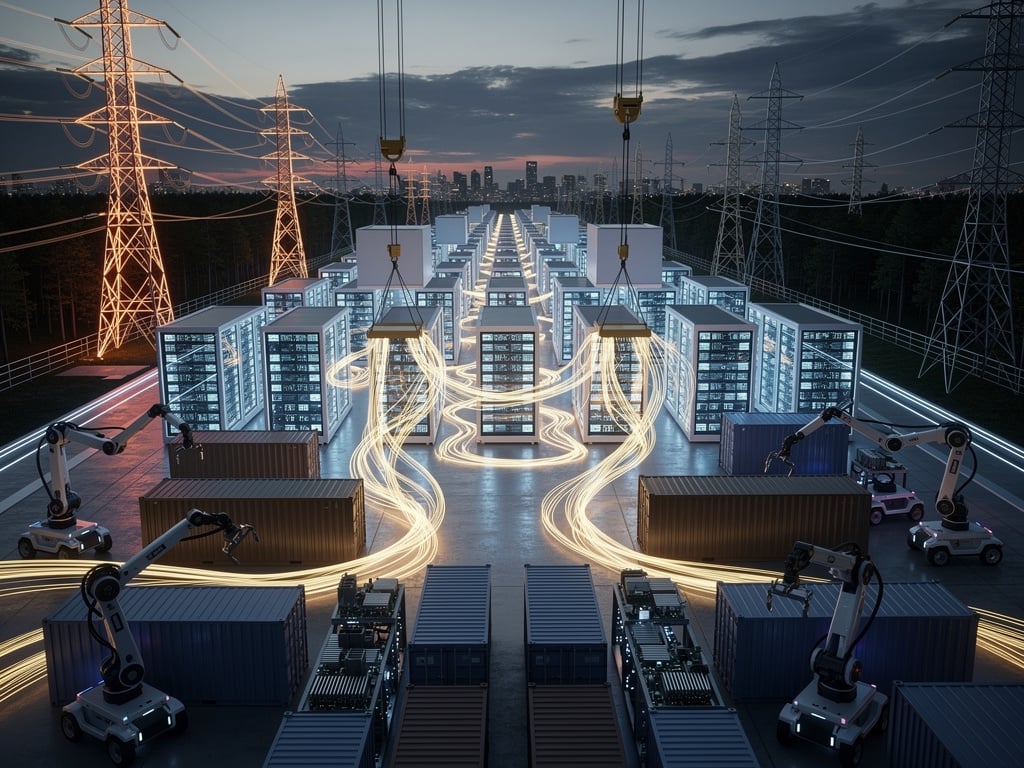
Alphabet has upsized its latest equity offering to roughly $85 billion. The Google parent aims to bankroll an unprecedented push into artificial intelligence infrastructure. That figure, revealed in early June, comes on the heels of the company guiding capital expenditures between $175 billion and $185 billion for 2026. The sums dwarf anything seen in previous technology cycles.
Wall Street analysts now project the five largest U.S. hyperscalers will spend between $660 billion and $700 billion on capital projects this year. Most of that money targets data centers, specialized chips, networking gear and the power systems needed to run them. Amazon plans around $200 billion. Meta expects $115 billion to $135 billion. Microsoft tracks toward $120 billion or higher. Oracle targets $50 billion. Alphabet’s share sits at the high end of the range and has been revised upward multiple times.
Yahoo Finance reported experts viewing the move as evidence that both the technology and its adoption remain early. “The financing deal shows that both AI technology and AI adoption are still in their infancy, so it will take a lot more cash than the market expected to drive this technology forward,” said Galina Fendikevich, founder of Fendikevich & Company. She added that Alphabet “is not going to sit on the sidelines” and “the fact that they are still rushing to play catch-up signals their appetite to be strong competitors.”
But. The revenue picture tells a different story. Pure-play AI companies such as OpenAI and Anthropic together generate well under $35 billion in annual recurring revenue. Hyperscalers report strong cloud growth and large backlogs. Alphabet’s cloud backlog exceeded $240 billion after a 55 percent sequential jump. Still, the gap between hundreds of billions spent on iron and the tens of billions earned from frontier AI services raises questions about payback periods.
Analysts at Goldman Sachs have lifted their five-year capex forecast for the four largest hyperscalers to $5.3 trillion. Earlier estimates sat at $4.5 trillion. The Futurum Group notes that execution risk, power shortages and uncertain monetization timelines could stretch returns. Some models suggest investors may wait a decade before seeing clear cash-flow benefits at scale.
The New York Times documented the frenzy in April. Google, Amazon, Microsoft and Meta reported more than $130 billion in combined capital expenditures for the first quarter alone. That total ran more than three times the inflation-adjusted cost of the Manhattan Project. It also stood 71 percent above the year-earlier period. Google lifted its full-year projection to at least $180 billion and signaled even higher spending ahead. Meta raised its own outlook. “Every sign we see gives us confidence,” Meta Chief Executive Mark Zuckerberg said at the time.
Power has become the binding constraint. Data-center electricity demand is forecast to double by 2030 according to the International Energy Agency. AI-accelerated servers, used heavily for inference, could account for nearly half that increase. A single advanced query can consume several times the electricity of a conventional web search. Training one frontier model may soon require gigawatts of continuous power. Hyperscalers have turned to nuclear restarts, renewable contracts and demand-response programs. Google itself has signed one gigawatt of data-center demand response with utilities.
Yet absolute energy consumption keeps rising. Google’s own environmental report showed data-center electricity use up 27 percent in one recent year even as it cut emissions through clean-energy purchases. Industry-wide, emissions have climbed. The tension between rapid buildout and grid limitations grows more acute each quarter.
Sundar Pichai, Alphabet’s chief executive, has acknowledged the internal debate over scale. The company points to cost reductions, Gemini serving expenses fell 78 percent over the past year, and to customer demand visible in that swelling backlog. Cloud revenue continues to grow at roughly 30 percent or better. Operating margins in the segment have expanded sharply. Those metrics provide some comfort. They do not yet prove the massive infrastructure bet will deliver proportional economic returns.
Comparisons to past booms surface often. AI-related capital spending now equals about 0.8 percent of U.S. gross domestic product. That trails the peaks of railroad construction, the dot-com telecom buildout or the interstate highway system. Should spending reach $700 billion in a single year, the share would approach historic highs. Some economists and fund managers already flag overinvestment risk as a top concern.
Competition adds pressure. Microsoft’s partnership with OpenAI, Amazon’s ties to Anthropic, Meta’s open-source Llama efforts. Each player races to secure chips, land, power and talent. Smaller AI labs burn cash at extraordinary rates while promising future profits that remain years distant. The hyperscalers enjoy vast advertising cash flows and balance sheets that rival sovereign nations. They can afford the spend. The open question remains whether customers will pay enough, fast enough, to justify it.
Recent earnings calls reveal a consistent message. Demand for AI infrastructure outstrips supply. Enterprises sign large multiyear commitments. Hyperscalers respond by accelerating construction of custom tensor-processing units, liquid-cooling systems and entire campuses powered by dedicated substations. Alphabet has expanded its TPU roadmap aggressively. The company also invests in undersea cables and global fiber to reduce latency for inference workloads.
So the capital flows. And the projections keep rising. Goldman Sachs now sees consensus 2026 capex for the group at $527 billion, up from $465 billion only months earlier. Other forecasts place the combined total near $750 billion when ancillary suppliers and international spending enter the picture. No one expects the curve to flatten soon.
Investors have reacted with mixed signals. Alphabet shares have held up better than some feared after the capex guidance. Cloud momentum and ad resilience help. Yet free-cash-flow estimates for the coming year have dropped sharply as spending accelerates. Some portfolio managers worry that the industry has entered a classic capital-expenditure trap. Billions go in. Revenue follows more slowly. Payback stretches. Stock multiples compress until proof of return materializes.
Fendikevich’s assessment captures the moment. The technology sits in its infancy. Adoption requires far more capital than initially modeled. Companies with the strongest balance sheets refuse to cede ground. Google’s $85 billion equity raise, backed by Goldman Sachs, JPMorgan and Morgan Stanley, plus a $10 billion commitment from Berkshire Hathaway, signals confidence from both management and sophisticated capital providers.
Whether that confidence proves warranted will not become clear for years. The data centers must be built. The chips must be installed. The models must improve. Customers must integrate the technology into core operations at scale. Only then will the return on these hundreds of billions come into focus. Until that day, the industry runs a vast, expensive experiment. The stakes, measured in trillions of dollars of market value and national competitiveness, could not run higher.


 WebProNews is an iEntry Publication