
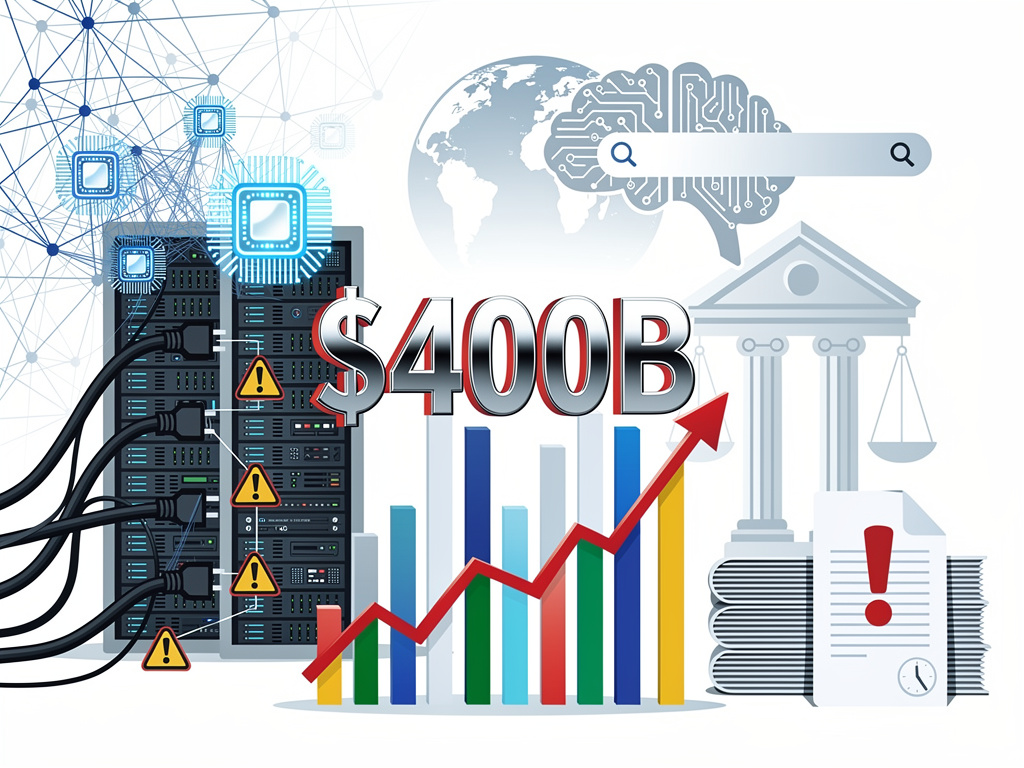
Google parent company Alphabet reached a historic milestone in its fourth quarter 2024 earnings, crossing $400 billion in annual revenue for the first time. Yet beneath this achievement lies a more complex narrative of surging artificial intelligence investments, mounting regulatory pressures, and fundamental questions about whether the search giant’s traditional business model can sustain its dominance in an AI-first era.
The company reported $96.5 billion in revenue for the fourth quarter alone, representing a 12% increase year-over-year, according to The Verge. This performance pushed Alphabet’s full-year 2024 revenue to $402.8 billion, cementing its position as one of the world’s most valuable technology companies. However, investors responded with measured enthusiasm, as the stock price fluctuated following the announcement, reflecting concerns about the sustainability of profit margins amid escalating AI infrastructure costs.
Google’s advertising business, which has historically generated the lion’s share of revenue, showed resilience despite industry-wide challenges. Search advertising revenue grew to $49.4 billion in the fourth quarter, while YouTube advertising contributed $9.2 billion. The Google Cloud division, increasingly positioned as a critical growth driver, reported $11.4 billion in quarterly revenue, marking a 29% increase from the previous year. This diversification has become essential as the company navigates an evolving competitive environment where artificial intelligence threatens to disrupt traditional search paradigms.
The AI Arms Race Reshapes Investment Priorities
Capital expenditures tell a more revealing story about Google’s strategic priorities and the challenges ahead. The company disclosed plans to invest between $75 billion and $80 billion in 2025, primarily focused on artificial intelligence infrastructure, data centers, and computing resources. This represents a substantial increase from previous years and underscores the existential nature of the AI competition. CEO Sundar Pichai emphasized during the earnings call that these investments are non-negotiable for maintaining competitive positioning in generative AI.
The financial commitment extends beyond mere infrastructure. Google has integrated AI capabilities across its entire product suite, from Search Generative Experience to Gemini, its flagship large language model. These integrations require continuous refinement and massive computational resources. The company’s AI Overviews feature, which provides AI-generated summaries at the top of search results, has been rolled out to hundreds of millions of users, fundamentally changing how people interact with search while simultaneously raising questions about click-through rates to publisher websites and the long-term implications for the digital advertising ecosystem.
Industry analysts note that Google faces a delicate balancing act. While AI enhancements may improve user experience and engagement, they also risk cannibalizing the traditional search advertising model that has fueled the company’s growth for two decades. Each AI-generated answer that satisfies a user’s query without requiring them to click through to a website potentially reduces advertising inventory and revenue opportunities. This tension between innovation and preservation of existing revenue streams represents one of the most significant strategic challenges in Google’s history.
Regulatory Storms Gather on Multiple Fronts
Beyond the technological transformation, Google confronts an increasingly hostile regulatory environment across multiple jurisdictions. The U.S. Department of Justice’s antitrust case against the company’s search business reached a critical juncture in 2024, with a federal judge ruling that Google maintains an illegal monopoly in search and search advertising. Potential remedies under consideration range from behavioral restrictions to structural separation of business units, including the possibility of divesting the Chrome browser or Android operating system.
The regulatory challenges extend far beyond American borders. European Union regulators have imposed multiple fines totaling billions of dollars for various antitrust violations, while also implementing the Digital Markets Act, which designates Google as a “gatekeeper” subject to stringent operational restrictions. These regulations mandate interoperability, data portability, and limitations on self-preferencing that could fundamentally alter how Google operates its platform ecosystem. The company has allocated substantial legal and compliance resources to navigate this regulatory maze, though the ultimate financial and operational impact remains uncertain.
In Asia, particularly in markets like India and South Korea, Google faces additional scrutiny over app store policies, payment processing requirements, and competitive practices. These regulatory actions collectively represent a coordinated global effort to constrain the power of dominant technology platforms, with Google serving as a primary target. The cumulative effect of compliance costs, potential fines, and operational restrictions could materially impact profitability and strategic flexibility in coming years.
Cloud Computing Emerges as Critical Growth Engine
Google Cloud’s accelerating growth trajectory offers a counterbalance to concerns about the core advertising business. The division has achieved consistent profitability and is gaining market share against entrenched competitors Amazon Web Services and Microsoft Azure. Fourth-quarter operating income for Google Cloud reached $1.9 billion, demonstrating that the years of heavy investment in cloud infrastructure are beginning to generate substantial returns. The integration of AI capabilities into cloud offerings has become a key differentiator, with customers increasingly seeking platforms that provide both computational resources and advanced AI tools.
The cloud business benefits from several favorable trends, including enterprise digital transformation, hybrid work arrangements requiring robust cloud infrastructure, and the computational demands of AI model training and deployment. Google’s technical expertise in machine learning and its proprietary tensor processing units (TPUs) provide competitive advantages in serving AI-intensive workloads. Major enterprise customers are adopting Google Cloud for specific use cases where these capabilities offer superior performance or cost efficiency compared to alternatives.
However, the cloud market remains intensely competitive, with pricing pressure and customer demands for multi-cloud strategies limiting margin expansion. Google Cloud’s operating margin, while improving, still lags behind the profitability of AWS, suggesting room for further operational optimization. The company must continue investing in sales capabilities, geographic expansion, and product development to sustain growth momentum, creating an ongoing tension between growth objectives and profitability targets.
YouTube’s Evolution Beyond Traditional Video
YouTube continues to evolve beyond its origins as a video-sharing platform, increasingly functioning as a comprehensive entertainment and commerce ecosystem. The platform’s Shorts feature, launched to compete with TikTok, has surpassed 70 billion daily views, creating new advertising inventory and engagement opportunities. YouTube’s living room presence through connected TV devices has grown substantially, with viewers watching over 1 billion hours of content daily on television screens, commanding premium advertising rates compared to mobile viewing.
The creator economy built around YouTube generates substantial economic activity extending far beyond Google’s direct revenue. Estimates suggest the platform supports hundreds of thousands of full-time content creators and millions of part-time participants, creating an ecosystem that would be difficult for competitors to replicate. Google has introduced various monetization tools, including channel memberships, Super Chat, and merchandise integration, diversifying revenue streams beyond traditional advertising while strengthening creator loyalty to the platform.
Yet YouTube faces its own challenges, including competition for viewer attention from TikTok, Instagram Reels, and emerging platforms, as well as ongoing content moderation controversies that risk advertiser relationships. The platform must continuously balance creator freedom with advertiser brand safety concerns, a tension that periodically erupts into public controversies affecting revenue. Additionally, music licensing costs and creator revenue sharing commitments limit margin expansion, even as overall revenue grows.
The OpenAI Factor Reshapes Competitive Dynamics
Perhaps no development has more profoundly impacted Google’s strategic calculus than the emergence of OpenAI’s ChatGPT and its integration into Microsoft’s product suite. The viral adoption of ChatGPT in late 2022 catalyzed an industry-wide recognition that generative AI could fundamentally disrupt search, productivity software, and numerous other categories where Google maintains dominant positions. Microsoft’s aggressive integration of AI capabilities into Bing and its productivity applications has intensified competitive pressure, even if Bing’s market share gains remain modest in absolute terms.
Google’s response has been multifaceted, accelerating the deployment of its own large language models while integrating AI features across its product portfolio. The company possesses deep technical expertise in artificial intelligence, having pioneered many foundational technologies including the transformer architecture that underlies most modern language models. However, Google has historically been more cautious about deploying AI features at scale, concerned about accuracy, brand reputation, and potential disruption to existing revenue streams.
This caution may have created a perception gap, with some industry observers questioning whether Google has lost its innovative edge to more aggressive competitors. The company has worked to counter this narrative through product launches, research publications, and public demonstrations of AI capabilities. Yet the fundamental challenge remains: Google must simultaneously defend its existing search business while pioneering technologies that could eventually make traditional search obsolete. This requires maintaining two potentially contradictory strategic priorities, a balancing act that will define the company’s trajectory in coming years.
Workforce Optimization and Cultural Transformation
Behind the revenue growth and AI investments lies a significant organizational transformation. Google implemented substantial workforce reductions in 2023 and 2024, eliminating thousands of positions across various divisions. These cuts, while modest relative to the company’s overall headcount of approximately 180,000 employees, represented a cultural shift for an organization historically characterized by rapid hiring and expansive employee benefits. Management has emphasized efficiency, accountability, and focus on core priorities, marking a departure from the more experimental, freewheeling culture of earlier years.
The workforce optimization extends beyond headcount reduction to include reorganizations, role consolidations, and increased performance expectations. Several high-profile projects and initiatives have been discontinued or scaled back, with resources redirected toward AI development and core business priorities. This discipline reflects both external pressure from investors seeking improved profitability and internal recognition that the company had accumulated organizational complexity that impeded execution speed.
Employee morale and retention present ongoing challenges as the company navigates this transition. Compensation packages remain competitive, but the combination of workforce reductions, increased performance pressure, and uncertainty about long-term strategic direction has created anxiety within the organization. Google must maintain its ability to attract and retain top technical talent, particularly in artificial intelligence, where competition for skilled practitioners has intensified dramatically. The company’s reputation, resources, and technical challenges provide advantages in talent competition, but cultural transformation inevitably creates friction and potential attrition of valuable employees.
Advertising Market Dynamics in an AI Era
The digital advertising market that fueled Google’s rise faces structural questions in an AI-mediated future. If users increasingly receive direct answers from AI assistants rather than clicking through to websites, the entire ecosystem of publishers, advertisers, and advertising platforms could require fundamental restructuring. Google has attempted to address these concerns by emphasizing that AI Overviews increase overall search engagement and that users still click through to websites for detailed information, commerce transactions, and verification of AI-generated content.
Early data on AI Overview performance suggests a more nuanced reality. While some queries are indeed fully satisfied by AI-generated summaries, many users continue to seek additional information, particularly for commercial queries, complex topics, and situations requiring trusted sources. Google has refined the AI Overview feature to include prominent links to source websites, attempting to preserve traffic flow to publishers while providing enhanced user experience. The long-term equilibrium between AI assistance and traditional search results remains uncertain, with significant implications for all participants in the digital advertising ecosystem.
Advertisers themselves are adapting strategies to account for AI-mediated search experiences. Performance marketing campaigns are increasingly focused on conversion optimization rather than simple click-through rates, with sophisticated attribution modeling attempting to capture the full customer journey across multiple touchpoints. Google has introduced new advertising formats and targeting capabilities designed for AI-enhanced search, though adoption remains in early stages. The company’s ability to maintain advertising revenue growth while fundamentally transforming the search experience will largely determine whether the $400 billion milestone represents a peak or a waypoint toward further growth.
Looking Ahead: Sustainability Questions and Strategic Imperatives
Google’s achievement of $400 billion in annual revenue represents remarkable business success, yet the company faces perhaps its most challenging period since its founding. The simultaneous pressures of AI transformation, regulatory constraint, competitive intensity, and business model evolution create a complex strategic environment with no clear precedents. Management’s ability to navigate these challenges while maintaining financial performance will determine whether Google remains among the world’s most dominant technology companies or gradually cedes ground to more nimble competitors.
The investment community appears cautiously optimistic, with analyst consensus suggesting continued revenue growth in 2025, albeit at potentially slower rates than the double-digit percentages of recent years. Profitability may face pressure from the massive AI infrastructure investments and potential regulatory compliance costs, though operational efficiencies could partially offset these headwinds. The stock’s valuation reflects these mixed signals, trading at multiples that suggest investors expect continued growth but recognize meaningful risks to the established business model.
For industry observers, Google’s trajectory offers insights into broader technology sector dynamics. The company’s experience demonstrates that even the most successful digital platforms face existential challenges from technological disruption, that regulatory pressure on dominant platforms continues to intensify globally, and that the transition to AI-first computing paradigms creates both opportunities and risks for established players. The next several years will reveal whether Google’s technical capabilities, financial resources, and strategic agility prove sufficient to maintain leadership in an industry characterized by relentless change and creative destruction. The $400 billion milestone, impressive as it is, may ultimately be remembered less for the achievement itself than for what it represented: the high-water mark of the search advertising era, or the foundation for an even more valuable AI-powered future.


 WebProNews is an iEntry Publication