
Gemini’s Cartographic Leap: AI-Powered Maps Reshape Digital Navigation
In the ever-evolving realm of digital navigation, Google has once again pushed boundaries with its latest integration of Gemini AI into the Maps experience within the Gemini app. This update, rolling out as of December 2025, promises to transform how users interact with location-based information, making queries more intuitive and visually rich. Drawing from recent announcements, this enhancement builds on Google’s ongoing efforts to infuse artificial intelligence into everyday tools, creating a seamless blend of conversational AI and geospatial data.
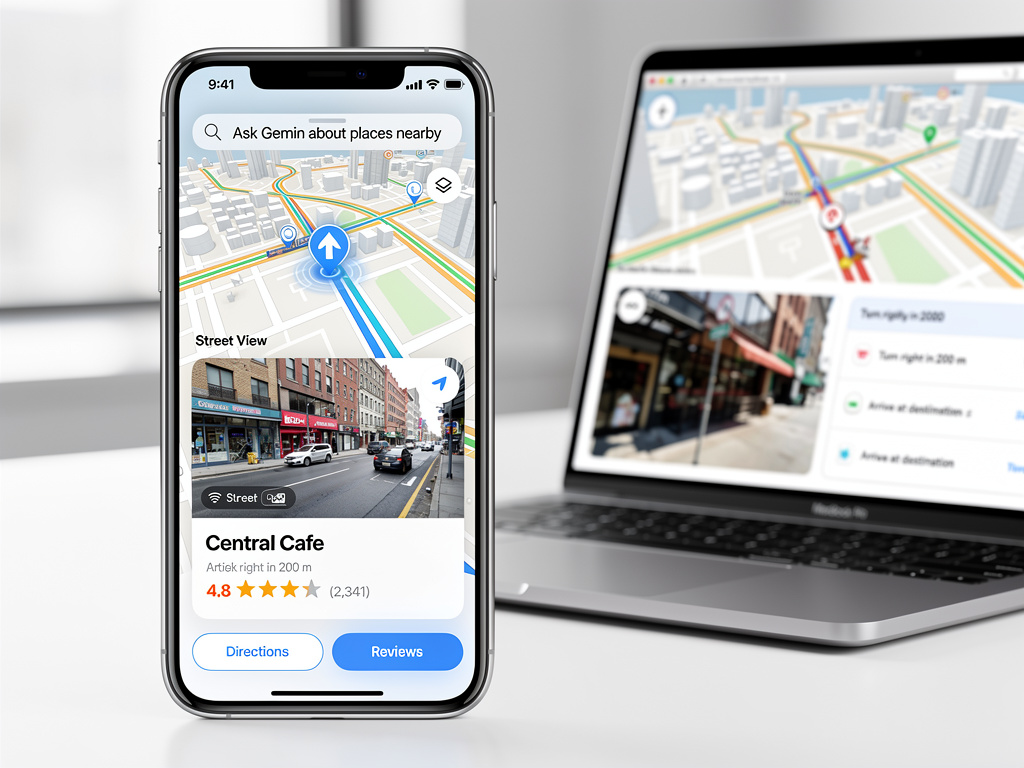
The core of this update lies in the improved display of Google Maps results directly within the Gemini app. Previously, responses to map-related queries were text-heavy and somewhat rudimentary. Now, users encounter a more immersive interface featuring high-quality images, detailed ratings, and direct links to directions or place details. This isn’t just a cosmetic upgrade; it’s a fundamental shift in how AI assistants handle location intelligence, leveraging Gemini’s multimodal capabilities to present information in a way that feels natural and comprehensive.
For industry observers, this development signals Google’s aggressive push to dominate the AI-assisted navigation space. By embedding richer Maps data into Gemini, the company is effectively creating a one-stop shop for users who might otherwise switch between apps. This integration comes at a time when competitors like Apple and OpenAI are also enhancing their mapping and AI offerings, but Google’s vast data trove gives it a distinct edge.
Enhancing User Interaction Through Visual Depth
One standout feature is the ability to pull in Street View imagery and satellite views seamlessly into responses. Imagine asking Gemini about a nearby coffee shop, and instead of a bland list, you get a carousel of photos, user reviews, and even walking directions overlaid on a mini-map. This visual richness stems from deeper API integrations, as detailed in Google’s own developer blog, where they announced grounding with Google Maps in the Gemini API back in October 2025. According to Google’s developer blog, this allows for real-time geospatial data to inform AI responses, ensuring accuracy and relevance.
The rollout has been gradual, with initial tests showing improved user engagement. Posts on X from users and tech enthusiasts highlight the excitement, noting how this makes Gemini feel more like a personal concierge than a simple chatbot. For instance, drivers can now query for landmarks along their route without leaving the app, a feature that echoes the navigation boosts announced in November 2025.
Technically, this involves Gemini’s extensions framework, which pulls data from Maps’ vast database. Developers can now build apps that ground AI outputs in real-world map data, reducing hallucinations and providing verifiable information. This is particularly crucial for enterprise applications, where accuracy in location-based queries can make or break operational efficiency.
From Text to Multimodal Mastery
Diving deeper, the update addresses a common pain point in AI interactions: the lack of visual context. Traditional chatbots might describe a location, but Gemini now shows it, complete with interactive elements. This multimodal approach aligns with broader trends in AI, where models like Gemini 2.5 incorporate image generation and analysis. A recent post on Google’s technology blog about improvements to Gemini’s text-to-speech models hints at future voice-guided navigation enhancements that could pair with these visual upgrades.
Industry insiders point out that this integration isn’t isolated. It’s part of a larger ecosystem play, where Gemini serves as the hub for Google’s services. For example, querying for a restaurant now yields not just Maps data but also integrated calendar suggestions or even recipe ideas from other Google tools. This cross-pollination enhances user stickiness, a key metric for tech giants.
Moreover, the update’s timing coincides with Gemini’s expansion to more devices, including iOS via Chrome, as reported by MacRumors. This cross-platform availability broadens the reach, potentially attracting users from Apple’s ecosystem who seek advanced AI features in navigation.
Navigational AI’s Competitive Edge
Comparing this to predecessors, earlier versions of Google Assistant offered basic map integrations, but they lacked the depth of Gemini’s current capabilities. The November 2025 launch of Gemini features in Maps proper, as covered by Google’s products blog, set the stage with landmark-based directions and hands-free queries. Now, extending that to the Gemini app creates a unified experience across Google’s portfolio.
On the competitive front, while Apple’s Maps has introduced AI elements like Look Around, it doesn’t yet match the conversational fluency of Gemini. Similarly, third-party apps like Waze, owned by Google, benefit indirectly, but the direct infusion into Gemini positions it as a frontrunner. Tech analysts on X have praised this as a “game-changer,” with one viral thread from a developer noting how it simplifies app development by providing pre-grounded AI responses.
For businesses, this means new opportunities in local search optimization. Retailers and service providers must now optimize for AI-driven queries that prioritize visual appeal and real-time data. This shift could alter how companies approach digital marketing, emphasizing high-quality imagery and accurate location tagging to appear prominently in Gemini’s responses.
Technical Underpinnings and Developer Implications
At its core, this enhancement relies on the Gemini API’s grounding features, which tie AI generations to external data sources like Maps. As explained in a developer-focused update from October 2025, this reduces errors by anchoring responses in verified information. Developers building on this can create custom agents that handle complex, multi-step location tasks, such as planning a road trip with stops optimized for traffic and preferences.
The visual improvements also stem from advancements in Gemini’s image processing. By analyzing Street View data, the AI can generate descriptive captions or even suggest alternative routes based on visual cues like construction sites. This level of sophistication is evident in demos shared on Tom’s Guide, which highlights features like asking for places of interest en route and getting tailored suggestions.
Privacy considerations are paramount here. Google has emphasized that location data remains user-controlled, with opt-ins for sharing. However, industry watchers caution that deeper integrations could raise concerns about data usage, especially in an era of increasing regulatory scrutiny on AI and personal information.
Real-World Applications and User Feedback
In practical terms, users are already reporting smoother experiences. For commuters, the ability to get visual previews of destinations without app-switching saves time and reduces distractions. A recent article from TechCrunch details how drivers can perform tasks like adding calendar events while navigating, all voice-activated through Gemini.
Feedback from X paints a picture of enthusiasm mixed with calls for further refinements. Some users suggest expanding to more languages or integrating with public transit APIs for even richer results. This community input is likely shaping Google’s roadmap, as the company has a history of iterating based on user data.
Looking ahead, this could pave the way for augmented reality integrations, where Gemini overlays map data onto live camera feeds. While not yet announced, hints in Google’s Labs experiments, like GenTabs for web navigation, suggest a future where AI blurs the lines between digital and physical worlds.
Broadening Horizons in AI Navigation
The implications extend beyond consumer use. In sectors like logistics and urban planning, Gemini’s enhanced Maps integration could revolutionize operations. Fleet managers might use it to optimize routes in real-time, factoring in variables like weather or events pulled from Maps data. This enterprise potential is underscored in discussions on developer forums, where APIs are being leveraged for custom solutions.
Comparatively, Microsoft’s Bing Maps with AI lacks the same level of visual integration, giving Google a lead. As per a USA Today piece from November 2025 on Google Maps’ AI enhancements, the focus on drivers’ needs sets a new standard for hands-free navigation.
Ultimately, this update reinforces Google’s vision of AI as an omnipresent assistant. By making Maps results more vivid and interactive within Gemini, the company is not just improving a feature—it’s redefining how we perceive and interact with our surroundings through technology.
Innovative Pathways Ahead
As adoption grows, expect refinements based on usage patterns. Google’s release notes from December 2025, available on Gemini Apps’ site, outline ongoing improvements, including better handling of complex queries. This iterative approach ensures the integration stays ahead of user expectations.
For tech insiders, the real intrigue lies in the underlying models. Gemini’s evolution from 1.0 to 2.5 has enabled these capabilities, with previews of even more advanced versions promising deeper integrations. Collaborations with third-party developers could further expand this, creating a vibrant ecosystem around AI-enhanced mapping.
In the broader context of AI’s role in daily life, this Maps upgrade exemplifies how incremental innovations accumulate to create transformative experiences. As Google continues to weave Gemini into its fabric, the boundaries of what’s possible in navigation—and beyond—continue to expand, offering users a glimpse into a more intelligent, connected future.


 WebProNews is an iEntry Publication