
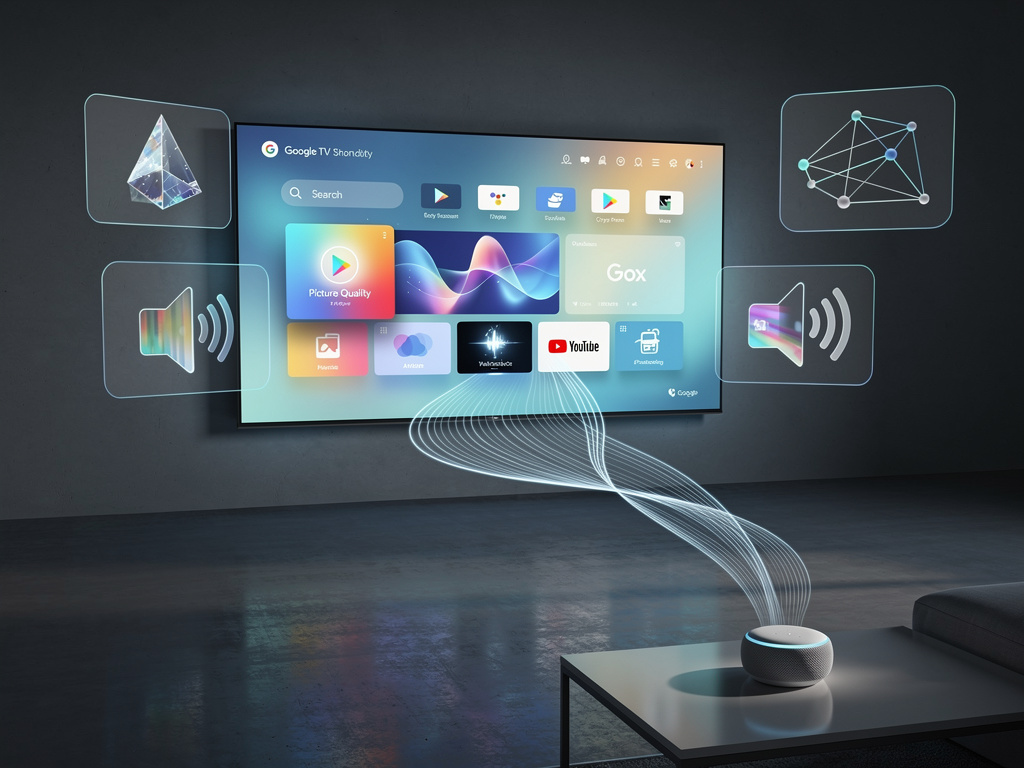
Voicing the Future: How Gemini is Revolutionizing Google TV Interactions
In the ever-evolving realm of smart home entertainment, Google has unveiled a significant upgrade to its Google TV platform, integrating advanced voice control capabilities through its Gemini AI. This development, showcased at CES 2026, allows users to adjust intricate TV settings using natural language commands, marking a pivotal shift in how consumers interact with their viewing devices. No longer confined to navigating complex menus with remotes, viewers can now simply speak to tweak picture quality, audio settings, and more, streamlining the user experience in ways that echo broader trends in AI-driven interfaces.
The announcement comes amid Google’s ongoing push to embed Gemini across its ecosystem, building on initial rollouts that brought conversational AI to content discovery and recommendations. According to details from Android Police, the new feature enables “deep dives” into settings adjustments solely through voice, eliminating the need for manual inputs. This isn’t just about convenience; it’s a strategic move to make Google TV more accessible, particularly for those who find traditional interfaces cumbersome.
Industry observers note that this integration could set a new standard for smart TV operating systems. By leveraging Gemini’s natural language processing, Google is addressing long-standing pain points in TV usability, where settings menus often bury essential controls under layers of sub-options. The update promises to make high-end features like HDR calibration or sound equalization as simple as saying, “Make the picture brighter” or “Boost the bass.”
Evolution of AI in Entertainment Systems
Google’s journey with AI on TV began with the introduction of Gemini for Google TV in late 2025, as detailed in a post on the official Google Blog. Initially focused on content summarization and skill-building via YouTube, the AI has progressively expanded its role. The latest enhancements, previewed at CES, include support for models like Nano Banana and Veo, which enhance visual and generative capabilities, but the voice control over settings stands out as a game-changer.
Drawing from web sources, The Verge reports that Gemini now supports natural language control over picture and audio settings, allowing for precise adjustments without interrupting viewing. This builds on Gemini’s multimodal strengths, where voice commands can trigger real-time changes, potentially using contextual awareness from the content being watched.
For insiders, this represents Google’s bet on voice as the primary interface for smart devices. Unlike competitors who rely on button-heavy remotes or app-based controls, Google’s approach leverages its prowess in AI to create a more intuitive ecosystem. Early adopters on platforms like X have expressed enthusiasm, with posts highlighting how this could reduce setup time for home theaters.
Technical Underpinnings and Implementation
At its core, the voice control feature relies on Gemini’s advanced language models, which process spoken queries and map them to specific TV functions. As explained in TechCrunch, users can ask Gemini to “find and edit photos” or “adjust TV settings,” indicating a seamless blend of voice with visual tasks. This is facilitated by on-device processing for faster responses, minimizing latency that has plagued earlier voice assistants.
The rollout is starting with select devices, such as TCL models, with broader expansion planned throughout 2026, per insights from Mezha. This phased approach allows Google to refine the technology based on user feedback, ensuring reliability across diverse hardware configurations.
Moreover, integration with Google Photos adds another layer, enabling voice-driven browsing and editing directly on the TV screen. This convergence of services underscores Google’s vision of a unified smart home, where TV acts as a central hub for media and personal content management.
Market Implications and Competitive Edge
The introduction of voice-controlled settings positions Google TV advantageously against rivals like Apple TV and Amazon Fire TV, which have their own AI assistants but lack this depth of integration. Industry analysts suggest this could boost adoption rates, especially among tech-savvy households seeking hands-free control.
From recent X posts, there’s buzz around how this feature enhances accessibility, with users noting its potential for elderly or disabled individuals who struggle with remotes. One post from Android Authority echoed this sentiment, praising the elimination of “menu hunting” for settings adjustments.
Furthermore, Google’s emphasis on natural language aligns with broader AI advancements, such as those in speech-to-speech translation, as seen in updates to Gemini Audio models. This holistic approach not only improves user satisfaction but also collects valuable data to refine AI models, creating a feedback loop for continuous improvement.
User Experience Transformations
Imagine settling into a movie night and realizing the colors look off— instead of pausing to dig through settings, a quick voice command to Gemini corrects it instantly. This scenario, highlighted in Google TV Help, illustrates how the AI can provide recommendations or automate adjustments based on ambient conditions or content type.
Early feedback from beta testers, shared on X, indicates high satisfaction with the responsiveness. Posts describe scenarios where users query complex setups, like optimizing for sports viewing, and receive tailored adjustments without manual intervention.
However, challenges remain, such as ensuring accuracy in noisy environments or handling accents. Google is addressing these through ongoing model training, drawing from its vast dataset of voice interactions across services.
Broader Ecosystem Integration
Beyond settings, Gemini’s expansion includes richer interactions with Google services. For instance, PCWorld notes new ways to browse Google Photos albums via voice, turning the TV into a dynamic photo frame or editing station.
This ties into Google’s smart home strategy, where Gemini for Home, as per Google Nest Help, offers similar voice controls for household devices. The synergy could lead to scenarios where TV commands extend to lighting or thermostat adjustments, creating immersive viewing environments.
Insiders speculate this is part of a larger play to dominate the living room, competing with ecosystems from Samsung and LG, which are also ramping up AI features.
Privacy and Ethical Considerations
As with any AI advancement, privacy concerns loom large. Voice data processed by Gemini could raise questions about storage and usage. Google has emphasized on-device processing to mitigate risks, but transparency in data handling will be crucial for user trust.
Ethical implications include ensuring the AI doesn’t inadvertently promote biased content or settings. Developers are tasked with auditing models for fairness, a point underscored in discussions on X regarding AI’s role in media consumption.
Looking ahead, this feature could pave the way for more proactive AI, where Gemini anticipates user needs based on habits, further blurring the line between passive viewing and interactive entertainment.
Industry Reactions and Future Prospects
Reactions from the tech community have been overwhelmingly positive. A post on X from 9to5Google praised the richer Photos support and voice responses, while The Verge’s coverage echoed excitement over Nano Banana integration for enhanced visuals.
Competitors are likely to respond; rumors suggest Amazon may accelerate Alexa updates for Fire TV. For Google, success hinges on seamless rollout and user education, perhaps through tutorials integrated into the Gemini interface.
In the grand scheme, this update signifies a maturation of AI in consumer electronics, where voice becomes the universal remote, promising a more intuitive future for home entertainment.
Innovation at the Intersection of AI and Media
Delving deeper, the technical feats involve Gemini’s ability to parse ambiguous commands into precise actions. For example, saying “Make it sound like a cinema” could trigger surround sound enhancements, drawing from learned patterns in user preferences.
Collaboration with hardware partners like TCL ensures compatibility, as noted in recent announcements. This partnership model accelerates adoption, potentially reaching millions of devices by year’s end.
Moreover, the inclusion of generative AI like Veo opens doors to custom content creation, such as generating backgrounds or summaries, enriching the TV experience beyond traditional broadcasting.
Challenges and Opportunities Ahead
Despite the promise, hurdles include integration with legacy devices and varying regional availabilities. Google’s strategy involves over-the-air updates, but older models may lag.
Opportunities abound in enterprise applications, like hospitality where voice controls could standardize guest experiences in hotels.
Ultimately, this evolution reflects Google’s commitment to AI ubiquity, transforming mundane tasks into effortless interactions and setting the stage for the next wave of smart tech innovations.


 WebProNews is an iEntry Publication