
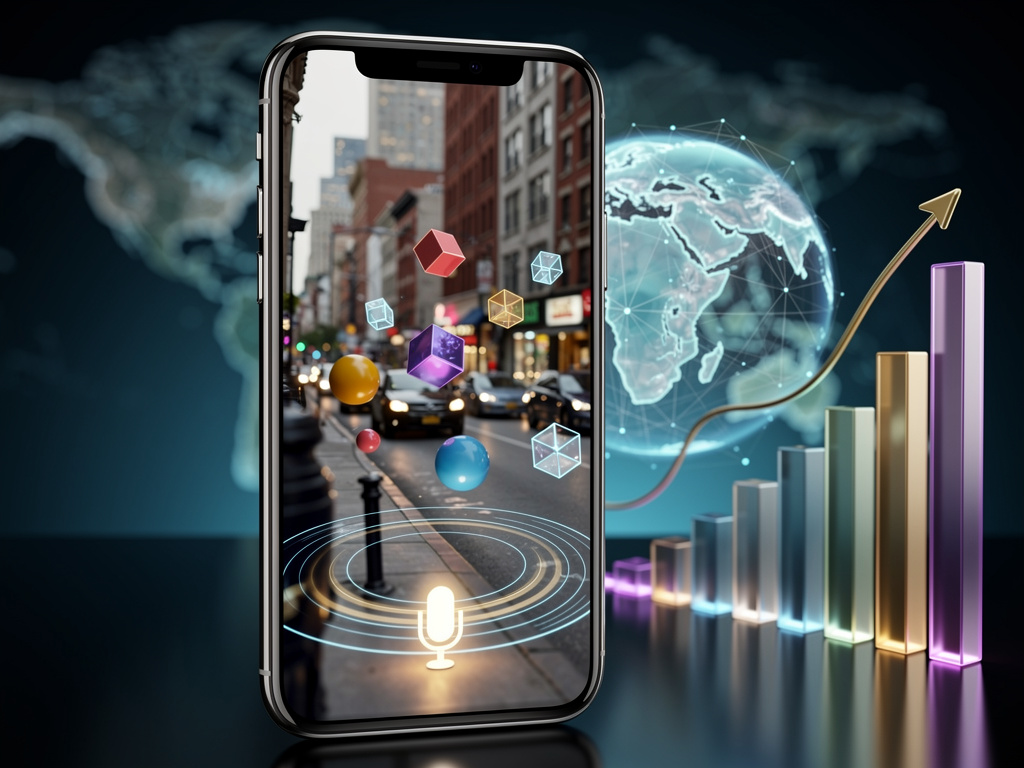
Google just made its boldest move yet to redefine what a search engine actually is. At its annual I/O developer conference, the company announced the global rollout of Search Live, a feature that lets users point their phone camera at the world and get real-time AI-powered answers about what they see. Pair that with a simultaneous expansion of voice-based AI search, and the message from Mountain View is unmistakable: the future of search isn’t typed. It’s spoken, shown, and streamed.
The feature, powered by Google’s Gemini AI model, works through the Google app and allows users to hold up their camera to an object — a plant, a piece of furniture, a restaurant menu in a foreign language — and receive instant, conversational information. It’s not just image recognition. It’s a live, two-way exchange. Users can ask follow-up questions by voice while the camera remains active, creating an interaction that more closely resembles talking to a knowledgeable companion than querying a database.
According to MSN, Search Live is expanding globally after an initial limited rollout, with both the camera and voice capabilities now available to users worldwide through the Google app. The voice mode, called AI Mode, lets users have a spoken conversation with Google Search — asking complex, multi-part questions without ever touching the keyboard.
This isn’t a minor product update. It represents a fundamental architectural shift in how Google thinks about its core product, one that has generated more than $300 billion in annual advertising revenue by serving links to websites. The question now confronting the entire digital advertising industry is whether that model survives when users stop reading blue links and start having conversations.
The Camera as the New Search Bar
Google has been experimenting with visual search for years. Google Lens, launched in 2017, allowed users to snap a photo and identify objects, translate text, or find similar products. But Search Live goes considerably further. Rather than analyzing a static image, it processes a continuous video feed, understanding context as the user moves the camera and asks questions in natural language.
During the I/O keynote, Google demonstrated the feature with scenarios ranging from identifying dog breeds at a park to troubleshooting a malfunctioning appliance. The AI didn’t just name what it saw — it offered practical advice, contextual details, and purchasing suggestions. For a company whose revenue depends on connecting users with merchants, that last capability is particularly telling.
The technical underpinnings matter here. Gemini, Google’s most capable multimodal AI model, can process text, images, audio, and video simultaneously. That multimodal capability is what makes Search Live possible. Earlier AI models could handle one input type at a time. Gemini handles them all at once, which means a user can point a camera at a broken bicycle chain while verbally explaining the problem and receive a synthesized answer that accounts for both the visual and spoken information.
And Google isn’t alone in recognizing the opportunity. Apple has been building visual intelligence into its camera app with Apple Intelligence features rolling out across iOS 18. OpenAI’s ChatGPT already supports image-based queries, and its voice mode has attracted millions of users. Meta has integrated AI assistants with visual capabilities across its Ray-Ban smart glasses. The camera, it turns out, is the new battleground.
But Google has a massive structural advantage: distribution. The Google app is pre-installed on virtually every Android device on the planet. That’s roughly three billion active devices. No competitor comes close to that kind of reach for a camera-based AI search tool.
Recent reporting from Google’s own blog confirms that AI Mode in Search — the conversational voice interface — has already been tested by hundreds of millions of users in the United States before this global expansion. The company says users are asking longer, more complex questions than they do in traditional search, and they’re coming back more frequently. That’s the engagement pattern Google is betting on.
For publishers and website operators, the implications are sobering. If users get their answers directly from an AI that synthesizes information from multiple sources, they may never click through to the underlying websites. This concern has been simmering since the launch of Google’s AI Overviews — the AI-generated summaries that appear at the top of search results — and Search Live intensifies it dramatically. There’s no results page to click through when you’re having a voice conversation with your phone.
Google has attempted to address these concerns. The company says AI Mode and Search Live include links and citations to source material, and that early data shows these features are actually driving more diverse traffic to websites. Industry observers remain skeptical. The incentive structure is clear: the more useful Google’s AI becomes on its own, the less reason users have to visit third-party sites.
The advertising model is evolving in parallel. Google has begun testing ads within AI Mode responses, integrating sponsored results into conversational answers. It’s early, and the company hasn’t disclosed detailed monetization metrics. But the direction is clear. Google isn’t abandoning advertising — it’s rebuilding the ad experience around a conversational interface rather than a list of links.
Wall Street appears cautiously optimistic. Alphabet’s stock has performed well in 2025, buoyed by strong cloud revenue and the perception that Google is keeping pace with — or outrunning — competitors in the AI race. The fear that ChatGPT or Perplexity would erode Google’s search dominance has faded somewhat as Google has shipped AI features at a pace that surprised even its critics.
Still, the transition is not without risk. Every AI-generated answer that replaces a traditional search result is a potential disruption to the advertising model that funds the entire operation. Google is essentially cannibalizing its own product in real time, betting that it can build a new revenue model faster than the old one decays. It’s a high-wire act, and the safety net is made of Gemini.
The global rollout also raises questions about accuracy and reliability. Multimodal AI systems can hallucinate — generating confident but incorrect information — and the stakes are different when the AI is interpreting a live camera feed. Misidentifying a plant as edible when it’s toxic, or providing incorrect medical information based on a photo of a skin condition, could create liability issues that Google hasn’t yet fully contended with. The company says it has built safety filters and confidence thresholds into Search Live, but real-world deployment at global scale will be the true test.
There’s a competitive dimension playing out in hardware, too. Google’s Pixel phones will likely get the most deeply integrated version of these features, but the real prize is ensuring they work well across all Android devices and, eventually, through the Google app on iPhones. The company confirmed at I/O that Search Live works on iOS, a critical detail given that iPhone users tend to have higher purchasing power and generate more advertising revenue per capita.
So where does this leave the industry? The search market — worth an estimated $350 billion globally in advertising revenue — is being reshaped by a technology that most consumers will experience simply as “talking to their phone.” The underlying complexity is enormous: real-time video processing, natural language understanding, multimodal reasoning, and instant information retrieval, all running on cloud infrastructure that spans the globe. But to the user, it just works. Point. Ask. Know.
That simplicity is the point. And it’s what makes this moment so consequential for everyone who builds businesses on the back of search traffic. The interface is changing. The economics will follow.


 WebProNews is an iEntry Publication