
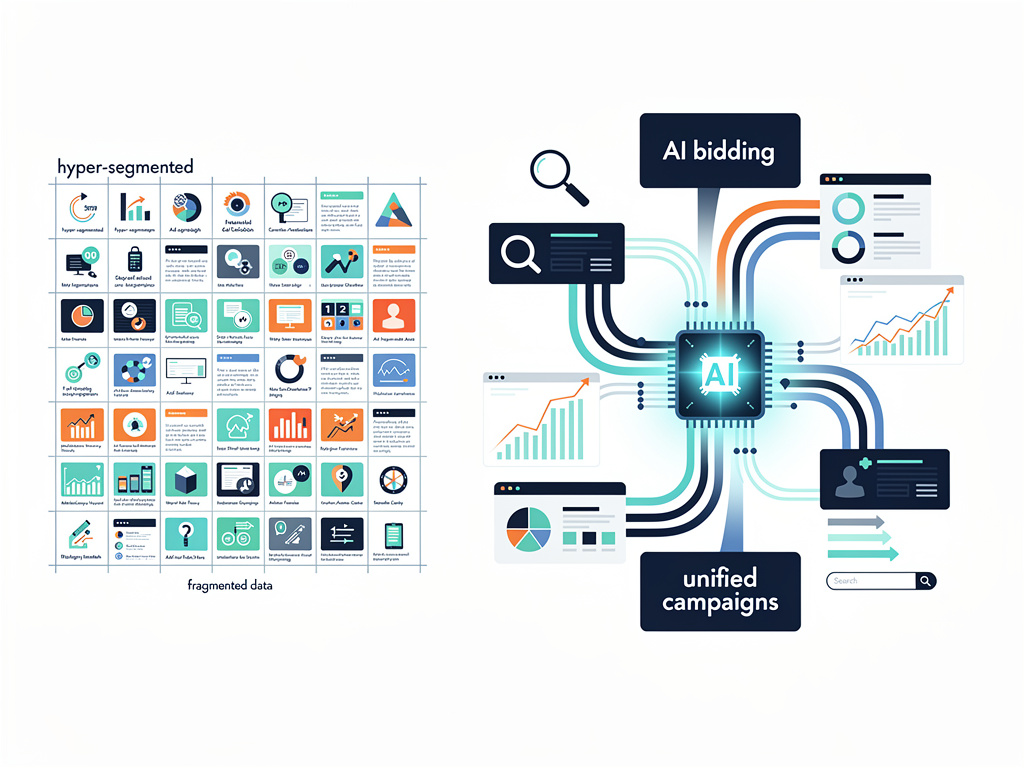
For the better part of two decades, the most sophisticated search advertisers prided themselves on architectural complexity. They built sprawling, meticulously segmented campaign structures — separating keywords by match type, splitting ad groups by device, creating bespoke landing pages for every conceivable query variation. It was painstaking, expensive work, and it was considered best practice. Now Google is telling them, in no uncertain terms, that the era of granularity-as-gospel is over.
In a sweeping blog post published on its official Ads & Commerce blog, Google laid out a case that many in the industry have been debating for years but few have been willing to fully embrace: that the hyper-segmented campaign structures advertisers spent years perfecting are now actively undermining the performance of Google’s AI-powered bidding and targeting systems. The message is clear — consolidate or be left behind.
The Architecture That Built an Industry Is Now Its Bottleneck
The logic behind granular campaign structures was always sound in a manual world. If you were hand-setting bids and writing ads for individual keyword clusters, you needed tight control. Separating exact match from broad match, isolating brand terms from generic queries, and splitting campaigns by geography or device gave advertisers the levers they needed to optimize performance one variable at a time. According to Google’s Ads & Commerce blog, this approach made sense “when manual bidding and limited automation were the norm.”
But the world has changed. Google’s AI systems — particularly its Smart Bidding algorithms and broad match capabilities — now process billions of signals in real time, including user intent, device context, time of day, location, and hundreds of other variables that no human team could ever manually optimize against. The problem, Google argues, is that overly fragmented campaign structures starve these AI systems of the data they need to learn and optimize effectively. When budgets and conversion signals are scattered across dozens or hundreds of tightly scoped campaigns, each individual campaign may not generate enough volume for the algorithm to identify patterns and make intelligent decisions.
Google’s Prescription: Fewer Campaigns, Broader Inputs, More Trust in the Machine
The core of Google’s recommendation is consolidation. Rather than maintaining separate campaigns for every match type, device, or audience segment, advertisers should merge related campaigns together, use broad match keywords paired with Smart Bidding, and let Google’s AI handle the granular optimization that humans once performed manually. As Google’s blog post puts it, advertisers should think of their campaign structure as providing “strategic guardrails” rather than micromanaged controls. The company recommends organizing campaigns around business objectives — such as different product lines, profit margins, or customer segments — rather than around tactical variables like keyword match types.
This is not merely a suggestion. Google has been steadily deprecating the tools that enabled the old approach. Modified broad match was retired in 2021. Device-level campaign segmentation has become less relevant as responsive search ads and automated bidding have taken over. The company’s push toward Performance Max campaigns — which run across Search, Display, YouTube, Gmail, and Discover simultaneously with minimal advertiser control over targeting — represents the logical endpoint of this philosophy. The direction of travel is unmistakable: Google wants advertisers to define the destination, and it wants its AI to chart the course.
The Industry’s Uneasy Relationship With Algorithmic Control
Not everyone in the advertising world is ready to hand over the keys. The tension between Google’s push for automation and advertisers’ desire for control has been a defining theme in paid search for the past several years. Many seasoned search marketers view Google’s consolidation advice with skepticism, noting that the company has an inherent conflict of interest — broader targeting and less advertiser control can mean higher costs per click and more spending flowing through Google’s auction system.
Industry practitioners have raised legitimate concerns. When campaigns are consolidated and broad match is used extensively, advertisers sometimes see their ads triggered by queries that are only tangentially related to their products. Negative keyword management becomes more critical but also more difficult at scale. And the “black box” nature of Google’s AI makes it harder to diagnose performance issues when they arise. Search engine marketing veterans who built their careers on the ability to dissect and optimize every element of a campaign find themselves being told that their expertise is now a liability — that the very structures they built with care are constraining the machine’s ability to perform.
Data Fragmentation: The Hidden Cost of Over-Segmentation
Despite the skepticism, there is a growing body of evidence that Google’s core argument holds water. The fundamental issue is statistical significance. Machine learning models require sufficient data volume to train effectively. A campaign that generates only a handful of conversions per week simply does not provide enough signal for Smart Bidding to optimize intelligently. According to Google’s Ads & Commerce blog, consolidating campaigns can lead to meaningful performance improvements because the AI has access to a richer, more complete dataset from which to learn.
Consider a retailer that sells running shoes. Under the old model, they might have separate campaigns for “men’s running shoes,” “women’s running shoes,” “trail running shoes,” and “road running shoes” — each further split by match type and device. That could easily produce 20 or more campaigns, each with its own budget and bidding strategy. If the total monthly budget is $50,000, each campaign might receive only $2,500 — potentially generating too few conversions for Google’s algorithms to optimize effectively. Consolidating into two or three campaigns organized by business objective (e.g., new customer acquisition vs. returning customer retention, or high-margin vs. low-margin products) concentrates the data and gives the AI a fighting chance.
Performance Max and the Future of Campaign Architecture
Google’s Performance Max campaign type, which launched broadly in late 2021 and has been aggressively promoted since, represents perhaps the most radical expression of the consolidation thesis. Performance Max campaigns allow advertisers to provide creative assets, audience signals, and conversion goals, and then Google’s AI determines where, when, and to whom the ads are shown — across virtually every Google property. The advertiser’s role shifts from tactical executor to strategic director.
Early results with Performance Max have been mixed, according to industry reports. Some advertisers have seen significant efficiency gains, particularly in e-commerce verticals where Google’s algorithms can leverage Shopping data and product feeds effectively. Others have struggled with a lack of transparency, reporting that Performance Max cannibalizes branded search traffic — essentially taking credit for conversions that would have happened anyway — and provides limited insight into which channels and queries are actually driving results. Google has gradually improved reporting capabilities in response to these criticisms, but the fundamental tension remains: the more control you cede to the algorithm, the less visibility you have into what it’s doing.
What Smart Consolidation Actually Looks Like in Practice
For advertisers willing to embrace Google’s direction, the practical implications are significant. The first step, as outlined in Google’s blog post, is to audit existing campaign structures and identify where fragmentation is limiting AI performance. Campaigns that share similar goals, target audiences, and return-on-ad-spend targets are prime candidates for consolidation. The company recommends maintaining separate campaigns only where there are genuine business reasons to do so — for example, when products have fundamentally different margin profiles, when geographic targeting requires distinct messaging, or when budget allocation needs to be strictly controlled across business units.
Keyword strategy also shifts dramatically under the new paradigm. Rather than maintaining exhaustive lists of exact match and phrase match keywords, Google recommends leaning into broad match combined with Smart Bidding, using the AI’s contextual understanding to reach relevant queries that might never have appeared in a traditional keyword list. First-party data becomes a critical input — uploading customer lists, defining audience signals, and feeding conversion value data back to Google all help the algorithm make better decisions. The advertiser’s job becomes less about controlling every input and more about ensuring the AI has the best possible information to work with.
The Strategic Imperative Behind the Technical Shift
Zooming out, Google’s campaign consolidation push is part of a broader transformation in digital advertising that extends well beyond search. As AI capabilities have advanced, the entire value chain of digital marketing is being restructured. Creative production, audience targeting, bid management, and performance measurement are all increasingly automated. The role of the marketer is evolving from hands-on-keyboard operator to strategic architect — someone who defines business objectives, sets constraints, provides high-quality inputs, and monitors outcomes.
This shift creates both opportunities and risks. Advertisers who adapt early may gain a genuine competitive advantage, benefiting from AI systems that are better trained and more effective due to consolidated data inputs. Those who cling to legacy structures may find themselves paying more for less as Google’s systems are increasingly optimized for the new paradigm. But the transition also concentrates power in Google’s hands, raising questions about market dynamics and advertiser autonomy that the industry will need to grapple with for years to come. The era of the meticulously hand-crafted campaign may not be entirely over — but its days as the default best practice almost certainly are.


 WebProNews is an iEntry Publication