
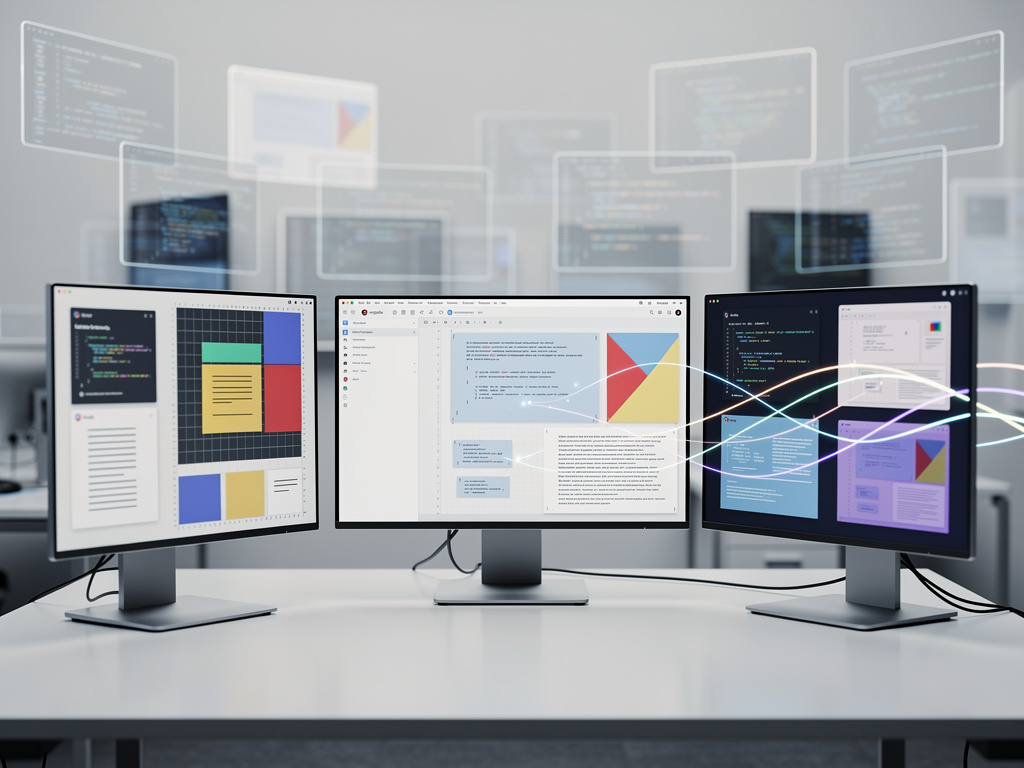
The era of the solitary chatbot window is drawing to a close. For the better part of two years, the generative AI industry has forced users to interact with large language models through a linear, conversational interface—a design inherited from messaging apps rather than productivity software. That dynamic is shifting. Google has expanded the availability of its "Canvas" interface within Gemini to all users in the United States, a move that signals a fundamental change in how the search giant envisions the future of work. This update acknowledges a growing consensus in Silicon Valley: for AI to be useful for complex tasks, it must escape the chat box.
Canvas creates a dedicated workspace alongside the standard conversation window, allowing users to generate, edit, and iterate on long-form writing or code without the friction of constant re-prompting. As reported by TechCrunch, this feature is now accessible to the broader American user base, moving it out of the exclusive domain of developers and early adopters. This rollout places Google in direct confrontation with OpenAI and Anthropic, both of which have introduced similar interfaces designed to transform their models from conversationalists into collaborative partners.
Breaking the Chatbot Containment
The limitation of standard Large Language Model (LLM) interfaces has long been the lack of persistence. A user asks for a marketing email; the bot provides it. If the user wants to change the tone of the second paragraph, they must ask the bot to rewrite the whole text, often resulting in unwanted changes to other sections. Canvas solves this by projecting the generated content into a separate, editable window. Here, users can highlight specific sections for targeted revisions, adjust reading levels, or debug code snippets directly.
This is not merely a cosmetic update; it is an infrastructure change designed to increase user stickiness. By keeping the user inside the Gemini interface for the editing phase, Google prevents the "copy-paste-exit" behavior that characterizes most current AI interactions. According to Google’s official release notes, the system automatically detects when a prompt would benefit from a canvas layout—such as requests to "write a blog post" or "debug this Python script"—and opens the workspace accordingly. This automatic triggering reduces the cognitive load on the user, who no longer needs to toggle settings to access advanced features.
Iterative Collaboration Over Static Generation
The underlying technology relies on a specialized model fine-tuned for editing and critique rather than just generation. When a user highlights a sentence in Canvas, Gemini understands the context of the entire document but focuses its processing power on the selected segment. This granular control is essential for professional workflows where precision outweighs speed. For instance, a programmer can ask Gemini to port a specific function from Java to Python within the code editor window, without altering the surrounding codebase, a capability that mirrors the functionality found in dedicated Integrated Development Environments (IDEs).
This approach mirrors the "Artifacts" feature launched by Anthropic for its Claude models earlier this year, which popularized the side-by-side view. However, Google is banking on its massive install base to win the standard-setting war. While Anthropic appeals to power users and coders, Google’s rollout targets the general consumer and enterprise worker who may be less familiar with prompt engineering but requires assistance with drafting memos or analyzing data. A recent analysis by The Verge points out that while the interface similarities between Gemini Canvas and OpenAI’s counterpart are striking, Google’s advantage lies in the potential connection to its existing productivity software.
The Developer Retention Battle
The coding capabilities within Canvas are particularly significant. The market for AI-assisted coding is currently dominated by Microsoft’s GitHub Copilot and newer entrants like Cursor. By integrating a robust code editor directly into the Gemini web interface, Google is attempting to reclaim developer attention. The Canvas interface allows for one-click debugging and the addition of comments, effectively turning the browser tab into a lightweight IDE. This is a defensive maneuver against the rapid adoption of Cursor, an AI-first code editor that has gained traction for its ability to predict developer intent.
For the enterprise sector, the implications are financial. If Google can prove that Gemini Canvas reduces the time required for junior developers to ship code or for marketing teams to finalize copy, the value proposition for their paid tiers increases. The company is actively trying to move the conversation away from model benchmarks—where GPT-4, Claude 3.5, and Gemini 1.5 trade blow-for-blow—toward utility and workflow integration. The question is no longer "which model is smarter," but "which interface lets me finish the job faster."
Integration with the Broader Productivity Stack
The rollout to all US users serves as a testing ground for deeper integration into Google Workspace. While the current iteration of Canvas operates within the Gemini app, the long-term play is almost certainly the dissolution of the barrier between the AI assistant and Google Docs. Currently, users still treat AI as a separate entity from their documents. Canvas bridges that gap halfway. The natural progression is for this "canvas" to simply become the document itself.
Competitors lack this specific advantage. OpenAI must rely on partnerships or build its own document editors from scratch. Google owns the editor. If Gemini Canvas becomes the preferred way to draft content, Google solidifies its hold on the office suite market against Microsoft’s Copilot implementation in Word. CNBC noted in their coverage of recent AI updates that Google’s strategy hinges on minimizing the disruption to existing user habits while injecting AI capabilities into familiar environments.
The Economic Stakes of Interface Design
The shift to Canvas-style interfaces also impacts the economics of AI inference. Collaborative editing sessions are longer and involve more frequent, smaller token exchanges than simple Q&A interactions. This increases the computational cost per user session. However, it also generates higher-quality data on how humans edit and refine AI outputs. This data is invaluable for Reinforcement Learning from Human Feedback (RLHF), the process used to train future models. By observing which AI suggestions users accept, reject, or modify in the Canvas, Google gains a feedback loop that is far richer than a simple "thumbs up" or "thumbs down."
Furthermore, this move acts as a gatekeeper against model commoditization. As underlying models become similar in performance, the interface becomes the differentiator. If a user builds a workflow around the specific highlighting and revision tools in Gemini Canvas, the switching costs to move to ChatGPT or Claude increase. Google is effectively trying to lock users in through superior UI/UX design, a strategy that Apple has employed successfully for decades in hardware.
Navigating the Agentic Future
Looking forward, Canvas is a stepping stone toward "agentic" workflows, where AI doesn’t just write text but performs actions. The isolated window provides a sandbox where an AI agent could eventually manipulate data, format charts, or execute code with supervision. Current chat interfaces are too messy for this level of autonomy. A structured canvas provides the boundaries necessary for an AI to operate safely on a specific task without hallucinating off-topic instructions.
The broad release to the US market allows Google to stress-test these interactions at scale. They will be watching closely to see if users actually adopt the "collaborator" mindset or if they continue to use the tool as a glorified search engine. The success of Canvas will depend on its latency and accuracy; if the editing tools feel sluggish or if the model creates new errors while fixing old ones, users will revert to their traditional text editors. But if it works as advertised, Google may have just set the standard for the next generation of human-computer interaction.


 WebProNews is an iEntry Publication