
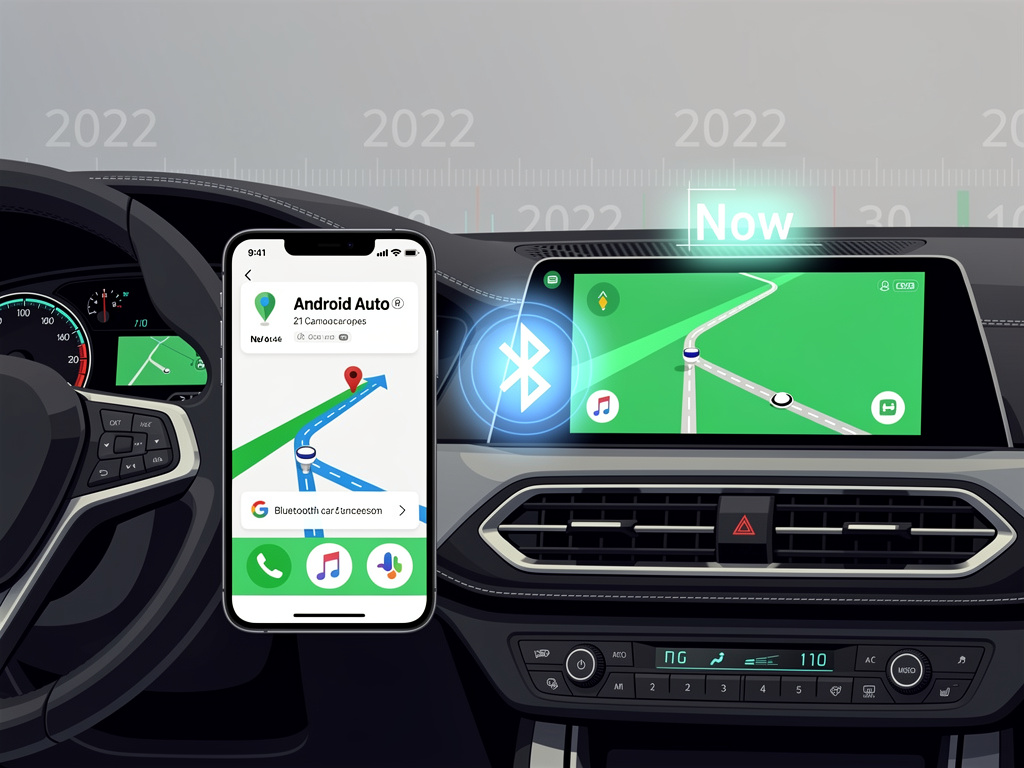
For years, Android users who connected their phones to their cars via Bluetooth were greeted by a rudimentary driving interface that felt more like an afterthought than a feature. Now, Google appears to be quietly reshaping that experience, rolling out a revamped driving mode that could redefine how millions of drivers interact with their smartphones behind the wheel — and potentially signal a strategic pivot away from the company’s dedicated Android Auto platform for phone screens.
The update, first spotted and reported by Android Police, introduces a redesigned driving mode that activates automatically when an Android phone connects to a car’s Bluetooth system. The changes are subtle in some respects but significant in their implications: a cleaner interface, better integration with Google Maps and Google Assistant, and a more cohesive experience that borrows design language from Android Auto while living natively within the phone’s operating system.
A Driving Interface That Finally Feels Intentional
The updated driving mode represents a marked departure from the sparse, utilitarian interface that previously appeared when users connected to their vehicles. According to Android Police, the new experience features a streamlined dashboard that surfaces navigation, media controls, and communication tools in a format optimized for glanceable use while driving. The layout prioritizes large touch targets, simplified menus, and voice-first interaction — all hallmarks of automotive interface design that Google has refined over years of developing Android Auto.
What makes this update particularly noteworthy is its automatic activation. Rather than requiring users to manually launch an app or toggle a setting, the driving mode engages when the phone detects a Bluetooth connection to a known vehicle. This frictionless approach mirrors the behavior that Apple has implemented with its CarPlay integration and suggests Google is thinking seriously about the passive, ambient computing experience that modern drivers expect.
The Ghost of Android Auto for Phone Screens
To understand the significance of this update, one must revisit a decision Google made in 2022 that frustrated many Android users. The company officially retired “Android Auto for phone screens,” a standalone app that provided a simplified, car-friendly interface directly on the user’s smartphone. That app was particularly valuable for drivers whose vehicles lacked built-in Android Auto compatibility — a population that, despite the growing adoption of in-dash systems, still numbers in the tens of millions globally.
When Google killed the phone-screen version of Android Auto, it pointed users toward Google Assistant’s driving mode as the replacement. But that substitute was widely criticized as incomplete and unreliable. Users complained about inconsistent activation, limited functionality, and a general sense that Google had downgraded their experience rather than improved it. Forums on Reddit and Google’s own support pages filled with complaints from drivers who felt abandoned by the transition.
Google’s Iterative Approach to Automotive Software
The latest driving mode update appears to be Google’s answer to those complaints — albeit one that has arrived with little fanfare or official announcement. This is consistent with Google’s broader pattern of rolling out significant feature changes through server-side updates rather than splashy product launches. The company has increasingly favored this approach across its ecosystem, from Google Photos to the Pixel feature drops, allowing it to test and iterate without committing to rigid release schedules.
Industry observers have noted that Google’s automotive strategy has become increasingly bifurcated. On one track, the company continues to develop Android Automotive OS, the embedded operating system that powers the infotainment systems in vehicles from Volvo, Polestar, General Motors, and others. On another track, Google maintains Android Auto as a projection protocol for cars that support it. The revamped driving mode now occupies a third lane — a native phone experience for the vast number of vehicles that support only basic Bluetooth connectivity.
Why Bluetooth-Only Drivers Still Matter
Despite the rapid adoption of Android Auto and Apple CarPlay in new vehicles, a substantial portion of the global car fleet remains equipped with nothing more than Bluetooth audio and hands-free calling. According to data from S&P Global Mobility, the average age of vehicles on American roads has climbed to over 12 years, meaning many cars in daily use predate the widespread availability of smartphone projection systems. In emerging markets, where older and more affordable vehicles dominate, the gap is even wider.
For Google, ignoring this segment would mean ceding a significant touchpoint in the daily lives of Android users. The driving commute represents one of the most consistent and extended periods of smartphone interaction for many consumers, and controlling that experience has implications for everything from Google Maps usage to media consumption through YouTube Music and podcast platforms. The updated driving mode ensures that Google maintains relevance in the vehicle cabin regardless of the car’s technological sophistication.
Design Choices That Echo Android Auto’s DNA
The visual and functional parallels between the new driving mode and Android Auto are difficult to ignore. As Android Police detailed in its analysis, the interface employs card-based layouts, prominent media controls, and a navigation-forward design philosophy that will feel immediately familiar to anyone who has used Android Auto. The color palette, typography, and iconography all align with Google’s Material You design system, creating visual continuity with the broader Android experience.
Voice interaction remains central to the experience, with Google Assistant serving as the primary input method for tasks like sending messages, making calls, and requesting navigation directions. This emphasis on voice control is both a safety consideration and a strategic one — every voice query routed through Google Assistant reinforces the company’s data ecosystem and advertising infrastructure, even in contexts where the screen is secondary to the road ahead.
Competitive Pressures From Cupertino and Beyond
Google’s renewed attention to the in-car phone experience does not exist in a vacuum. Apple has been aggressively expanding CarPlay’s capabilities, with its next-generation CarPlay platform promising to take over a vehicle’s entire instrument cluster and climate controls. Samsung, meanwhile, has been developing its own automotive integrations through partnerships with Harman International, its subsidiary that supplies infotainment systems to numerous automakers.
The competitive dynamics extend beyond traditional tech rivals. Chinese technology companies including Huawei and Xiaomi have been making aggressive moves into the automotive space, with Huawei’s HarmonyOS-based in-car systems gaining traction in the world’s largest auto market. For Google, which has limited access to the Chinese market, ensuring a superior driving experience on Android phones elsewhere becomes all the more critical for maintaining global platform loyalty.
What This Means for the Average Android User
For the typical Android phone owner, the practical implications of this update are straightforward but meaningful. Drivers who connect their phones to their cars via Bluetooth should begin seeing a more polished, more functional interface that makes it easier to navigate, control music, and manage communications without fumbling through a standard phone UI at 65 miles per hour. The update is rolling out gradually, as is Google’s custom, and availability may vary by device and region.
The deeper significance, however, lies in what this update reveals about Google’s long-term thinking. Rather than treating the phone-based driving experience as a vestigial feature to be deprecated in favor of embedded systems, Google appears to be investing in it as a parallel product with its own trajectory. This three-pronged approach — Android Automotive OS for new vehicles, Android Auto for compatible cars, and an enhanced driving mode for Bluetooth-only connections — suggests the company has concluded that the automotive market is too fragmented and too slow-moving to be served by a single solution.
The Road Ahead for Google’s Automotive Ambitions
Whether this updated driving mode represents a permanent strategic commitment or merely a stopgap measure remains to be seen. Google has a well-documented history of launching, iterating on, and eventually discontinuing products and features — a pattern that has bred skepticism among users and developers alike. The retirement of Android Auto for phone screens just two years ago serves as a cautionary reminder that today’s feature could be tomorrow’s deprecated service.
Yet the investment in a more polished driving mode suggests that Google recognizes a durable need. As long as hundreds of millions of cars on the road lack native smartphone integration, and as long as Android commands roughly 70% of the global smartphone market, the Bluetooth-connected driving experience will remain a touchpoint too valuable to neglect. For now, at least, Google appears to be driving in the right direction.


 WebProNews is an iEntry Publication