
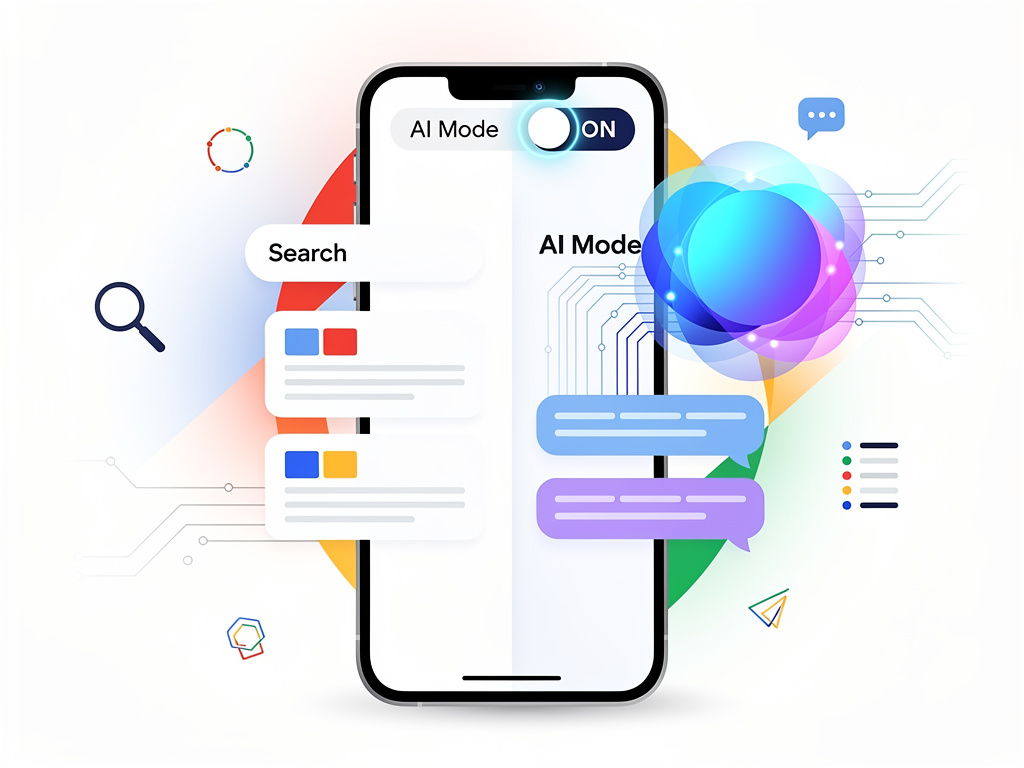
In the high-stakes theater of algorithmic dominance, Google appears to be preparing a significant strategic pivot, hidden deep within the code of its flagship Android application. As the tech giant grapples with the existential threat posed by generative AI competitors, new findings suggest the company is developing a dedicated “AI Mode” for Google Search. This feature, unearthed in a recent application teardown, indicates a move toward a bifurcated user interface that could fundamentally alter how billions of users interact with the world’s most valuable digital real estate.
The revelation comes from a detailed analysis of the Google app’s underlying code, specifically version 15.52.49.29. According to a report by Android Authority, the company is testing a toggle feature that transforms the traditional search results page into a streamlined, conversational interface. This “AI Mode” is essentially a stripped-down, chat-centric environment that prioritizes the company’s Gemini-powered AI Overviews while relegating the traditional list of blue links to the background. The interface is designed to allow users to refine queries and ask follow-up questions without the visual noise of standard search engine results pages (SERPs).
A Strategic Pivot Toward Conversational Interfaces
This development is not merely a cosmetic update; it represents a defensive fortification against the encroachment of “answer engines” like Perplexity and OpenAI’s SearchGPT. For two decades, Google’s hegemony relied on the “ten blue links” model. However, the rise of Large Language Models (LLMs) has shifted user expectations toward direct answers rather than curated lists of websites. By integrating a dedicated AI Mode, Google is effectively internalizing the product philosophy of its competitors, offering a ChatGPT-like experience directly within the chrome of its dominant search app.
The mechanics of this potential rollout suggest a focus on user agency. The code strings identified in the teardown reveal that users might soon see a floating action button or a distinct toggle within the Search Labs environment. This suggests that rather than forcing the AI experience on all users—a strategy that has previously drawn ire regarding hallucinated answers and cluttered interfaces—Google is opting for a modal approach. Users can choose to engage with the “AI Mode” for complex, multi-step queries, or remain in the traditional interface for navigational searches where a simple link is preferred.
Deconstructing the User Interface Overhaul
The technical architecture of this new mode appears to be built on the foundations of previous experiments. Industry observers note that this resembles the “Simple Search” test spotted earlier in the year, which removed sidebar clutter and extraneous widgets. However, the new iteration goes further by centering the experience entirely around the AI Overview. In this mode, the input field remains at the bottom of the screen, encouraging a continuous dialogue rather than a “fire and forget” query style. This subtle UX change is engineered to increase dwell time and engagement depth, metrics that are increasingly vital as search volume growth stabilizes in mature markets.
Furthermore, the visual language of the “AI Mode” seems designed to bridge the gap between a utility and an assistant. The interface reportedly features a colorful background distinct from the stark white of standard search, providing a visual cue that the user has entered a different cognitive space. This separation is crucial for managing user expectations; in a conversational mode, users anticipate synthesis and analysis, whereas the standard mode promises speed and accuracy of retrieval. By separating these streams, Google may be attempting to solve the branding crisis that occurs when its AI products provide inaccurate summaries alongside factual web results.
The Economic Implications for Publishers and Ad Revenue
The introduction of a dedicated AI Mode raises profound questions regarding the economics of the open web. If users can toggle into a mode that obscures organic search results in favor of synthesized answers, the click-through rates (CTR) for publishers could face a precipitous decline. Google has long argued that it sends traffic to the web, but a feature that encapsulates the user within a closed-loop conversational interface challenges that narrative. The industry is watching closely to see how—or if—citations and outbound links are preserved within this streamlined view.
From a monetization standpoint, this shift presents a complex calculus for Mountain View. Google’s business model is predicated on inserting advertisements into high-intent search queries. A conversational interface offers fewer pixels for traditional display inventory. However, it opens new avenues for “sponsored answers” or integrated commercial suggestions within the dialogue. If the “AI Mode” gains traction, it will likely serve as a testing ground for high-value, native advertising formats that are less intrusive but potentially more persuasive than banner ads, mirroring the evolution seen in social media feeds.
Navigating the Search Labs Ecosystem
Currently, this feature appears destined for “Search Labs,” Google’s testing ground for experimental features. This staging area allows the company to gather telemetry on user behavior without disrupting the core product for the general public. It serves as a pressure valve, releasing advanced features to power users while insulating the mass market from potential volatility. The presence of the code in the beta version of the app suggests that a public test is imminent, though Google has yet to officially confirm a release window.
The iterative nature of these tests highlights the internal tension at Google between innovation and preservation. The company must innovate to stave off irrelevance in the AI era, yet it must preserve the friction-free utility that makes Google Search a daily habit for billions. The “AI Mode” toggle is a compromise: it offers the future of search without destroying the past. It acknowledges that while the underlying technology of information retrieval is changing, user habits possess a significant inertia that cannot be ignored.
The Competitive Terrain of AI-First Search
Google’s move must be viewed through the lens of aggressive competition. OpenAI has begun rolling out search features that bypass the traditional index-and-rank methodology entirely. Similarly, startups are gaining traction by offering ad-free, summary-based search engines. Google’s vast index gives it a data advantage, but its user interface has become increasingly crowded with shopping widgets, knowledge panels, and sponsored slots. The “AI Mode” can be interpreted as a “reset” button—a way to offer the clean, minimalist experience of a startup competitor while leveraging Google’s superior infrastructure.
Moreover, this development aligns with Google’s broader “Gemini era” branding. By explicitly labeling the feature as an AI mode, the company is reinforcing the visibility of its proprietary models. This is a branding play as much as a functional one; it reminds the user constantly that they are interacting with Google’s AI, attempting to reclaim the narrative that the company is a leader, not a follower, in artificial intelligence.
Future-Proofing the Search Experience
As the line between search engines and chatbots blurs, the “AI Mode” may eventually become the default rather than an option. For now, however, the toggle represents a transitional phase in the evolution of the internet. It provides a safety net for users who still trust the authority of a source list over the convenience of a summary. It also buys Google time to refine the accuracy of its models, ensuring that when the switch is eventually flipped permanently, the AI is robust enough to handle the entirety of the world’s queries.
Ultimately, the code unearthed by Android Authority signals that Google is ready to cannibalize its own interface to save its market position. The “AI Mode” is an admission that the classic search page, which has served as the front door to the internet for twenty years, is no longer sufficient for every query. By offering a dedicated lane for AI interactions, Google is attempting to build a hybrid engine—one that can run on the old oil of links and the new electricity of generative text simultaneously.


 WebProNews is an iEntry Publication