
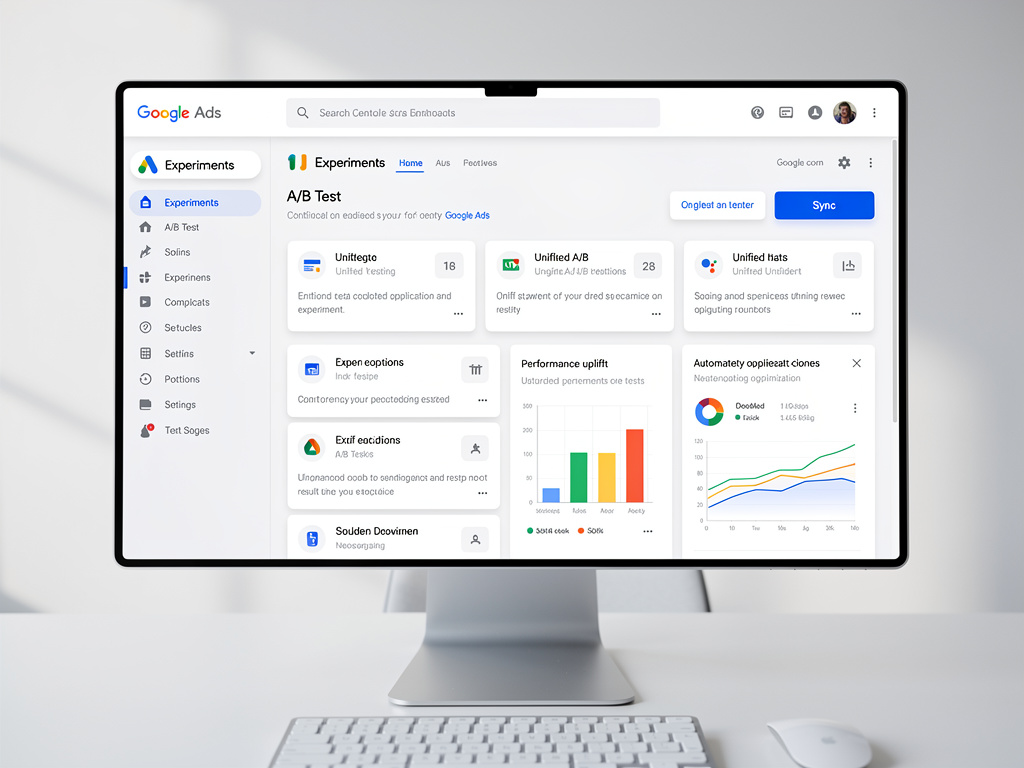
MOUNTAIN VIEW, Calif. — In a significant move to streamline one of digital advertising’s most critical and often complex tasks, Google is rolling out a centralized “Experiments page” within its Google Ads platform. The overhaul consolidates all campaign testing into a single hub and introduces a powerful automation feature, signaling a strategic push by the tech giant to lower the barrier for sophisticated, data-driven optimization and encourage advertisers to more rigorously test their way to higher returns.
For years, digital marketers managing campaigns on the world’s largest advertising platform have navigated a disjointed system for A/B testing. Running an experiment for a Performance Max campaign required delving deep into that specific campaign’s settings, while testing a new video creative involved a completely different workflow under the “Assets” section. This fragmentation created inefficiencies, discouraged frequent testing, and made it difficult for advertisers to maintain a holistic view of their optimization efforts across an entire account.
A Unified Command Center for Campaign Optimization
The new Experiments page, which is becoming available globally, aims to solve this long-standing issue by creating a unified command center. According to a report from Search Engine Land, this central location will house all experiment types, including Custom experiments for Search and Display, as well as tests for Video, Demand Gen, and Performance Max campaigns. This consolidation provides advertisers with a single destination to create, manage, and analyze the results of their tests, drastically simplifying workflow and improving visibility.
The goal, as outlined in Google’s own documentation, is to provide a more intuitive and efficient process for validating the impact of changes before they are fully applied to a campaign. By bringing disparate testing tools under one roof, Google is not just offering a cosmetic update; it is fundamentally altering the way advertisers can approach their campaign management strategy. The new interface allows for at-a-glance comparisons of all ongoing and completed tests, enabling quicker insights and more informed decision-making about where to allocate budget and creative resources.
The ‘Sync’ Button: Automation Enters the A/B Testing Arena
Perhaps the most impactful element of this rollout is the introduction of a new “Sync” feature. Previously, when an experiment concluded and a clear winner emerged, an advertiser had to manually replicate the successful changes—be it new ad copy, bidding strategies, or audience targeting—in the original campaign. This manual step was not only time-consuming but also fraught with the potential for human error, where a winning test might be implemented incorrectly or forgotten entirely, negating the value of the experiment.
The Sync function automates this crucial final step. With a single click, advertisers can now instruct Google Ads to automatically apply the changes from the winning experimental arm to the base campaign. As detailed by Google’s help center documentation on the new Experiments page, this feature is designed to help advertisers “launch experiments faster and more easily.” This seemingly small addition represents a significant quality-of-life improvement, freeing up marketing professionals from tedious administrative tasks and allowing them to focus on higher-level strategy and the next round of hypotheses.
From Fragmented Tools to a Cohesive Strategy
The strategic implication of this overhaul extends beyond mere convenience. By making experimentation more accessible and seamless, Google is actively encouraging a culture of continuous testing among its advertisers. In an increasingly automated advertising environment dominated by AI-driven campaigns like Performance Max, the ability to conduct controlled tests is one of the most important levers advertisers have left to exert strategic influence and truly understand what drives performance. The previous, fragmented system acted as a deterrent to this best practice.
This move aligns with Google’s broader strategic imperative to demonstrate value and performance in an era of heightened scrutiny over ad budgets and return on investment. When advertisers can easily test and prove that a new strategy works, they are more likely to increase their investment in the platform. Centralizing the tools to do so effectively removes friction from this value-discovery process, benefiting both the advertiser’s bottom line and Google’s revenue stream.
Industry Reception and the Push for Continuous Improvement
The initial reaction from the professional pay-per-click (PPC) community has been largely positive. On platforms like X, seasoned marketers have lauded the move as a long-overdue improvement that addresses a common pain point. The Sync feature, in particular, has been singled out as a game-changer for agencies and in-house teams that manage numerous experiments simultaneously, where the risk of manual implementation errors is magnified. The consensus is that while it doesn’t introduce a brand-new form of testing, it perfects the operational side of the existing framework.
This update can be viewed as part of an ongoing effort by Google to refine its powerful but often complex advertising suite. By simplifying the user experience around a core optimization practice, Google is ensuring its platform remains manageable for a wide spectrum of users, from small business owners to large enterprise teams. It is a tacit acknowledgment that the efficacy of its advanced AI and machine learning tools is ultimately dependent on the quality of the strategic inputs and the rigor of the testing that informs them.
Navigating the New Framework: What Advertisers Need to Know
For advertisers, the immediate action is to become acquainted with the new Experiments page as it rolls out to their accounts. The shift requires a re-evaluation of internal workflows that were built around the old, siloed system. Teams should identify which manual processes related to experiment implementation can now be retired in favor of the Sync feature. This is also an opportune moment for marketing leaders to revisit their testing roadmaps, as the reduced operational burden may allow for a higher velocity of experimentation.
Looking forward, this centralized hub could become the foundation for even more advanced testing capabilities. Industry observers speculate that Google could integrate more sophisticated AI-powered suggestions for what to test next directly into this interface, or potentially expand the framework to include other test types, such as landing page experiments. For now, the new Experiments page stands as a significant step toward making robust, methodical testing not just a best practice for the elite, but a standard operating procedure for every advertiser on the platform.


 WebProNews is an iEntry Publication