
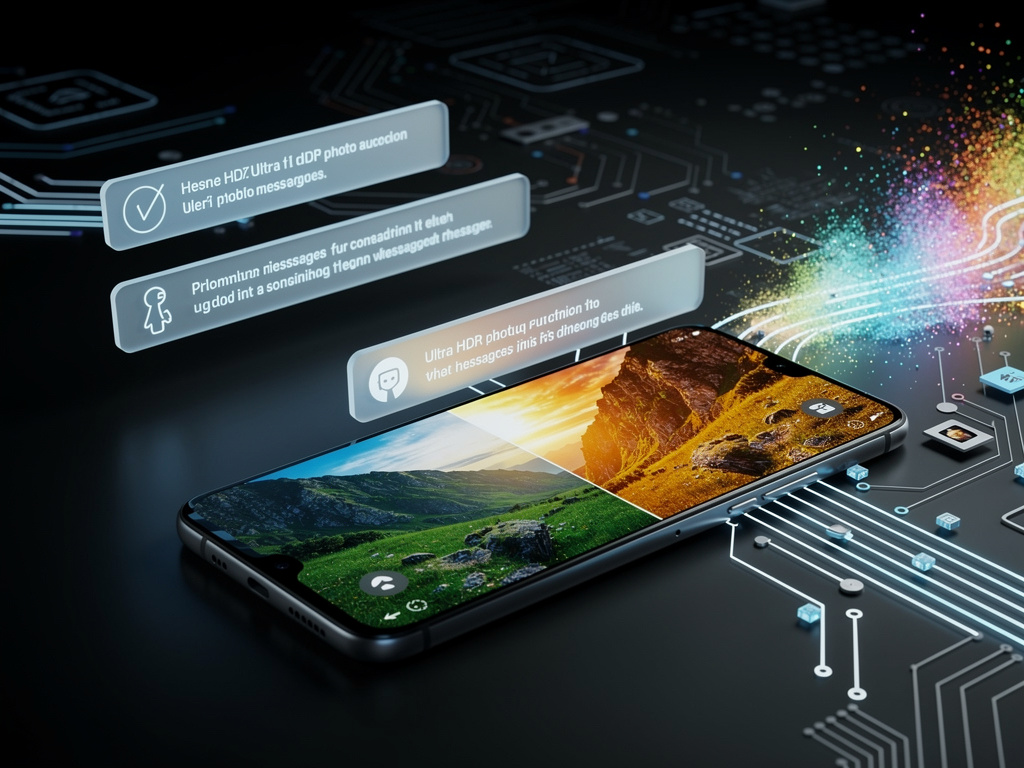
Buried inside the latest version of Google Messages lies a feature that hasn’t been announced, hasn’t been promoted, and isn’t yet available to users. But it’s there. Strings of code discovered through an APK teardown reveal that Google is preparing to bring Ultra HDR image support to its default messaging app for Android — a move that would significantly upgrade the visual quality of photos shared between more than a billion devices.
The discovery, first reported by Android Authority, came from an analysis of Google Messages version 20250511. Code references point to a new toggle that would let users send photos in Ultra HDR format, preserving the expanded brightness range and vivid color data that modern Android phones capture but currently strip away during messaging compression.
It’s a quiet development with loud implications.
What Ultra HDR Actually Means for Messaging
Ultra HDR is Google’s open-source image format, built on top of the standard JPEG container. Introduced with Android 14, it embeds a gain map within a conventional JPEG file, allowing HDR-capable displays to render images with dramatically higher brightness, deeper contrast, and more accurate color reproduction. On older screens or apps that don’t support the format, the image simply displays as a normal JPEG. No breakage. No compatibility headaches.
Google’s Pixel phones — starting with the Pixel 7 series and continuing through the Pixel 9 lineup — already capture photos in Ultra HDR by default. Samsung’s Galaxy S24 and S25 series do the same. So do several devices from OnePlus and other manufacturers running Android 14 or later. The hardware side of the equation has been solved for well over a year now.
The problem has been the pipeline. Users capture these rich, high-dynamic-range images, then share them through messaging apps that compress and flatten the HDR data into standard dynamic range. The photo that looked stunning in the gallery arrives looking merely adequate on the other end. Google Messages, despite being Google’s own product and the default SMS/RCS app on most Android phones, has been part of this problem.
That’s about to change.
According to the APK teardown, the new feature will appear as a user-facing option, likely within the messaging settings. The code includes strings referencing the ability to “send photos in Ultra HDR” with explanatory text noting that the format “keeps the brightness and color range of HDR photos.” There’s also a reference to a condition: the feature appears to require RCS (Rich Communication Services) to be active, which makes technical sense given that traditional SMS and MMS protocols impose severe file size limitations that would make HDR data transmission impractical.
RCS, the messaging protocol Google has been aggressively pushing as a successor to SMS, supports larger file transfers, higher resolution media, and end-to-end encryption. Apple finally added RCS support to iPhones with iOS 18 in late 2024, though its implementation remains limited compared to Google’s. Whether Ultra HDR images sent from Google Messages would retain their HDR data when received on an iPhone through RCS is an open question — and potentially a significant one.
The Competitive Context Is Shifting Fast
Google isn’t operating in a vacuum here. Apple has supported its own flavor of HDR photography for years, and iMessage handles high-quality image transfers natively between Apple devices. But cross-platform HDR image sharing remains fragmented and inconsistent. WhatsApp, the world’s most popular messaging app, still compresses images heavily by default, though Meta has been gradually improving media quality. Telegram offers higher-quality photo sharing but doesn’t specifically preserve HDR gain map data.
The timing of Google’s move aligns with a broader push across the Android platform to close quality gaps with iOS. Google Photos already supports Ultra HDR viewing. The Pixel camera app captures it natively. Android 15 expanded Ultra HDR support further at the system level. Google Messages has been the missing link in the chain — the point where HDR image quality went to die.
And this matters more than it might seem on the surface. Photography quality is one of the primary battlegrounds in the smartphone wars. Consumers increasingly judge their phone’s camera not just by how photos look on the device itself, but by how they look when shared. A photo that loses its punch in transit undermines the entire value proposition of a flagship camera system. For Google, which has staked Pixel’s reputation heavily on computational photography, fixing this leak in the pipeline is overdue.
There’s also a standards play here. Ultra HDR is based on the ISO 21496-1 specification, making it an open standard rather than a proprietary format. Google has been positioning Ultra HDR as the default HDR photo format for the Android world, and getting it working end-to-end in Google Messages would set a precedent that other Android messaging apps would likely follow. If Google Messages proves that HDR photos can be shared without ballooning file sizes or breaking backward compatibility — which the gain map approach is specifically designed to prevent — it removes the last credible excuse for other apps not to support it.
So when does this actually ship? The APK teardown doesn’t provide a release date. Features found in code analysis don’t always make it to production, and timelines can shift. But the presence of user-facing strings — not just internal flags or developer-only references — suggests this is relatively far along in development. A reasonable guess would place it in a Google Messages update sometime in the second half of 2025, possibly coinciding with the Pixel 10 launch or an Android 16 feature drop.
One technical detail worth watching: how Google handles the toggle. Making Ultra HDR opt-in rather than on-by-default would limit adoption. Making it default-on could confuse users who notice slightly larger file sizes or who share photos with recipients on apps or devices that don’t render HDR. The code strings suggest it will be a settings toggle, which implies opt-in — at least initially.
What This Signals About Google’s Messaging Ambitions
This feature doesn’t exist in isolation. Google Messages has been accumulating capabilities at an accelerating pace throughout 2024 and into 2025. Gemini AI integration for chat suggestions. Improved spam detection. Better group messaging features. Screen sharing during video calls. Each addition chips away at the argument that Android’s default messaging experience is inferior to iMessage.
Ultra HDR support fits squarely into this pattern. It’s not flashy. It won’t generate breathless headlines. But for the millions of users who care about photo quality — and especially for the subset who own flagship phones with HDR-capable cameras and displays — it addresses a real and persistent frustration.
The broader strategic picture is one of vertical integration. Google controls the camera software on Pixel. It controls Google Photos. It controls Google Messages. And it sets the standards for the Android platform that Samsung, OnePlus, and others build on. Getting Ultra HDR to flow cleanly from capture through storage through sharing, all within Google’s own products, creates a coherent experience that rivals what Apple offers within its walled garden.
Whether third-party apps follow quickly is another matter. But Google doesn’t need every app to support Ultra HDR overnight. It needs Google Messages to support it, because that’s the app that ships on every Android phone. That’s the app that handles RCS. And increasingly, that’s the app Google wants to be the center of communication on Android.
For now, the feature remains hidden in code, waiting for its moment. But the groundwork is clearly laid. When Ultra HDR support does go live in Google Messages, it won’t just be a checkbox feature. It’ll be the final piece connecting Android’s HDR photography chain from lens to recipient — something that should have happened a long time ago.


 WebProNews is an iEntry Publication