
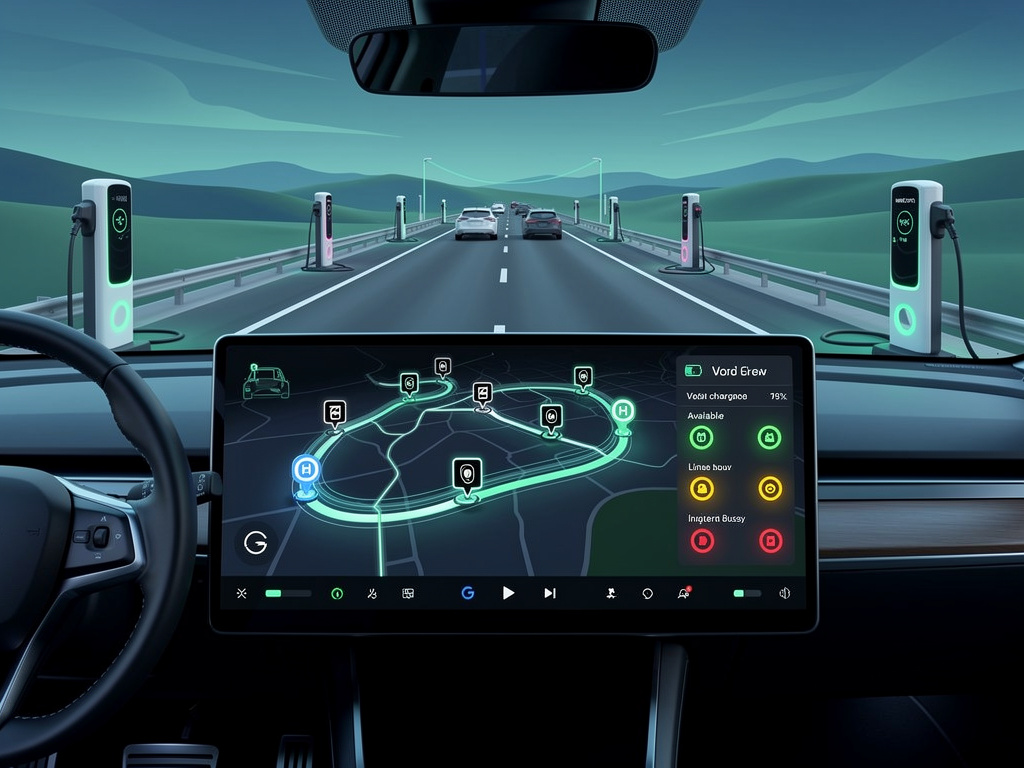
For years, the electric vehicle road trip has been an exercise in anxiety management. Not range anxiety in the traditional sense — most modern EVs can comfortably cover 250 miles or more on a full charge — but planning anxiety. The nagging question of where to stop, how long to charge, and whether the station you’re counting on actually works when you get there. Google is now making its most aggressive move yet to eliminate that friction, and the implications stretch well beyond convenience.
Google Maps is rolling out a comprehensive EV road trip charging plan feature for Android Auto users, according to CNET, which reported on the update as part of a broader wave of Google Maps enhancements. The feature automatically generates a full charging itinerary when you input a long-distance destination, factoring in your vehicle’s current battery level, its energy consumption characteristics, and the availability of compatible chargers along the route. It’s the kind of integrated intelligence that EV drivers have been cobbling together manually with third-party apps like A Better Route Planner for years. Now it’s baked directly into the navigation system most drivers already use.
Here’s what makes this different from Google’s earlier EV-related features. Previous iterations of Google Maps could show you nearby charging stations and filter by connector type. Useful, sure. But that’s like handing someone a phone book when they need a travel agent. The new charging plan feature thinks holistically about the entire trip. It identifies optimal stopping points based on your vehicle’s real energy needs, shows estimated charging times at each stop, and adjusts dynamically if conditions change — say, if you’re driving faster than expected and burning through battery more quickly, or if a planned charging station goes offline.
The timing is not accidental.
EV sales in the United States hit record levels in 2024, with battery-electric vehicles accounting for roughly 9% of new car sales according to Cox Automotive data. But adoption remains uneven, and consumer surveys consistently identify charging infrastructure concerns as the single biggest barrier to purchase. A 2024 J.D. Power study found that public charger reliability hovered around 80% — meaning one in five attempts to charge at a public station resulted in some kind of failure. That’s an unacceptable rate for a technology that’s supposed to replace the gas station, where pumps work 99% of the time without anyone thinking twice about it.
Google’s approach attacks this problem from the software side. By integrating real-time charger availability data, the Maps charging plan can steer drivers away from broken or occupied stations before they arrive. It can also factor in charger speed, so drivers aren’t routed to a 50kW Level 2 station when a 350kW DC fast charger sits just a few miles further along the route. These distinctions matter enormously. A 50kW charger might need 90 minutes to add meaningful range, while a 350kW unit can deliver 200 miles of range in under 20 minutes on compatible vehicles.
And this isn’t limited to a handful of vehicle brands. Google has been expanding its library of EV energy consumption profiles, working with automakers to ensure the algorithms reflect real-world performance rather than EPA estimates that often prove optimistic. The feature supports vehicles across multiple manufacturers, though the depth of integration varies. Drivers with Google built-in — the Android Automotive OS found in vehicles from Volvo, Polestar, GM, Ford, and others — get the most tightly integrated experience. But Android Auto users, who connect their phones to their car’s infotainment system, now get access to much of the same intelligence.
The competitive dynamics here are worth watching closely. Apple has been notably slower to build EV-specific intelligence into Apple Maps and CarPlay, leaving a gap that third-party apps have filled. Tesla, meanwhile, has long offered its own route planning with Supercharger integration — widely regarded as the best in the industry — but it only works within Tesla’s walled garden. Google’s play is to become the universal EV trip planner, agnostic to vehicle brand and charging network.
That universality is the real strategic asset. Google already dominates navigation. According to Statista, Google Maps had over 2 billion monthly active users globally as of early 2025. If it becomes the default tool for EV charging logistics, it gains an extraordinary data advantage: real-time information on charger utilization patterns, driver behavior, energy consumption trends, and infrastructure gaps. That data is valuable to automakers, charging network operators, utilities, and policymakers alike.
The federal government has poured billions into charging infrastructure through the National Electric Vehicle Infrastructure (NEVI) program, part of the 2021 Bipartisan Infrastructure Law. But building stations is only half the battle. Making them discoverable, reliable, and integrated into the tools drivers actually use — that’s the other half. Google is positioning itself as the connective tissue between the physical infrastructure and the driver.
There are limitations, of course. The charging plan feature depends on data feeds from charging network operators like ChargePoint, EVgo, Electrify America, and others. If those feeds are inaccurate or delayed, the plan breaks down. Google has been working to improve data quality through its own verification systems and user-submitted reports, but the problem of “ghost stations” — chargers that appear available in apps but are actually broken or offline — persists industry-wide. The Department of Energy’s Alternative Fuels Station Locator, which feeds into many navigation apps, has acknowledged data accuracy challenges.
Still, the direction is clear. Software is becoming as important as hardware in the EV ownership experience, and the companies that control the software layer — Google chief among them — are accumulating outsize influence over how, where, and when people charge. For charging network operators, this creates both opportunity and dependency. Being prominently featured in Google Maps route plans could drive significant traffic to a station. Being excluded, or deprioritized because of poor reliability scores, could be devastating.
The broader Google Maps update includes other enhancements beyond EV charging. Improved lane guidance, better construction zone alerts, and more granular arrival time estimates are all part of the package. But the EV charging plan is the headline feature for a reason. It addresses a specific, measurable pain point that directly affects purchase decisions for a category of vehicle that every major automaker is betting its future on.
So where does this leave the third-party EV planning apps? Companies like A Better Route Planner (ABRP), which was acquired by Rivian-backed company Iternio, have built loyal followings among early EV adopters who needed sophisticated tools that OEM systems couldn’t provide. Google’s entry into this space with a comparable feature, distributed to billions of users at zero cost, is a serious competitive threat. ABRP and similar apps may need to differentiate on depth — offering more granular control over charging preferences, cost optimization, and integration with home energy systems — or risk being absorbed into Google’s gravitational pull.
For the average consumer considering their first EV, though, this update removes one more excuse not to buy. The road trip problem — real or perceived — has been a persistent talking point among EV skeptics. When the most popular navigation app in the world handles charging logistics automatically, the cognitive burden drops substantially. You type in your destination. The app tells you where to stop, for how long, and what you’ll pay. That’s not quite as simple as stopping at any gas station you see, but it’s closing the gap fast.
The feature is rolling out now to Android Auto users, with broader availability expected through 2025. Google has not announced a timeline for equivalent functionality in iOS via CarPlay, though the company’s web-based Maps application has offered some EV routing features for several months. The asymmetry between Android and iOS support is notable and could become a point of friction as Apple prepares its next-generation CarPlay platform, which promises deeper vehicle integration.
One thing is certain: the era of planning an EV road trip with a spreadsheet, three apps, and a prayer is ending. Google just made sure of that.


 WebProNews is an iEntry Publication