
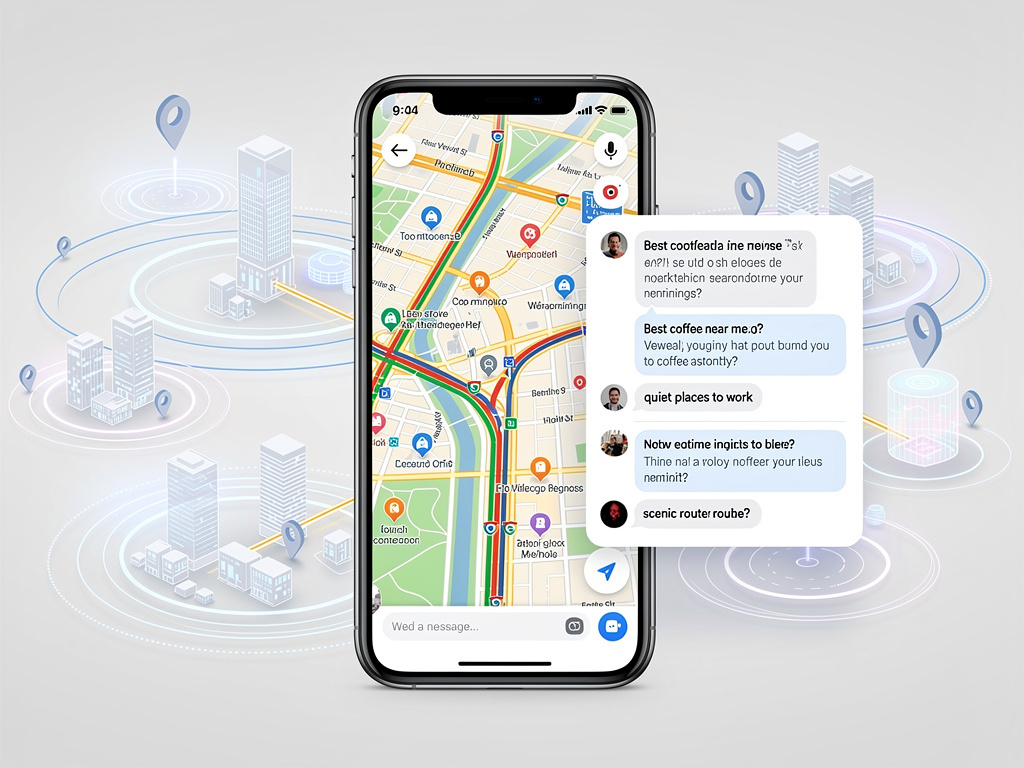
Google has initiated a significant transformation in how users interact with its Maps platform, integrating its advanced Gemini artificial intelligence model to enable natural language queries and conversational navigation experiences. This development represents a fundamental shift from traditional search-based mapping interfaces toward context-aware, dialogue-driven location services that could redefine consumer expectations for digital navigation tools.
According to Android Authority, Google Maps is now testing Gemini integration that allows users to ask complex, conversational questions about locations and receive detailed, AI-generated responses. Rather than simply searching for “restaurants near me,” users can now pose nuanced queries such as “find me a quiet coffee shop with outdoor seating that’s good for working” and receive contextually appropriate recommendations. This capability leverages Gemini’s large language model architecture to understand intent, preferences, and contextual requirements that traditional keyword-based search systems struggle to process effectively.
The technical implementation represents a convergence of Google’s mapping data infrastructure, real-time location intelligence, user-generated content from reviews and ratings, and Gemini’s natural language processing capabilities. This integration allows the AI to synthesize information from multiple data streams—including business hours, user reviews, popular times, menu information, and accessibility features—to generate comprehensive responses that would require multiple searches in the current Maps interface. The system can understand follow-up questions and maintain conversational context, enabling users to refine their searches through natural dialogue rather than reformulating keyword queries.
The Architecture Behind Conversational Mapping
The integration of Gemini into Google Maps required substantial backend infrastructure modifications to support real-time AI inference at scale. Unlike static search queries that can be cached and optimized, conversational AI interactions demand dynamic processing of user intent, context management across multiple query turns, and personalized response generation based on individual user preferences and location history. Google’s engineering teams have implemented a hybrid architecture that combines pre-computed mapping data with on-demand AI inference to balance response latency with computational efficiency.
The system architecture likely employs a multi-tiered approach where initial query processing determines whether a request requires full Gemini inference or can be satisfied through traditional search mechanisms. Simple queries like specific address lookups continue to use optimized search paths, while complex, conversational requests trigger Gemini’s language understanding capabilities. This tiered approach minimizes computational overhead while ensuring that users receive appropriately detailed responses matched to their query complexity.
Competitive Implications for Location-Based Services
This strategic deployment positions Google Maps to defend its dominant market position against emerging competitors leveraging AI capabilities. Apple has been steadily improving its Maps offering with enhanced detail and features, while newer entrants are exploring AI-driven navigation experiences. Google’s integration of Gemini creates a significant technical moat by combining the company’s unparalleled mapping data—accumulated over nearly two decades—with cutting-edge AI capabilities that competitors would struggle to replicate without similar data assets and AI infrastructure.
The business implications extend beyond consumer navigation to Google’s local advertising ecosystem. Conversational AI interfaces create new opportunities for contextual advertising and business discovery that align more naturally with user intent. When users engage in dialogue about finding specific types of businesses or experiences, the AI can surface relevant sponsored listings in ways that feel organic to the conversation rather than intrusive. This could fundamentally alter how local businesses approach digital marketing, shifting focus from keyword optimization to ensuring their business information, reviews, and attributes align with the types of conversational queries potential customers might pose.
Privacy and Data Processing Considerations
The implementation of conversational AI in Google Maps raises important questions about data privacy and processing. Conversational queries inherently reveal more detailed information about user preferences, habits, and intentions than traditional keyword searches. A user asking “find restaurants my vegetarian partner and I would both enjoy near our hotel” discloses dietary preferences, relationship status, and travel patterns in a single query. Google’s privacy policies and data handling practices will face increased scrutiny as these more revealing interaction patterns become normalized.
Google has stated that users maintain control over their location history and can delete conversational query data, but the technical reality of AI model training complicates these assurances. While individual query logs can be deleted, the insights derived from user interactions may inform model fine-tuning and optimization. The company faces the challenge of balancing personalization—which improves user experience—with privacy preservation, particularly in jurisdictions with stringent data protection regulations like the European Union’s GDPR framework.
Technical Challenges in Real-Time Location Intelligence
Implementing conversational AI for location services presents unique technical challenges distinct from general-purpose chatbots. The system must process queries with temporal sensitivity—understanding that “open now” means something different at 10 AM versus 10 PM—and spatial context, recognizing that “nearby” has different meanings for pedestrians versus drivers. Gemini’s integration must account for dynamic factors like current traffic conditions, temporary business closures, special events, and real-time crowding levels to provide accurate, actionable recommendations.
The latency requirements for navigation applications are particularly demanding. Users expect near-instantaneous responses when seeking directions or location information, leaving little tolerance for the multi-second processing times that complex AI inference might require. Google’s engineering teams have likely implemented aggressive optimization strategies, including model quantization, edge computing deployment for certain inference tasks, and predictive pre-processing of likely follow-up queries to maintain the responsive experience users expect from Maps.
Integration with Existing Google Ecosystem
The Gemini integration in Google Maps represents one component of a broader strategy to infuse AI capabilities across Google’s product portfolio. The company has already deployed Gemini in Search, Gmail, Docs, and other core services, creating an interconnected ecosystem where AI capabilities can leverage shared context and user data. A user planning a trip might research destinations in Search, receive restaurant recommendations through Maps with Gemini, book reservations through integrated services, and receive calendar reminders—all powered by interconnected AI systems that share contextual understanding.
This ecosystem approach creates powerful network effects that reinforce user lock-in. As users invest more interactions and preferences into Google’s AI-powered services, the personalization and utility improve, making alternative platforms less attractive. For enterprise users and developers, Google is positioning its AI infrastructure as a platform through which third-party applications can access similar conversational location intelligence capabilities, potentially creating a new category of location-aware AI applications.
User Experience Transformation and Adoption Patterns
Early user testing and feedback will prove critical in determining how conversational AI navigation is received by different demographic segments. Younger, tech-savvy users may quickly adopt conversational querying as their primary interaction mode, while older users accustomed to traditional search interfaces might require more gradual onboarding. Google faces the design challenge of making conversational AI discoverable and intuitive without disrupting the established user experience that hundreds of millions of users rely upon daily.
The success of this feature will likely depend on its ability to handle the inevitable edge cases and ambiguous queries that real-world usage generates. When the AI misunderstands intent or provides irrelevant recommendations, the user experience can deteriorate rapidly. Google’s approach to error handling, clarification dialogues, and graceful degradation to traditional search will determine whether conversational AI becomes a preferred interaction mode or a occasionally-used novelty feature.
Future Directions for AI-Powered Navigation
The current Gemini integration represents an initial step toward more ambitious AI-powered navigation capabilities. Future developments could include proactive recommendations based on learned patterns, multi-modal interactions combining voice, visual, and text inputs, and augmented reality overlays that provide contextual information about the physical environment. Google’s recent advances in computer vision and spatial computing suggest potential integration of real-time visual recognition with conversational AI, enabling users to point their phone camera at a building and ask “what’s inside?” or “is this place good for families?”
The evolution toward autonomous vehicle navigation presents another frontier where conversational AI could prove transformative. Rather than programming destinations, passengers could describe their intentions—”take me somewhere I can work for a few hours then grab dinner”—and the vehicle would optimize routing based on real-time conditions and learned preferences. While fully autonomous vehicles remain years away from widespread deployment, the conversational AI infrastructure being developed today will likely form the foundation for these future applications, making current investments in natural language navigation strategically significant beyond their immediate consumer applications.


 WebProNews is an iEntry Publication