
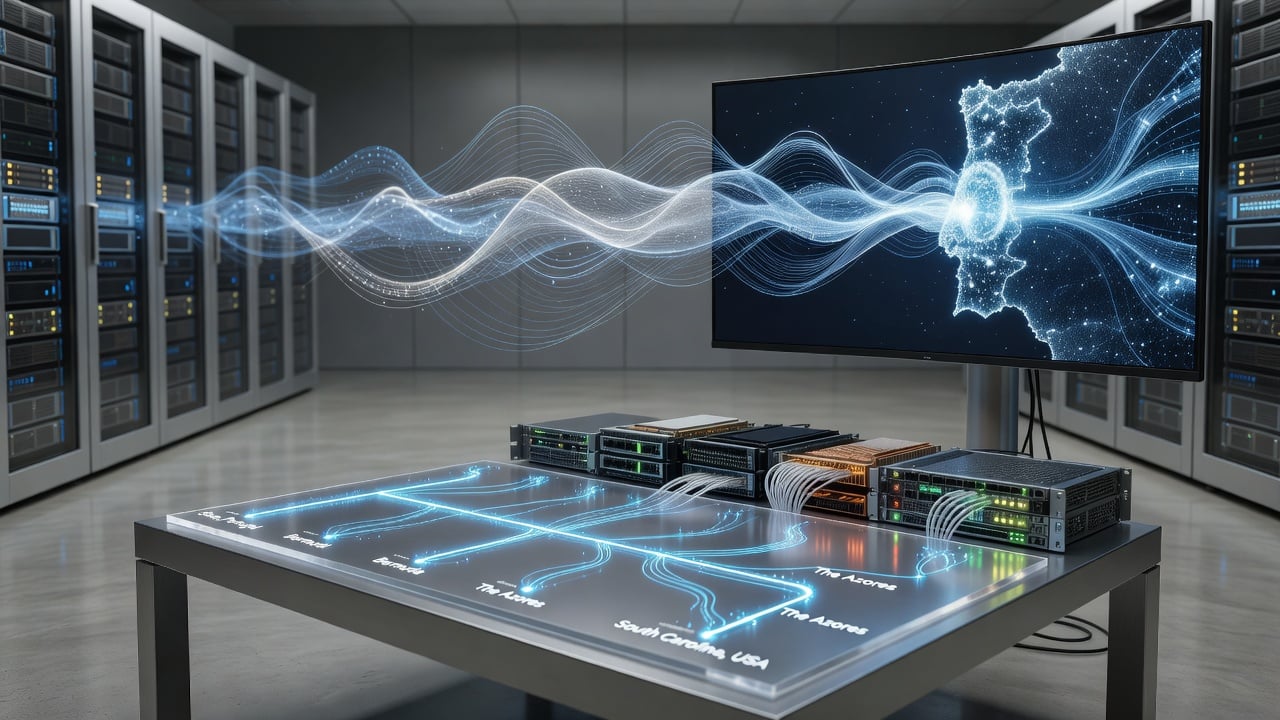
Google has activated its latest undersea cable. The system, named Nuvem, now links Sines on Portugal’s coast to Myrtle Beach, South Carolina. It crosses 7,000 kilometers beneath the Atlantic. Branches reach Bermuda and the Azores. Capacity hits 384 terabits per second.
Announced today, the cable’s connection marks a concrete step in hyperscalers’ race to own their physical networks. SubCom built and laid it. Google owns the asset outright through its Starfish Infrastructure subsidiary. Full service arrives in the second half of 2026. The Myrtle Beach landing happened back in May.
Why now? AI training and inference devour bandwidth. Data must move fast between continents. Owning the cable gives Google end-to-end control. It avoids reliance on third-party carriers. Costs stay predictable. Routes stay resilient. One fault won’t force traffic onto competitors’ lines.
Strategic positioning meets surging demand
Portugal gains status as an Atlantic gateway. Its renewable energy projects, now targeting over 2.6 gigawatts, attract data centers. Sines already serves as a hub for cables to Europe, Africa and the Americas. The new link deepens that role. Azores landings add mid-ocean options. Bermuda gets its first direct transatlantic fiber connection.
Giorgia Abeltino, Google Cloud’s EMEA policy director, described the project in precise terms. “Nuvem was part of a wider vision for Portugal and Europe to invest in the strategic infrastructure underpinning the digital economy,” she said, according to Reuters.
Portugal’s State Reform Minister Goncalo Matias struck a similar note. “Portugal is becoming what geography always invited us to be — the Atlantic gateway of Europe, the meeting point of three continents: Europe, Africa, and the Americas,” he told reporters at the landing ceremony. The remarks appear in the same Reuters dispatch.
This isn’t Google’s first move. The company has invested in private cables for over a decade. Firmina, completed in 2023, also lands in South Carolina. Equiano connects Portugal to West Africa. Nuvem joins them to form a tighter mesh. Traffic can reroute around outages. Latency drops. Reliability climbs. The approach echoes decisions by Meta, Microsoft and Amazon. All now build or buy substantial subsea capacity rather than lease it.
Technical details tell part of the story. Sixteen fiber pairs carry the load. Each pair handles roughly 24 terabits per second. Total design capacity reaches 384 Tbps. That’s a sharp increase from earlier Google projects. A 2016 Asia cable offered 26 Tbps. Advances in fiber technology, signal processing and amplification drive the gains. SubCom’s systems reflect years of incremental progress in marine engineering.
Subsea cables already move 95 percent of global internet traffic. Yet few companies control their own. Google stands out. It designs routes to match its cloud regions and AI clusters. Capacity aligns with internal forecasts. No consortium negotiations slow deployment. The model reduces risk in an era when a single cable cut can disrupt entire regions.
Recent coverage highlights the timing. AI workloads have accelerated bandwidth needs. Training a single large model can require data transfers measured in petabytes. Inference at scale adds constant flow. Public cloud usage compounds the pressure. The Next Web noted how Nuvem feeds exactly those demands. It positions the cable as infrastructure built for workloads reshaping data center strategy.
Analysts see broader implications. Portugal eyes a bigger share of European data center investment. Renewable power gives it an edge over markets facing energy constraints. Sines already hosts multiple landing stations. The Google project signals confidence. Other hyperscalers may follow. Bermuda officials welcomed the branch as a chance to become a digital waypoint. Local connectivity improves. Transit traffic could generate revenue.
But challenges remain. Cable laying depends on weather, geopolitics and supply chains. Maintenance at sea costs millions. Security concerns grow as reliance on few owners increases. Governments watch these assets closely. Europe’s push for digital sovereignty adds another layer. Nuvem supports that goal by diversifying routes away from traditional chokepoints.
Full activation still lies ahead. Engineers must light all fiber pairs. Integration into Google’s global backbone takes time. Live traffic should flow before year’s end. When it does, the cable becomes one more piece of invisible plumbing that keeps cloud services responsive.
Competitors pursue parallel paths. Meta’s Anjana cable also lands near Myrtle Beach. Microsoft’s investments span multiple oceans. The collective spending runs into billions. Industry data show subsea capacity demand rising 30 to 40 percent annually in some corridors. AI accounts for much of the surge.
Google’s blog first introduced Nuvem back in 2023. Brian Quigley, then vice president of global network infrastructure, called it a system that would “add capacity, increase reliability, and decrease latency for Google users and Google Cloud customers around the world.” The original post sits at Google Cloud Blog. Today’s connection turns that plan into operational reality.
Industry watchers on X reacted quickly. Posts from economic outlets and tech accounts noted the cable’s role in AI infrastructure. One semiconductor analyst highlighted indirect benefits to optics suppliers such as Marvell and Ciena. The sentiment? Bandwidth buildout continues without pause.
Nuvem’s name means “cloud” in Portuguese. The choice feels deliberate. It ties the physical cable to the virtual services it supports. Data centers in Europe gain faster access to U.S.-based models and datasets. Latency-sensitive applications improve. Enterprises running hybrid workloads notice the difference.
Longer term, the cable supports Google’s ambitions in generative AI. Models grow larger. Training runs lengthen. Real-time applications multiply. Each advance demands more bandwidth, more redundancy, more control. Private cables deliver all three.
Portugal’s government sees the arrival as validation. Years of policy work focused on connectivity and green energy. The payoff arrives in the form of direct investment and strategic relevance. Sines evolves from fishing port to digital crossroads.
The Atlantic has carried data for decades. Yet the infrastructure beneath its waves keeps changing. Fiber counts rise. Capacities climb. Ownership consolidates among technology giants. Nuvem represents the current state of that evolution. Fast. Owned. Purpose-built for artificial intelligence.
Engineers will monitor its performance closely in coming months. Early traffic will test real-world throughput. Any surprises in signal quality or power efficiency could influence future designs. For now, the cable sits ready. Another 384 terabits per second, quietly waiting to carry the next wave of computation.


 WebProNews is an iEntry Publication