
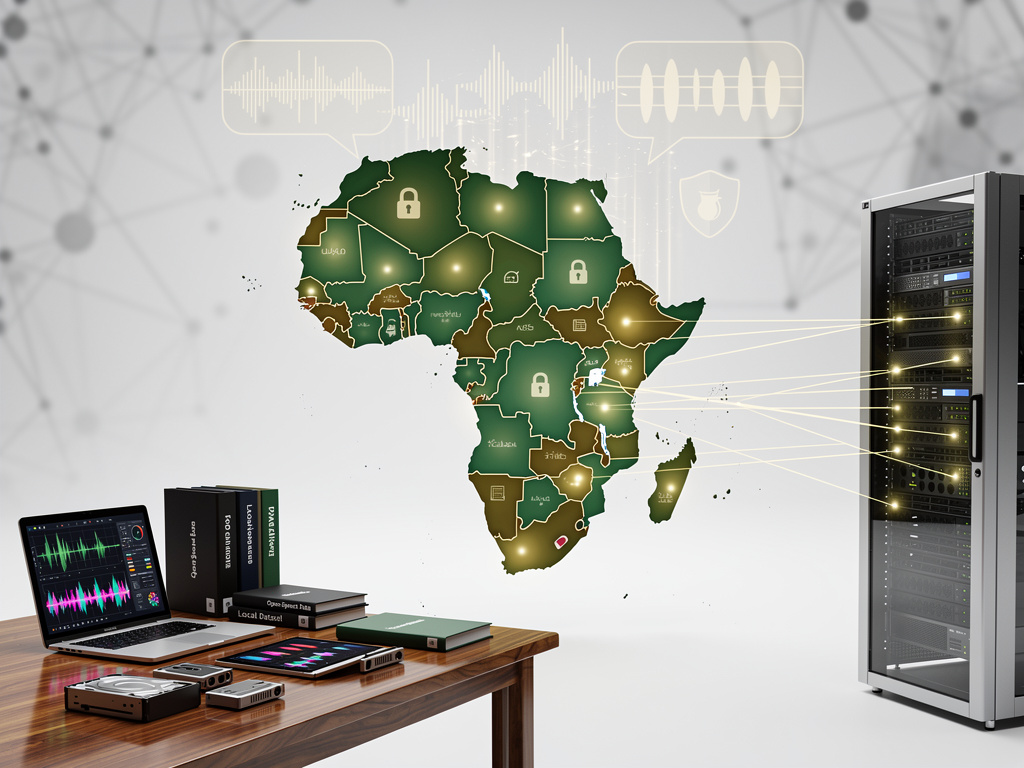
For decades, the development of speech recognition technology has been shaped overwhelmingly by companies headquartered in Silicon Valley, trained on data collected from English, Mandarin, and a handful of other globally dominant languages. Hundreds of millions of Africans who speak languages like Wolof, Yoruba, or Amharic have been largely excluded from the artificial intelligence revolution — not because the technology couldn’t serve them, but because the data to build it simply didn’t exist in usable, open formats. That dynamic shifted meaningfully this month when Google unveiled WAXAL, an open speech dataset spanning 21 African languages, with a critical twist: African institutions, not Google, own and control the data.
The name WAXAL, derived from the Wolof word meaning “to speak” or “to give voice,” is more than branding. It signals a deliberate philosophical departure from the extractive data-collection practices that have historically characterized Big Tech’s engagement with the Global South. As Rest of World reported, the dataset gives African institutions ownership and governance authority in a field long dominated by a small number of Western technology companies. The project represents one of the most significant efforts yet to democratize the raw materials of AI development for underserved linguistic communities.
A 21-Language Repository Built From the Ground Up
According to Google’s official announcement, the WAXAL dataset encompasses speech data for 21 African languages, including widely spoken ones such as Swahili, Hausa, Yoruba, and Amharic, as well as languages with fewer digital resources like Lingala, Luganda, Ewe, and Wolof. The dataset was constructed through partnerships with African universities, research labs, and language organizations across the continent. Crucially, the data was collected with informed consent from speakers, and the recordings were gathered in naturalistic settings to capture the diversity of accents, dialects, and speaking styles that characterize real-world language use.
The scale of the undertaking is notable. Each language in the dataset includes hours of transcribed speech, carefully annotated and quality-checked by native speakers. Google provided funding, technical infrastructure, and machine learning expertise, but the company emphasized that the intellectual property and governance rights rest with the African partner institutions. This structure is designed to ensure that the communities whose voices populate the dataset retain the ability to decide how it is used, who can access it, and under what terms — a model that stands in contrast to earlier data-collection efforts in which recordings from developing nations were absorbed into proprietary corporate systems with little accountability or benefit flowing back to the source communities.
Why Data Sovereignty Matters More Than Data Availability
The question of who owns AI training data has become one of the most consequential issues in global technology policy. In the African context, it carries particular weight. As Rest of World noted, the continent’s linguistic diversity — with more than 2,000 languages spoken across 54 countries — represents both an enormous opportunity and a profound challenge for AI developers. Most commercial speech recognition systems perform well in perhaps a dozen languages; the remaining thousands are effectively invisible to the technology. This gap has real-world consequences: it limits access to voice-activated services, digital assistants, automated translation, healthcare information systems, and financial tools that increasingly rely on speech interfaces.
But the solution is not simply to collect more data. The history of AI development is littered with examples of datasets that were assembled without adequate consent, that reinforced biases, or that enriched the companies that built them while offering little to the populations they were drawn from. WAXAL’s governance model attempts to address these concerns head-on. By vesting ownership in African institutions, the project creates a framework in which local researchers and organizations can build their own speech technologies, license the data on their own terms, and ensure that the economic value generated by the dataset circulates within the continent rather than being extracted from it.
Google’s Calculated Bet on Open Data and African AI Ecosystems
From Google’s perspective, the investment in WAXAL aligns with a broader strategic interest in expanding its products and services across Africa, a continent with a young, rapidly growing population and accelerating internet adoption. The company has made significant investments in African infrastructure in recent years, including undersea cables, cloud computing regions, and AI research centers. Supporting the development of open speech datasets is, in part, a way to cultivate the ecosystem of developers and researchers who will build applications on Google’s platforms — even if the data itself is not proprietary to Google.
This approach reflects a growing recognition within the technology industry that the old model of hoarding data as a competitive moat is increasingly untenable, both politically and practically. Governments around the world are imposing stricter data sovereignty requirements, and communities that have been subjects of data extraction are demanding a greater share of the value their information creates. By positioning itself as a partner rather than an owner, Google may be attempting to build goodwill and long-term relationships in markets that will be critical to its growth over the coming decades. The company’s blog post framed the initiative as part of its commitment to “responsible AI development” and to ensuring that the benefits of artificial intelligence are “shared broadly,” according to the Google Africa blog.
The African Institutions at the Center of the Project
The partner institutions involved in WAXAL span multiple countries and include universities, language technology labs, and civil society organizations with deep expertise in African linguistics. These partners were not merely subcontractors collecting audio files; they played active roles in designing the data collection protocols, selecting speakers, supervising transcription, and establishing quality benchmarks. This collaborative structure is significant because it builds local capacity — training African researchers in the methodologies of speech dataset construction so that future projects can be undertaken independently of any single corporate sponsor.
The emphasis on institutional ownership also has implications for how the dataset will evolve over time. Unlike a static data dump, WAXAL is designed to be a living resource that can be expanded, updated, and refined by its African stewards. New languages can be added, existing recordings can be supplemented, and the governance framework can be adapted as the needs of the research community change. This is a model that several AI ethics researchers have advocated for but that has rarely been implemented at this scale. As Rest of World highlighted on Bluesky, the project’s structure is explicitly designed to counter the pattern of data colonialism that has characterized much of the AI industry’s engagement with the developing world.
Bridging the Gap Between Research and Real-World Applications
The immediate practical applications of the WAXAL dataset are substantial. Speech-to-text systems, voice-activated interfaces, automated translation services, and accessibility tools for people with disabilities all depend on large, high-quality speech corpora. For the 21 languages included in the initial release, WAXAL provides a foundation that developers can use to train and fine-tune models without having to build their own datasets from scratch — a process that is prohibitively expensive and time-consuming for most African startups and research institutions.
The dataset also has potential applications in education, healthcare, and governance. Voice-based information systems could deliver agricultural advice to farmers in their native languages, provide health guidance in regions with low literacy rates, or enable citizens to interact with government services without needing to read or write in a colonial-era official language. These are not hypothetical use cases; they are active areas of development across the continent, and the primary bottleneck has consistently been the lack of labeled speech data. WAXAL directly addresses that constraint.
Challenges and Open Questions for the Road Ahead
For all its promise, the WAXAL initiative also raises questions that will need to be answered as the project matures. Twenty-one languages, while a significant start, represent only a fraction of Africa’s linguistic diversity. The criteria for selecting which languages to include — and which to leave out — inevitably involve difficult trade-offs between population size, digital readiness, and institutional capacity. Expanding the dataset to cover more languages will require sustained investment and coordination that goes beyond any single corporate partnership.
There are also questions about enforcement. Vesting ownership in African institutions is a meaningful structural choice, but its effectiveness depends on the legal and institutional frameworks available to those organizations. If a multinational company uses the data in ways that violate the terms of access, do the partner institutions have the resources and legal standing to enforce their rights? These are challenges that the broader open-data movement has grappled with for years, and they are not unique to WAXAL. But they are especially acute in contexts where power imbalances between global technology companies and local institutions remain vast.
A Template That Could Reshape How AI Meets the Developing World
Despite these uncertainties, the WAXAL project represents a genuinely novel approach to a problem that has vexed the AI community for years: how to build inclusive technology without perpetuating extractive dynamics. If the governance model holds and the dataset proves useful to researchers and developers, it could serve as a template for similar initiatives in other regions where linguistic diversity has been underserved by mainstream AI development — from South Asia to Indigenous communities in the Americas and the Pacific.
The broader significance of WAXAL may ultimately lie not in the dataset itself but in the precedent it sets. By demonstrating that it is possible to build large-scale, high-quality speech corpora with genuine community ownership, the project challenges the assumption that AI development must be a top-down process driven by a handful of wealthy corporations. It suggests that a different model is not only possible but practical — one in which the people whose voices power the technology also hold the keys to its future. Whether Google and its African partners can sustain and scale that model will be one of the most important stories in global AI development in the years ahead.


 WebProNews is an iEntry Publication