
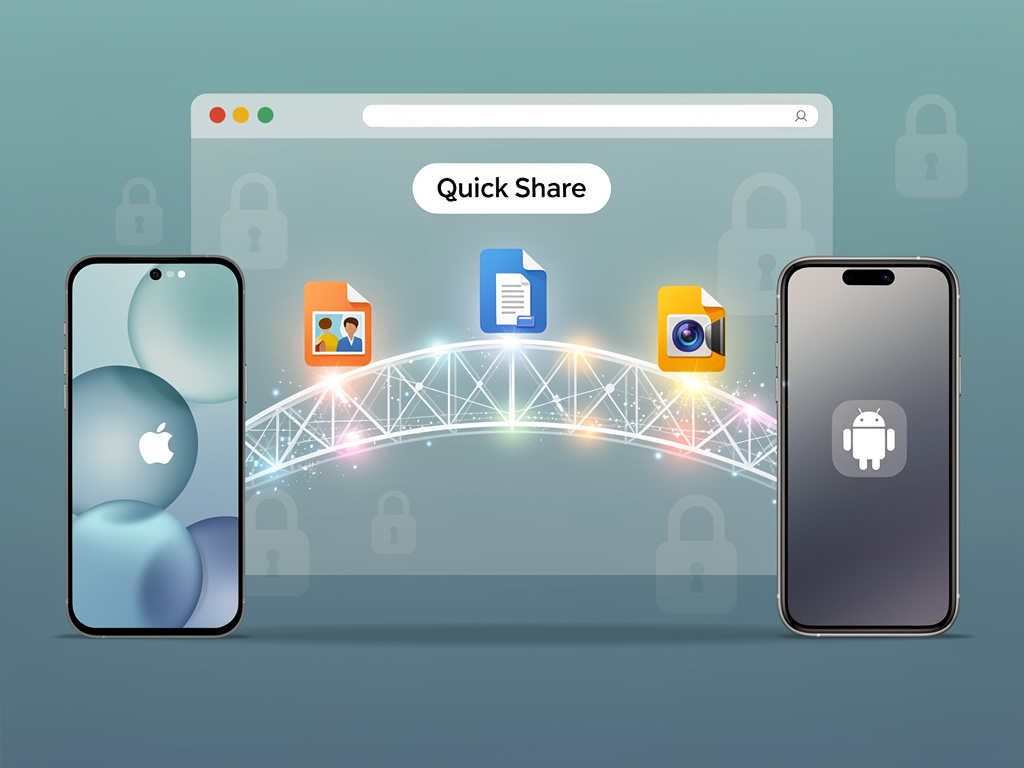
For years, one of the most persistent frustrations in mobile technology has been the simple act of sending a file from an Android phone to an iPhone. While Apple’s AirDrop made iPhone-to-iPhone sharing effortless and Google’s Nearby Share (now Quick Share) handled Android-to-Android transfers, the gap between the two platforms remained stubbornly wide. That gap is now closing.
Google has begun rolling out Quick Share support for iOS, enabling Pixel 9 owners—and soon, users of other Android devices—to beam photos, videos, and files directly to iPhones and iPads without relying on email, messaging apps, or third-party cloud services. The feature, which surfaced as part of a broader Pixel software update, represents one of the most practical cross-platform improvements Google has delivered in recent memory.
How Quick Share for iOS Actually Works
According to reporting from MSN, the new capability allows Pixel 9 devices to send files directly to Apple devices running iOS. The mechanism works through a web-based transfer system: the Android device generates a link or initiates a direct connection, and the iOS recipient can accept and download the file through their browser or a lightweight client. This approach sidesteps the need for Apple to approve a dedicated Quick Share app in the App Store—a strategic move given Apple’s historically tight control over its platform.
The feature was spotted in the latest Pixel Feature Drop, Google’s quarterly software update that brings new capabilities to its flagship phone line. While Pixel 9 devices are the first to receive the update, Google has indicated that the functionality will expand to other Android phones in the coming months. The rollout follows months of beta testing and user feedback, during which Google refined the transfer protocol to handle a variety of file types and sizes reliably.
A Long-Overdue Solution to a Persistent Problem
The inability to easily share files between Android and iOS has been a pain point that predates both AirDrop and Quick Share. For more than a decade, users caught between the two platforms have resorted to workarounds: emailing files to themselves, uploading to Google Drive or iCloud, using Bluetooth (which is notoriously slow and unreliable for large files), or turning to third-party apps like SHAREit or Snapdrop. None of these solutions offered the speed or simplicity that same-platform sharing tools provided.
Apple introduced AirDrop in 2011, and it quickly became one of the iPhone’s most beloved features. Google’s answer came much later—first as Nearby Share in 2020, then rebranded as Quick Share in 2024 after Google merged its technology with Samsung’s competing standard. But both systems were walled gardens, working only within their respective device families. The new iOS compatibility breaks down that wall from the Android side, even if Apple has shown no indication of reciprocating by bringing AirDrop to Android.
Google’s Strategic Calculus
Google’s decision to extend Quick Share to iOS is not purely altruistic. The company has long positioned itself as the more open, interoperable alternative to Apple, and cross-platform file sharing reinforces that narrative. It also serves a practical business purpose: the easier it is for Android users to interact with iPhone users, the less likely Android owners are to switch platforms simply because their friends and family use iPhones.
This move comes amid broader regulatory pressure on both companies to improve interoperability. The European Union’s Digital Markets Act, which took effect in March 2024, has pushed Apple to open up several previously closed systems, including allowing third-party app stores and alternative browser engines on iOS. While the DMA does not specifically mandate cross-platform file sharing, the regulatory environment has created a climate in which platform openness is increasingly expected by both users and lawmakers.
The Technical Details Behind the Transfer
Quick Share for iOS does not function identically to its Android-to-Android counterpart. On Android, Quick Share uses a combination of Bluetooth Low Energy for device discovery and Wi-Fi Direct for the actual file transfer, enabling high-speed transfers without an internet connection. The iOS version, by contrast, relies on a web-based mechanism because Apple does not grant third-party developers the same low-level access to Bluetooth and Wi-Fi protocols that would be needed for a native implementation.
This means that transfers to iOS devices may be slightly slower than Android-to-Android Quick Share, and they require an active internet connection in most cases. However, Google has optimized the process so that the user experience remains straightforward: the sender selects Quick Share on their Android device, chooses the iOS recipient, and the recipient receives a notification or link to download the file. Early reports from users who have tested the feature suggest that transfer speeds are competitive with email attachments and significantly faster than Bluetooth.
What the Pixel Feature Drop Includes Beyond File Sharing
The Quick Share expansion is part of a larger Pixel Feature Drop that includes several other notable additions. Google has enhanced its on-device AI capabilities, improved the Pixel’s call screening features, and added new camera tools for the Pixel 9 series. The company has also rolled out updates to its Gemini AI assistant, which now handles more complex tasks directly on the device without sending data to the cloud.
But it is the Quick Share update that has generated the most discussion among technology commentators and industry analysts. File sharing may seem mundane compared to AI-powered photo editing or real-time language translation, but it addresses a friction point that affects millions of users daily. As MSN reported, the feature has been among the most requested by Pixel owners who regularly interact with iPhone users—a group that, in the United States, represents roughly half the smartphone market.
Apple’s Silence and the Interoperability Question
Apple has not publicly commented on Google’s Quick Share expansion to iOS. The company has historically been reluctant to support cross-platform sharing standards initiated by competitors, preferring instead to keep features like AirDrop, iMessage, and FaceTime exclusive to its own hardware. This exclusivity has been a powerful driver of iPhone sales, particularly among younger users who value the social currency of blue bubbles in iMessage and the convenience of AirDrop in group settings.
However, Apple has made some concessions in recent months. The company adopted the RCS messaging standard in iOS 18, bringing richer text messaging between Android and iPhone users after years of resistance. That move was widely seen as a response to both regulatory pressure and a sustained public campaign by Google, which ran advertisements and social media campaigns highlighting the degraded messaging experience between the two platforms. Whether Apple will eventually allow AirDrop to work with Android devices remains an open question, but the trend line suggests that the walls between the two platforms are gradually eroding.
What This Means for Enterprise and Professional Users
The implications extend beyond casual photo sharing between friends. In corporate environments, where employees frequently use a mix of Android and iOS devices, cross-platform file transfer has been a persistent IT headache. Companies have spent significant resources on mobile device management solutions and enterprise file-sharing platforms partly to address this gap. A native, built-in solution—even one that works only from Android to iOS—could reduce reliance on third-party tools and simplify workflows for mixed-device teams.
For creative professionals, the ability to quickly send high-resolution photos or video clips from a Pixel to an iPhone for editing or review could streamline production processes. The Pixel 9’s camera has earned strong reviews for its computational photography capabilities, and the ability to share those files directly with collaborators on iOS removes a step that previously required cloud uploads or wired transfers.
The Road Ahead for Cross-Platform Sharing
Google’s Quick Share for iOS is a significant step, but it is not the final word on cross-platform file sharing. The web-based transfer method, while functional, lacks the polish and speed of a fully native implementation. True parity with AirDrop or Android-to-Android Quick Share would require Apple to open its platform to deeper integration—something the company has shown little appetite for absent regulatory compulsion.
Still, the direction of travel is clear. Users increasingly expect their devices to work together regardless of manufacturer, and both Google and Apple are being pushed—by regulators, by market pressure, and by user demand—toward greater interoperability. Google has taken the more aggressive posture on this front, and the Quick Share expansion to iOS is the latest evidence of that strategy. For the millions of users who have long struggled with the simple act of sending a file from one phone to another, it is a welcome and overdue development.


 WebProNews is an iEntry Publication