
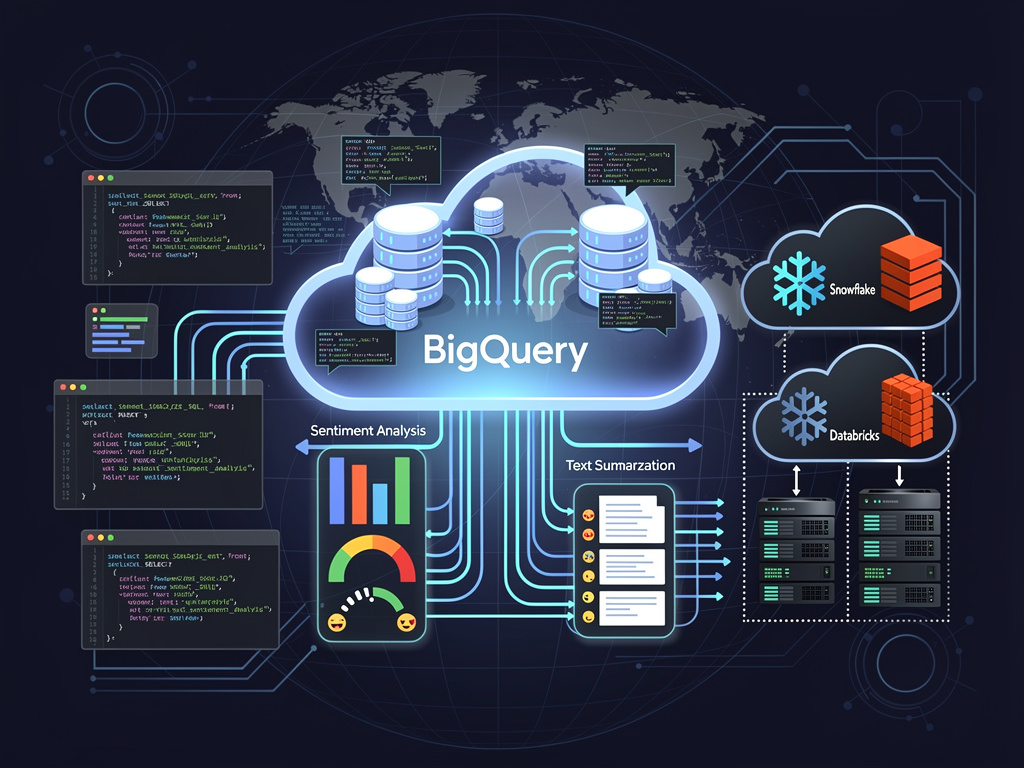
MOUNTAIN VIEW, Calif. — In a move that signals a significant escalation in the battle for enterprise data dominance, Google is embedding its powerful generative artificial intelligence capabilities directly into the heart of its BigQuery data warehouse. The new functionality allows data analysts to perform sophisticated tasks like sentiment analysis, text summarization, and entity extraction using simple SQL commands, a language familiar to millions of business users who lack deep machine learning expertise.
This strategic integration, which directly connects BigQuery to Google’s Vertex AI platform, is designed to dramatically lower the barrier to entry for applying AI to massive corporate datasets. By bringing large language models (LLMs) to the data, rather than requiring complex and costly data movement, Google aims to streamline workflows and solidify BigQuery’s position against formidable rivals such as Snowflake and Databricks, which have been making similar high-stakes plays in the generative AI space.
Unlocking AI with a Familiar Language
The core of the new offering lies in two new SQL functions. The first, `ML.GENERATE_TEXT`, allows users to send prompts to Google’s foundational LLMs, such as `text-bison`, directly from a BigQuery query. According to a Google Cloud blog post detailing the launch, this enables analysts to classify unstructured text, summarize lengthy customer reviews, or extract specific information like product names from feedback forms without writing a single line of Python or managing complex API calls. For instance, a retailer could run a query on a table of millions of customer reviews to automatically categorize each one as ‘Positive’, ‘Negative’, or ‘Neutral’, providing near real-time business intelligence.
This capability effectively transforms the data warehouse from a passive repository into an active, intelligent engine. Instead of merely storing and retrieving information, BigQuery can now be used to interpret and create new insights from it on the fly. The move is a direct appeal to the vast population of data analysts and business intelligence professionals whose primary tool is SQL, empowering them with capabilities previously reserved for specialized data science teams.
From Keywords to Concepts with Vector Embeddings
The second function, `ML.GENERATE_EMBEDDING`, introduces a more advanced concept to the SQL environment: vector embeddings. This function uses models like `textembedding-gecko` to convert text data into numerical representations, or vectors, that capture its semantic meaning. This is a crucial technology for powering more nuanced applications like semantic search, where the goal is to find results based on conceptual similarity rather than just keyword matching. A company could use this to build a recommendation engine that suggests products based on the meaning of their descriptions, not just shared tags.
By integrating embedding generation directly into BigQuery, Google simplifies the creation of sophisticated search and clustering applications. Analysts can now generate and store these vectors alongside their original data within the same secure environment. This avoids the traditional, multi-step process of exporting data to an external service for processing and then re-importing it, which introduces security risks, latency, and operational overhead. The entire workflow, from raw data to AI-powered insight, can now be managed within BigQuery’s governance framework.
A Direct Challenge in a Crowded Field
Google’s announcement is not occurring in a vacuum. It is a direct and forceful response to similar initiatives from its chief competitors, who are all racing to define the future of the intelligent data platform. Snowflake, for its part, has been aggressively pushing Snowflake Cortex, a service that provides access to LLMs and AI models through SQL functions. The goal is the same: to make AI a native component of the data cloud experience. Similarly, Databricks has integrated AI Functions into its Lakehouse Platform, allowing users to apply machine learning models, including those for natural language processing, directly within their data workflows.
The competitive dynamic is now centered on which platform can offer the most seamless, powerful, and cost-effective integration of AI and data. Google’s potential advantage lies in its vertical integration; it owns the entire stack, from the underlying cloud infrastructure (Google Cloud), to the data warehouse (BigQuery), to the world-class AI models themselves (Vertex AI, powered by PaLM 2 and Gemini). This tight coupling could translate into better performance, enhanced security, and more predictable pricing, key considerations for enterprise customers wary of runaway AI-related cloud bills.
Security and Governance at the Forefront
For enterprise IT leaders, one of the most pressing concerns with generative AI is data security. Sending sensitive corporate data to external model APIs can be a non-starter for many organizations in regulated industries. Google is addressing this head-on by emphasizing that with the new BigQuery functions, data does not leave the BigQuery security perimeter. The processing happens within Google’s network, subject to the same robust governance and access controls that customers already rely on for their data warehouses. This is a critical selling point that reduces the friction and risk associated with AI adoption.
This approach also simplifies data management. By keeping AI-generated outputs, such as sentiment labels or text summaries, within the same tables as the source data, organizations can maintain a single source of truth. This avoids the creation of disparate data silos and ensures that all information, whether human- or machine-generated, is managed under a unified governance policy. The serverless, auto-scaling nature of BigQuery means that these new, computationally intensive AI queries can be run without the need for manual infrastructure provisioning, a key tenet of the platform’s value proposition.
The Evolving Role of the Data Analyst
The broader implication of these developments is the fundamental transformation of the data analyst’s role. With generative AI tools embedded in their primary workspace, analysts can now move beyond traditional descriptive analytics (what happened) and diagnostic analytics (why it happened) into the realm of more advanced analysis. They can now ask more open-ended, qualitative questions of their data and receive structured, synthesized answers, effectively augmenting their own analytical capabilities.
As these features become more widespread across all major data platforms, the ability to write a clever SQL prompt may become as valuable as the ability to write a complex join. This democratization of AI is set to unlock significant new value from the vast stores of unstructured text data—such as emails, support tickets, and social media comments—that have historically been difficult and expensive for businesses to analyze at scale. The race is on, and the ultimate winners will be the organizations that can most effectively empower their teams to turn this data into a competitive advantage.


 WebProNews is an iEntry Publication