
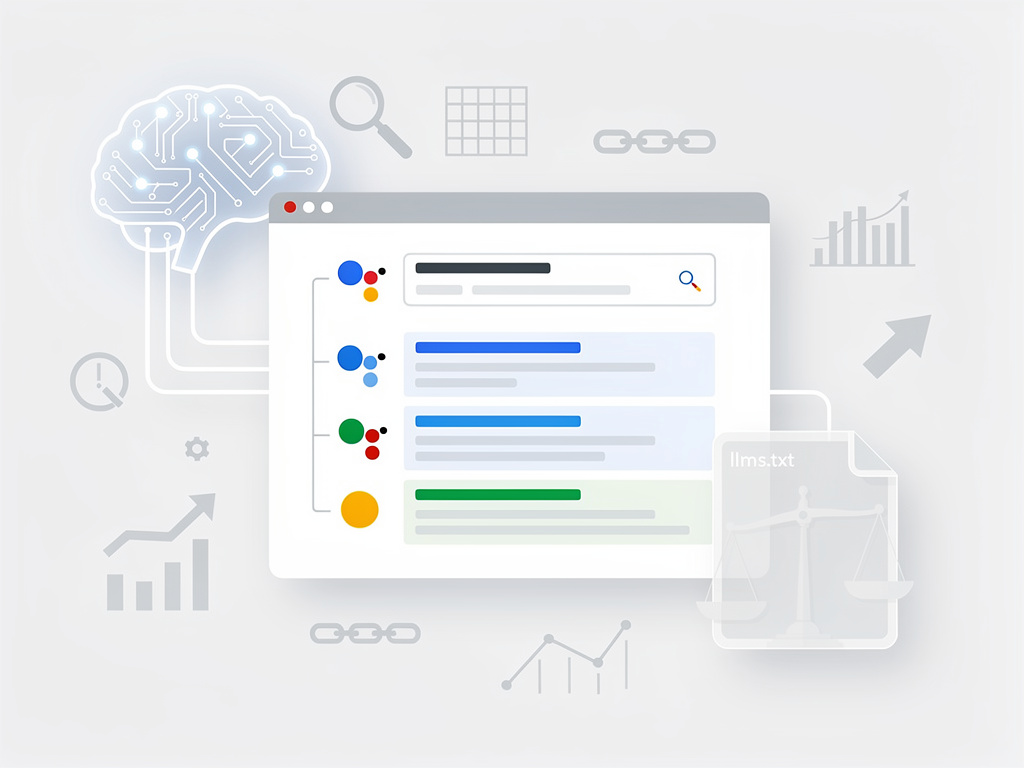
Google has updated its official guidance on optimizing for AI-powered search features. The change delivers a straightforward message to site owners and SEO teams. Adding an llms.txt file will neither lift nor sink your positions in Google Search results.
The clarification appeared in the company’s guide to optimizing for generative AI features on Google Search. Barry Schwartz first reported the update for Search Engine Land on June 15, 2026. In it Google states plainly that its systems ignore the file for ranking purposes.
“You don’t need to create new machine readable files, AI text files, markup, or Markdown to appear in Google Search (including its generative AI capabilities), as Google Search itself doesn’t use them,” the document reads. It adds that Google may still crawl and index such files. Yet this activity carries no special weight.
A second paragraph drives the point home. “It’s completely fine if you decide to create and maintain LLMS.txt files (or other similar files) for other services or systems that use these files. Doing so won’t harm (nor help) your visibility or rankings in Google Search, as Google Search ignores them.”
The language leaves little room for interpretation. Google Search does not factor llms.txt into its algorithms. Nor does it penalize sites that publish one. The file simply exists alongside other content types the crawler encounters.
But not every corner of Google agrees. Or at least not every product team. Chrome’s Lighthouse tool added an experimental audit for agentic browsing in May 2026. That check looks for the presence of llms.txt at the domain root. It treats the file as a signal of readiness for AI agents that browse the web.
Search Engine Land covered the Lighthouse update on May 20, 2026. The audit frames llms.txt as a machine-readable summary that can help agents grasp site structure faster. Without it, the documentation notes, agents might spend extra time crawling to build their own understanding.
This split creates tension. One part of Google tells publishers the file changes nothing for search visibility. Another part flags its absence in tools aimed at emerging agent technologies. SEOs have watched the mixed signals with growing frustration.
The file itself emerged as a proposal in late 2024 from Jeremy Howard of Answer.AI. Placed at the root of a domain, llms.txt offers a plain-text, often Markdown-formatted overview. It can include site descriptions, key content summaries, usage guidelines for AI systems, and links to important pages or full Markdown versions of articles.
Proponents saw it as robots.txt for the AI age. A lightweight way to tell large language models what a site stands for and how its content should be represented. Early tests showed some AI crawlers fetching the file. Yet adoption by major model providers remained patchy at best.
Google’s own documentation teams briefly published llms.txt files across developer properties in December 2025. The files pointed to Markdown versions of API references and guides. They disappeared quickly. John Mueller, a Google Search advocate, responded to questions about the appearance with a simple “no” when asked if it signaled endorsement.
In recent weeks Mueller reinforced the position. He stated that llms.txt offers limited help for LLMs trying to differentiate one site from another. The file alone cannot supply the depth of signals that come from well-structured HTML, strong internal linking, external citations, and clear, authoritative content.
Industry testing backs up the caution. Researchers have found thousands of llms.txt files indexed by Google. A small percentage rank for keywords. Some even appear in featured snippets or get cited in AI Mode responses. But correlation does not prove causation. Many of those sites also maintain strong traditional SEO profiles.
One analysis of hundreds of files suggested that roughly 5 percent surface in search results with measurable keyword rankings. Observers noted that random text files like cats.txt can rank too if their content matches a query. The pattern points to standard indexing behavior rather than special treatment for llms.txt.
Other AI platforms show uneven interest. OpenAI’s crawlers have fetched the file on some domains. Perplexity and Anthropic have referenced similar conventions in agent-to-agent protocols. Yet none have published clear documentation confirming that llms.txt drives citation decisions or training data selection. The lack of transparency leaves marketers guessing.
So what should teams do? The Google guidance offers practical advice. Focus first on fundamentals that have powered search success for years. Create clear, well-organized pages. Build topical authority. Earn links from trusted sources. Structure content so both humans and machines can parse it easily.
That does not mean dismissing llms.txt entirely. For organizations that interact with browser-based AI agents, experimental tools, or third-party models, the file costs little to maintain. A concise summary of mission, key offerings, and preferred citations can serve as a polite instruction manual. Just don’t expect it to move the needle on Google rankings today.
The broader picture reveals a web in transition. Traditional search engines still rely on HTML signals, link graphs, and behavioral data. New agentic systems want higher-level summaries and explicit permissions. Publishers must serve both audiences without diluting their core optimization efforts.
Some companies already publish both an llms.txt and per-page Markdown files. They report increased crawling by certain AI bots and occasional upticks in referral traffic from ChatGPT or Perplexity interfaces. These wins remain anecdotal. Larger studies have yet to isolate the file’s contribution from other quality factors.
Google’s latest statement cuts through the speculation. The company has no current plans to incorporate llms.txt into its Search or generative AI systems. That stance could shift as agent technologies mature. For now the instruction is clear. Treat the file as optional infrastructure for other platforms. Build your Google visibility on proven foundations.
And the conversation continues. SEO professionals debate whether the Lighthouse audit hints at future Search integration. Others argue the split reflects deliberate separation between search relevance and agent usability. Mueller’s recent comments suggest the Search team sees little unique value in the format compared with ordinary web content.
Site owners who have already implemented llms.txt face no downside according to Google. Those considering it can weigh the effort against potential benefits for non-Google AI tools. The decision comes down to resource allocation and risk tolerance in an uncertain environment.
What remains certain is the primacy of quality. Google’s AI Overviews and AI Mode still draw from the same index and signals that power classic blue links. Strong content, technical soundness, and user-focused design continue to drive outcomes. A single text file at the root directory changes none of that equation. At least not yet.


 WebProNews is an iEntry Publication