
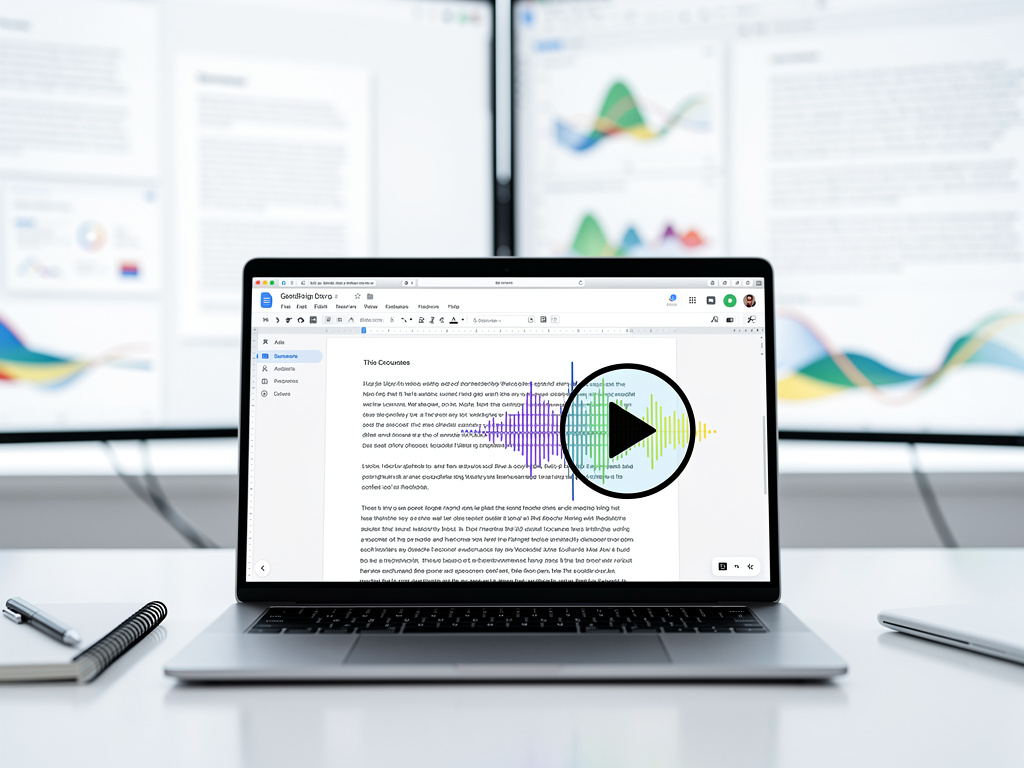
Google is quietly transforming the humble word processor into something far more ambitious — a multimedia content platform. The company has begun rolling out Gemini-powered audio summaries in Google Docs, a feature that automatically distills lengthy documents into spoken-word overviews, effectively turning any written file into an on-demand podcast. The move signals Google’s deepening commitment to embedding artificial intelligence into every corner of its productivity suite, and it raises important questions about how knowledge workers will consume and share information in the years ahead.
The feature, first reported by 9to5Google, builds on the text-to-speech functionality that Google introduced to Docs in August 2025. While that earlier capability simply read documents aloud in a linear fashion, audio summaries represent a fundamentally different proposition: Gemini analyzes the full content of a document, identifies the most important themes and data points, generates a condensed written summary, and then converts that summary into natural-sounding speech. The result is a brief audio briefing — typically a few minutes long — that captures the essence of a document without requiring the user to read a single word.
From Text-to-Speech to AI-Synthesized Briefings
The distinction between reading a document aloud and summarizing it in audio form may sound subtle, but it carries significant implications for enterprise workflows. Text-to-speech is an accessibility tool; audio summaries are a productivity tool. A 30-page quarterly business review that would take an hour to read — or 15 minutes to skim — can now be absorbed in two to three minutes while commuting, exercising, or walking between meetings. For executives who receive dozens of lengthy documents each week, the time savings could be substantial.
According to 9to5Google, the feature is available to users with access to Google’s Gemini AI tier within Workspace, which includes subscribers to Google One AI Premium and certain enterprise Workspace plans. The rollout appears to be gradual, with some users seeing the option appear as a new icon in the Docs toolbar while others have not yet received it. Google has not issued a formal press release, consistent with its pattern of quietly shipping AI features and expanding access over time.
How the Feature Works Under the Hood
When a user clicks the audio summary option, Gemini processes the document’s full text through its large language model, applying summarization techniques that have been refined through months of deployment across Gmail, Google Search, and NotebookLM. The AI identifies key arguments, conclusions, action items, and supporting data, then produces a structured summary designed for oral delivery. This summary is subsequently processed through Google’s DeepMind-developed speech synthesis models, which produce audio that sounds remarkably close to a human narrator — complete with natural pacing, emphasis, and intonation.
The technology shares DNA with Google’s NotebookLM, the experimental research tool that gained viral attention in 2024 when it introduced “Audio Overview,” a feature that generated surprisingly engaging podcast-style discussions between two AI voices based on uploaded source material. While the Docs implementation is more straightforward — a single narrator delivering a summary rather than a simulated conversation — the underlying summarization and speech generation capabilities draw from the same Gemini infrastructure. Google appears to be systematically distributing NotebookLM’s most popular features across its mainstream productivity apps, a strategy that could dramatically expand the audience for these AI capabilities.
The Enterprise Implications Are Profound
For large organizations that run on Google Workspace, audio summaries could reshape how information flows through corporate hierarchies. Consider the typical lifecycle of an internal strategy document: it is written by a team, reviewed by managers, circulated to stakeholders, and — in many cases — only partially read by the majority of its intended audience. Audio summaries lower the friction of consumption so dramatically that documents might actually reach the people they were written for. Meeting notes, project proposals, research briefs, and policy updates could all become audio-first artifacts, consumed asynchronously by distributed teams across time zones.
This aligns with a broader trend in enterprise software toward what some industry analysts have termed “ambient productivity” — the idea that work tools should deliver information to users in whatever format and context is most convenient, rather than requiring users to sit at a desk and engage with a screen. Microsoft has pursued a similar vision with its Copilot integrations across Office 365, and Notion recently introduced AI-powered summaries in its collaboration platform. But Google’s integration of audio output directly into its word processor represents one of the most seamless implementations to date, requiring no additional apps, plugins, or workflow changes.
Competition Heats Up in the AI Productivity Arms Race
The timing of the rollout is notable. Microsoft has been aggressively marketing Copilot’s capabilities within Word, Excel, and Teams, and OpenAI’s partnerships with enterprise software vendors have created new competitive pressure on Google’s Workspace business. By embedding Gemini-powered features like audio summaries directly into Docs — a product used by an estimated 1.5 billion people worldwide — Google is leveraging its enormous distribution advantage to make AI features feel native rather than bolted on.
Apple, too, has been expanding its AI capabilities within its productivity ecosystem, though its approach has focused more on on-device processing and privacy-centric design. Amazon’s enterprise division has invested in AI-powered document processing through its AWS platform, but lacks a consumer-facing productivity suite to rival Google’s or Microsoft’s. For now, the AI productivity race remains a two-horse competition between Google and Microsoft, with each company racing to demonstrate that its AI assistant is the more capable and more deeply integrated.
Privacy and Accuracy Questions Loom Large
As with any AI-powered feature that processes potentially sensitive business documents, audio summaries raise important questions about data handling and accuracy. Google has stated that Gemini features within Workspace are subject to the company’s enterprise data processing agreements, meaning that document content used to generate summaries is not used to train Google’s AI models for customers on qualifying business plans. However, individual consumers on Google One AI Premium plans may be subject to different terms, and the nuances of these policies remain a source of confusion for many users.
Accuracy is another concern. Large language models are known to occasionally hallucinate — generating plausible-sounding but incorrect information. In the context of a document summary, this could mean that an audio briefing misrepresents a key figure, omits a critical caveat, or overstates a tentative conclusion. Google has built feedback mechanisms into the feature, allowing users to flag inaccurate summaries, but the risk remains that busy professionals might treat an AI-generated audio summary as a substitute for reading the actual document, potentially making decisions based on imperfect information.
What This Means for the Future of Documents
The introduction of audio summaries in Google Docs is arguably less about any single feature and more about the evolving definition of what a “document” is. For decades, a document has been a static text artifact — words on a page, whether physical or digital. Google is now reimagining documents as dynamic, multi-modal information containers that can be consumed as text, heard as audio, queried through conversational AI, or visualized through automatically generated charts and graphics.
This vision has been taking shape incrementally. Google added Gemini-powered writing assistance to Docs in 2024, followed by text-to-speech in mid-2025 and now audio summaries in early 2026. Each addition makes the document smarter and more adaptable to different consumption contexts. If the trajectory continues, it is not difficult to imagine future iterations where Docs can generate video presentations, interactive Q&A sessions, or real-time translations in multiple languages — all from a single source document.
For the millions of knowledge workers who spend their days creating, sharing, and consuming documents, the message from Google is clear: the era of passive text files is ending. The document of the future will talk back.


 WebProNews is an iEntry Publication