
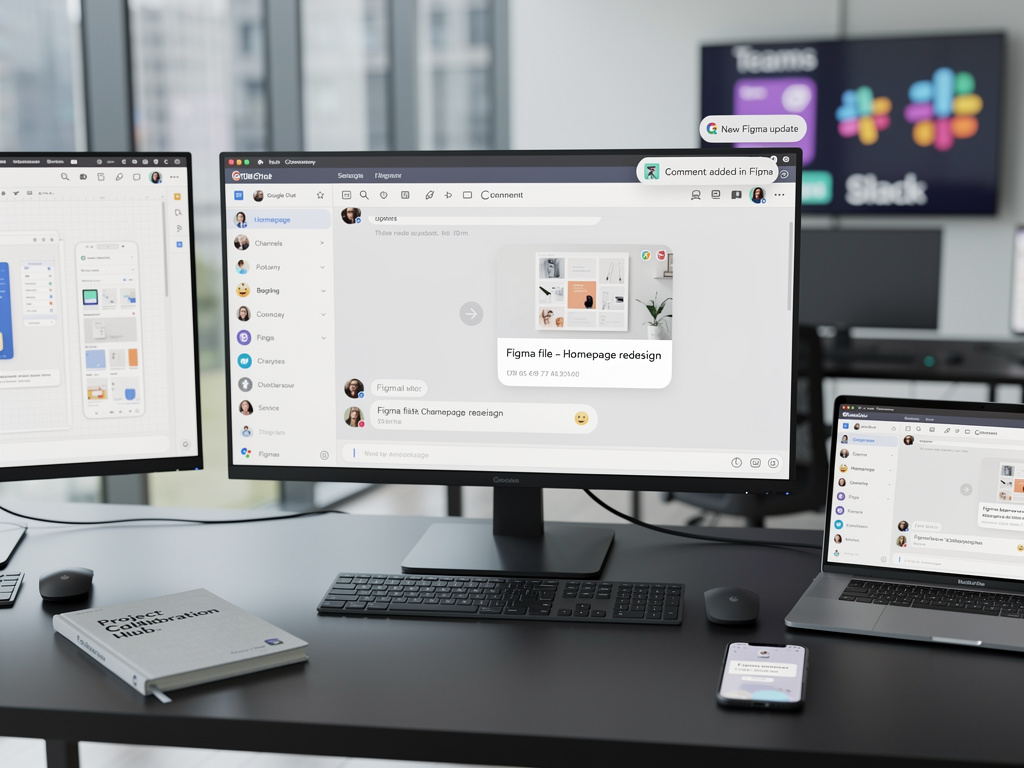
In the ever-intensifying battle for enterprise productivity dominance, Google is making a calculated move to transform its Chat platform from a simple messaging tool into a centralized command center for workplace collaboration. The company has quietly begun rolling out a native Figma integration within Google Chat, allowing design teams to receive real-time notifications, preview files, and interact with Figma content without ever leaving the messaging interface.
The integration, first spotted and reported by Android Authority, represents more than a mere convenience feature. It is the latest in a series of third-party integrations that Google has been weaving into Chat, and it underscores a strategic imperative: if Google Workspace is to compete meaningfully with Microsoft Teams and Slack, Chat must become the connective tissue that binds disparate enterprise tools together.
What the Figma Integration Actually Does
According to the reporting from Android Authority, the Figma integration for Google Chat enables users to receive notifications directly within Chat when activity occurs in their Figma projects. This includes alerts for comments, file updates, and other collaborative actions that would typically require switching to Figma’s own notification system or relying on email alerts.
Perhaps more significantly, the integration supports rich link previews. When a user shares a Figma link in a Google Chat conversation, the platform automatically generates a visual preview of the design file, complete with relevant metadata. This means team members can quickly assess the state of a design without clicking through to Figma itself — a small but meaningful reduction in context-switching that, multiplied across thousands of daily interactions in a large organization, can translate into measurable productivity gains.
The Context-Switching Tax and Google’s Answer
The cost of context-switching in modern knowledge work has been well documented. Research from the University of California, Irvine has suggested that it takes an average of 23 minutes to return to full focus after an interruption. In design-heavy workflows, where teams routinely toggle between messaging platforms, design tools, project management software, and documentation systems, the cumulative cognitive toll is substantial.
Google appears to be acutely aware of this problem. Over the past 18 months, the company has steadily expanded the roster of third-party applications that integrate natively with Google Chat. The Figma addition joins existing integrations with tools like Asana, Jira, Workday, and others that allow enterprise teams to manage workflows from within the Chat interface. Each new integration strengthens the argument that Google Chat can serve as a single pane of glass for workplace activity — a proposition that has been central to Slack’s value pitch for years and that Microsoft Teams has aggressively pursued through its own app ecosystem.
Why Figma Matters More Than Most Integrations
Figma occupies a unique and increasingly important position in the enterprise software stack. Since its acquisition by Adobe — a deal that was ultimately abandoned in late 2023 after regulatory resistance — Figma has continued to operate independently and has expanded its reach well beyond traditional UI/UX design. The platform is now used for brainstorming, wireframing, prototyping, and even slide deck creation through its FigJam whiteboarding tool, making it relevant to product managers, marketers, and executives, not just designers.
By integrating Figma into Google Chat, Google is effectively acknowledging that design collaboration has become a cross-functional activity. The notifications and previews aren’t just for the design team; they’re for the product manager who needs to approve a layout, the engineer who needs to understand a component’s behavior, and the marketing lead who wants to review brand assets. This cross-functional utility makes the Figma integration particularly valuable as a demonstration of Google Chat’s ambitions.
Google Workspace’s Competitive Position
Google Workspace has long held a strong position in certain enterprise segments, particularly among startups, digital-native companies, and educational institutions. But in the broader enterprise market — especially among Fortune 500 companies — Microsoft 365 and its Teams platform remain the dominant force. According to recent estimates from Gartner and other analyst firms, Microsoft Teams boasts over 320 million monthly active users, a figure that dwarfs Google Chat’s user base.
Google has been working to close this gap through a combination of AI-powered features — most notably its Gemini AI assistant, which has been integrated across Workspace products — and by deepening the integration ecosystem within Chat. The company’s strategy appears to be one of differentiation through openness: rather than trying to replicate every feature of every enterprise tool within its own ecosystem, Google is building bridges to the tools that teams already use.
The Slack Parallel and Lessons Learned
Google’s approach with Chat integrations bears a striking resemblance to the playbook that Slack pioneered. Slack built its early enterprise traction in large part on the strength of its integration marketplace, which allowed teams to pipe notifications and workflows from hundreds of third-party tools into Slack channels. The strategy transformed Slack from a chat app into what its founders called “the operating system for work.”
Salesforce’s acquisition of Slack in 2021 for $27.7 billion was, in many ways, a bet on this integration-centric model of enterprise collaboration. However, Slack’s growth has faced headwinds in the post-acquisition period, as Salesforce has worked to integrate the platform into its broader Customer 360 ecosystem. This has created an opening for both Google Chat and Microsoft Teams to capture teams that are evaluating their collaboration stack.
How the Integration Fits Into Google’s AI Ambitions
It is impossible to discuss Google’s Workspace strategy without addressing the role of artificial intelligence. Google has been aggressively embedding its Gemini AI models across Workspace, offering features like AI-powered email drafting in Gmail, smart summaries in Google Docs, and automated meeting notes in Google Meet. In Google Chat specifically, Gemini can summarize conversation threads, suggest responses, and help users find information across their Chat history.
The addition of rich third-party integrations like Figma creates new surface area for AI to add value. One can envision a near-future scenario where a user asks Gemini in Google Chat to summarize the latest design feedback on a Figma file, or to identify which design iterations received the most comments. By combining integration data with AI capabilities, Google could create a collaboration experience that is not just centralized but genuinely intelligent — one that proactively surfaces relevant information rather than requiring users to hunt for it.
What Enterprise IT Leaders Should Watch
For enterprise IT decision-makers, the Figma integration is a signal worth paying attention to — not because of its standalone impact, but because of what it reveals about Google’s trajectory. The company is clearly investing in making Google Chat a more capable and extensible platform, and the pace of new integrations suggests that more are on the way.
The key question for IT leaders is whether Google can build an integration ecosystem that is deep enough and reliable enough to compete with the entrenched positions of Microsoft Teams and Slack. Breadth of integrations is one thing; depth — meaning the ability to take meaningful actions within the integrated tool from within Chat, rather than just receiving notifications — is another. The Figma integration, with its rich previews and notification support, suggests that Google is aiming for the latter.
The Road Ahead for Google Chat
Google’s track record with messaging products has been, to put it diplomatically, inconsistent. The company has launched and shuttered numerous messaging platforms over the years, from Google Talk to Allo to Hangouts, creating a credibility gap with enterprise customers who need assurance that the tools they adopt will be supported for the long term. Google Chat, which emerged from the rebranding and repositioning of Hangouts Chat, has so far avoided this fate, but the shadow of Google’s messaging history lingers.
The Figma integration, and the broader integration strategy it represents, is Google’s way of building stickiness into Chat — making it so embedded in daily workflows that abandoning it would be costly and disruptive. If Google can continue to add high-value integrations at a steady clip while layering on AI capabilities that make those integrations more powerful, it has a genuine shot at reshaping how enterprise teams think about their collaboration hub. The design community, which has long been a bellwether for broader technology adoption trends, may be among the first to put that proposition to the test.


 WebProNews is an iEntry Publication