
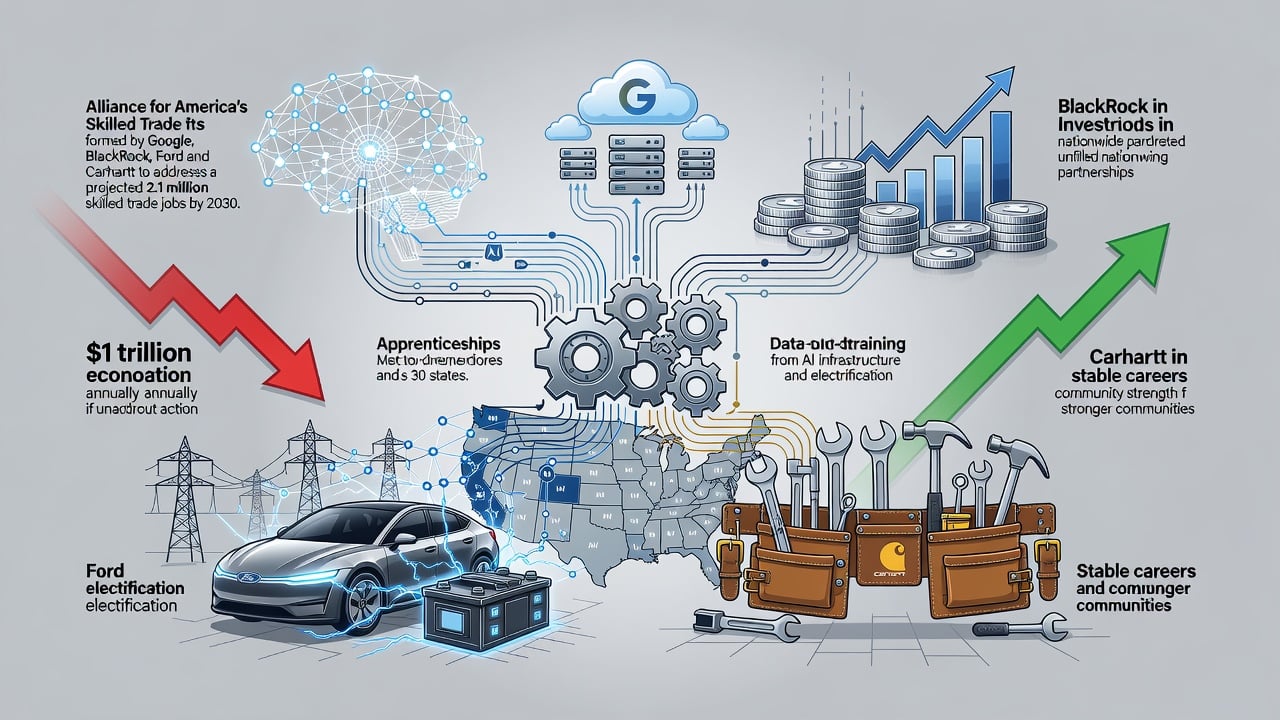
Two point one million jobs. That figure looms large. By 2030, skilled trades positions across the U.S. risk going unfilled. Electricians. Auto technicians. Builders. The shortfall hits infrastructure, manufacturing and the data centers powering artificial intelligence.
Today four major players announced a joint push to change that. Google. BlackRock. Ford Motor Company. Carhartt. They formed the Alliance for America’s Skilled Trades. The group starts with training programs in 30 states. Its stated aim? Expand nationwide. Fill hundreds of thousands of open roles. Create pathways that deliver stable pay and transferable skills.
The Scale of the Shortage
The numbers come from multiple analyses. JLL research, cited in Fortune, projects potential annual economic losses near $1 trillion if the gap persists. Last year alone nearly 600,000 skilled trades jobs were posted while only about 150,000 new workers entered via apprenticeships. For every five veterans who retire in construction or manufacturing, just two replacements step in.
Specific gaps tell the story. An estimated 130,000 more electrical workers needed by 2030. More than 350,000 new auto technicians required by 2029. Demand surges from electrification, infrastructure renewal and AI-driven data center construction. Supply shrinks as workers age out. Forty percent of the roughly 12 million people in skilled trades are already over 45. Many approach retirement.
Yet wages rise. Openings multiply. And attitudes shift. Enrollment in undergraduate certificates and associate degrees grew about 2% in fall 2025. Bachelor’s programs rose less than 1%, per the National Student Clearinghouse Research Center. A Lumina Foundation and Gallup poll shows confidence in four-year degrees slipping while two-year options gain favor. “A four-year degree is still the gold standard,” said Courtney Brown, chief data and research officer for the Lumina Foundation. “Community colleges are doing really well with affordability and value. More people gravitate towards that.”
The Alliance builds on earlier individual efforts. Google had committed to train more than 300,000 American workers for high-paying careers, as outlined in its official announcement. Ford, Carhartt and BlackRock pursued their own workforce initiatives. Now they combine forces. Three priorities guide the work: expand the pipeline of interested candidates, scale training models backed by evidence, and recruit additional partners from unions, nonprofits and educators.
Ruth Porat, president and chief investment officer of Alphabet and Google, put it plainly in the joint op-ed published by Fortune. “Building the physical infrastructure for America’s future requires significantly increasing the pipeline of skilled tradespeople across the country — a challenge that can only be addressed with collective action.”
Bayo Ogunlesi, chairman and chief executive officer of Global Infrastructure Partners at BlackRock, echoed the sentiment. “Investment in America’s infrastructure will help shape the country’s long-term economic trajectory, but its success ultimately depends on the skilled workforce that brings these projects to life. Expanding that talent pipeline requires long-term commitment and partnership across sectors.”
Their op-ed, co-authored with Jim Farley, CEO of Ford Motor Company, and Linda Hubbard, president and CEO of Carhartt, frames skilled trades as foundational to American growth. “Skilled workers laid the infrastructure for America,” they wrote. “Today, as our nation looks to the next 250 years, there is an opportunity to build a new era of economic productivity and innovation that benefits generations of working Americans.”
Apprenticeships sit at the center. Participants earn while they learn. They gain mentorship without accumulating college debt. The Alliance plans to co-fund a Skilled Trades Report with Burning Glass Institute and Jobs for the Future. That document will track gaps, measure progress and spread best practices. Data, not anecdotes, will drive decisions.
Reactions on X poured in quickly after the July 21 announcement. BlackRock’s own post highlighted the investment angle: “Investing in the skilled trades is an investment in America’s future.” CNBC’s coverage amplified the news, noting how AI fears accelerate interest in hands-on careers that machines cannot easily replace. One user called it “bullish” for the companies involved. Another asked about average starting wages across those 30 states. Practical questions persist even amid the optimism.
Context matters. Data centers proliferate to support AI. Aging commercial buildings need upgrades. Manufacturing evolves toward electrification. Each trend demands electricians, HVAC technicians, plumbers and welders. Paul Morgan, global chief operating officer of real estate management services at JLL, warned in an April research note that the shortage “threatens how we power our data centers, cool our laboratories, secure our manufacturing facilities and maintain the spaces where millions of Americans work every day.”
The Alliance does not pretend to solve everything alone. It invites unions, trade associations, community colleges and corporations to join. Its aspiration remains explicit: grow training opportunities for skilled roles across the entire country. Success will show in higher enrollment, completed apprenticeships and filled positions.
Change at the kitchen table. That phrase appears in the founding document. Parents and counselors must see trades as viable, respected paths. Students and mid-career adults need clear on-ramps. Employers must offer sustained training rather than poaching already-skilled workers.
Google’s involvement ties directly to its data center footprint and broader workforce commitments. Ford needs technicians for electric vehicles and advanced manufacturing. Carhartt supplies the durable clothing tradespeople wear; its stake reflects deep industry relationships. BlackRock, through infrastructure investing, understands the capital projects that depend on human hands.
Critics might wonder if four large entities can shift cultural perceptions built over decades. College-for-all messaging dominated for years. Vocational education sometimes carried stigma. Reversing that requires more than press releases. It demands sustained funding, visible success stories and policy support at state and federal levels.
Still. The timing feels urgent. Enrollment trends already bend toward shorter, career-focused programs. Wages in trades outpace inflation in many regions. And the infrastructure bills passed in recent years will only increase demand.
So the Alliance launches at a moment of genuine need. Two point one million jobs. Hundreds of thousands of opportunities for workers and families. The question now becomes execution. Will the evidence-based approaches scale? Can partnerships multiply impact beyond the initial 30 states? Answers will emerge over the next several years. For now, four influential organizations have placed a sizable bet on American tradespeople. The rest of the economy watches closely.


 WebProNews is an iEntry Publication