
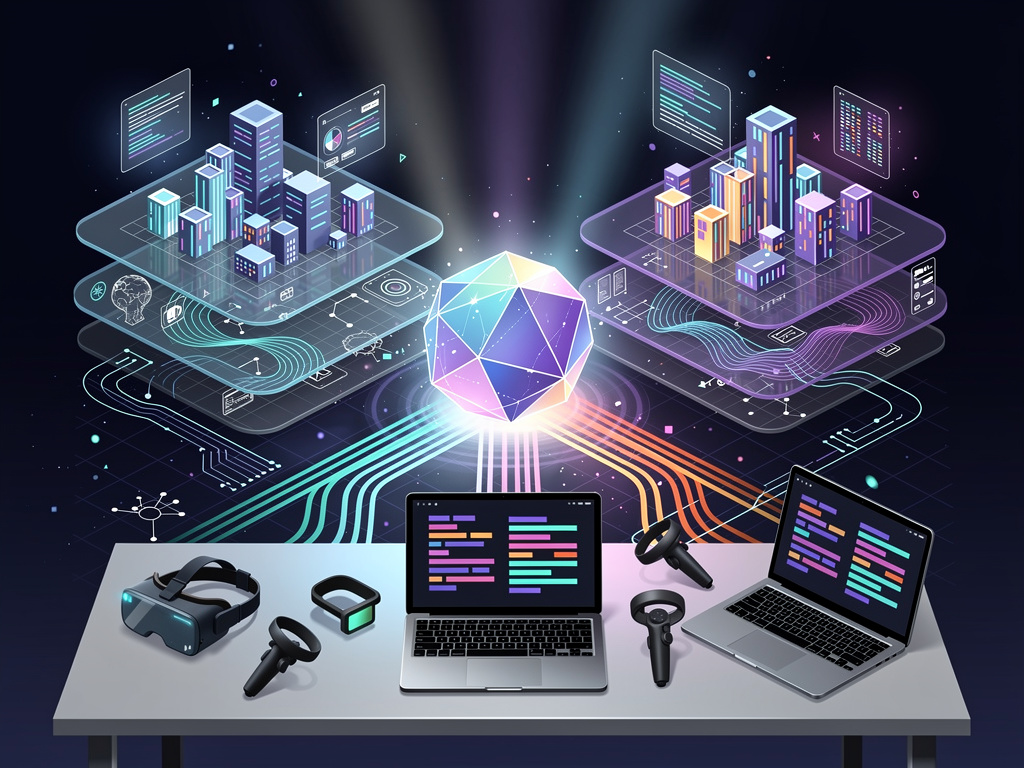
Google is making a calculated play to position its Gemini AI as the backbone of two converging trends: AI-assisted software development and extended reality applications. The strategy, laid out across recent product announcements and developer-focused updates, signals that Google sees a future where writing code by conversation and building immersive 3D experiences aren’t separate ambitions — they’re the same one.
The company’s moves come at a time when the so-called “vibe coding” phenomenon — where developers describe what they want in natural language and let AI generate the underlying software — has graduated from novelty to genuine workflow. Google wants Gemini at the center of it.
Gemini’s Expanding Ambitions in AI-Assisted Development
As Android Authority reported, Google has been steadily expanding Gemini’s capabilities in ways that directly target developers building applications across platforms, including extended reality. The integration isn’t superficial. Google is embedding Gemini into its core developer tools, making AI code generation a first-class feature rather than an afterthought bolted onto existing products.
Vibe coding itself is a term that’s gained traction rapidly. The concept is simple: instead of writing every line of code manually, a developer describes the desired functionality, UI behavior, or logic flow in plain English (or any language), and the AI model produces working code. Think of it as pair programming where your partner has memorized every API reference ever written but still needs your architectural judgment.
Google’s approach with Gemini goes beyond basic code completion. The model is being trained and tuned to handle multi-step reasoning about software projects — understanding not just what a single function should do, but how it fits into a larger application structure. For XR development specifically, this matters enormously. Building 3D environments, handling spatial input, managing rendering pipelines — these are domains where boilerplate is abundant and expertise is scarce. Exactly the kind of territory where AI assistance can compress development timelines from months to weeks.
And Google isn’t alone in recognizing this. Microsoft’s GitHub Copilot, powered by OpenAI’s models, has been the incumbent in AI coding tools. Anthropic’s Claude has attracted a devoted following among developers who prefer its reasoning style for complex programming tasks. But Google has a structural advantage that neither competitor can easily replicate: it controls Android, it controls Chrome, and it’s building its own XR platform ambitions on top of Android. Vertical integration from AI model to operating system to hardware reference designs gives Google a path to optimization that pure-play AI companies can’t match.
The XR angle is particularly telling. Meta dominates the current VR/AR headset market with Quest devices. Apple entered with Vision Pro, targeting the high end. Google, after its early and somewhat painful experience with Google Glass, has been more cautious this time around. But the company has been quietly building Android XR, a version of its mobile operating system designed for headsets and spatial computing devices. Samsung is expected to be a key hardware partner.
Here’s where the pieces connect. Developing for XR platforms is notoriously difficult. The talent pool is thin. The tooling has historically been fragmented across Unity, Unreal Engine, and various proprietary SDKs. If Google can make Gemini good enough at generating XR application code — handling 3D scene construction, spatial anchoring, gesture recognition, and the dozens of other XR-specific programming challenges — it dramatically lowers the barrier to entry for developers considering the platform.
That’s not altruism. It’s platform strategy.
A platform with no apps is a paperweight. Google learned this lesson with several previous hardware efforts. By investing in AI tools that make it easier to build for Android XR, the company is effectively subsidizing its own app catalog before the hardware even ships at scale.
The Competitive Pressure and What’s Actually at Stake
The broader context matters here. The AI coding tools market is growing at a pace that has attracted serious venture capital and corporate investment. According to recent industry analyses, AI-assisted development tools are expected to become standard in professional software engineering workflows within the next two to three years. Not optional add-ons. Standard.
Google’s Gemini 2.5 models have shown strong performance on coding benchmarks, and the company has been aggressive about making them available through Google AI Studio and the Gemini API. The strategy appears to be: get developers building with Gemini now, across every type of application, so that when Android XR devices hit the market, there’s already a community fluent in using Google’s AI tools for spatial computing.
So what does this mean practically? A few things.
First, expect Google to continue tightening the integration between Gemini and Android Studio, its primary IDE for Android development. XR-specific templates, AI-generated 3D asset suggestions, and natural-language scene description tools are all logical next steps. Some of these capabilities have already been previewed in developer sessions.
Second, the competitive dynamics between Google, Apple, and Meta in XR are going to be shaped as much by developer tools as by hardware specs. Apple’s Xcode and RealityKit offer a polished but closed development environment. Meta has invested heavily in its own SDK and has partnered with Unity. Google’s bet is that AI-powered development tools will be the differentiator — that making it radically easier to build XR apps will attract the long tail of developers who wouldn’t otherwise bother learning spatial computing frameworks.
Third, and perhaps most importantly for the industry, vibe coding for XR could accelerate the creation of spatial applications in categories that have been underserved. Enterprise training, medical visualization, architectural walkthroughs, education — these are areas where the demand for XR content exists but the development cost has been prohibitive. If a subject matter expert with moderate coding skills can describe a training simulation in natural language and have Gemini generate a working prototype, the economics of XR content creation change fundamentally.
But there are real limitations to acknowledge. AI-generated code still requires human review, especially in performance-sensitive XR applications where frame rate drops cause literal nausea. Gemini’s ability to reason about 3D spatial relationships and real-time rendering constraints is improving but not yet reliable enough for production-grade applications without significant human oversight. The “vibe” in vibe coding can carry you through a prototype. Shipping a polished product still demands traditional engineering discipline.
Google knows this. The company has been careful to position Gemini as an accelerator for developers rather than a replacement. The messaging emphasizes productivity gains and creative exploration, not the elimination of engineering roles. Smart positioning, given the sensitivity around AI and employment in the tech sector right now.
Where This Goes From Here
The convergence of generative AI and spatial computing is still early. Very early. But the infrastructure investments being made today — by Google, by Meta, by Apple, by Microsoft — will determine which companies control the developer platforms of the next decade. Google’s decision to tie Gemini’s advancement directly to its XR strategy is a bet that the next major computing platform won’t be won by hardware alone. It’ll be won by whoever makes building for it the least painful.
That’s a lesson the mobile era taught clearly. Android didn’t win on hardware elegance. It won on openness, tooling, and sheer developer momentum. Google appears to be running the same playbook, updated for an era where the most powerful tool you can hand a developer isn’t a better IDE. It’s an AI that understands what they’re trying to build.
Whether Gemini can deliver on that promise at the quality level XR demands remains an open question. The ambition, though, is unmistakable. And in a race where Apple has the design advantage and Meta has the installed base advantage, Google is betting that the AI advantage will be the one that matters most.
Time will tell. But the pieces are moving fast.


 WebProNews is an iEntry Publication