
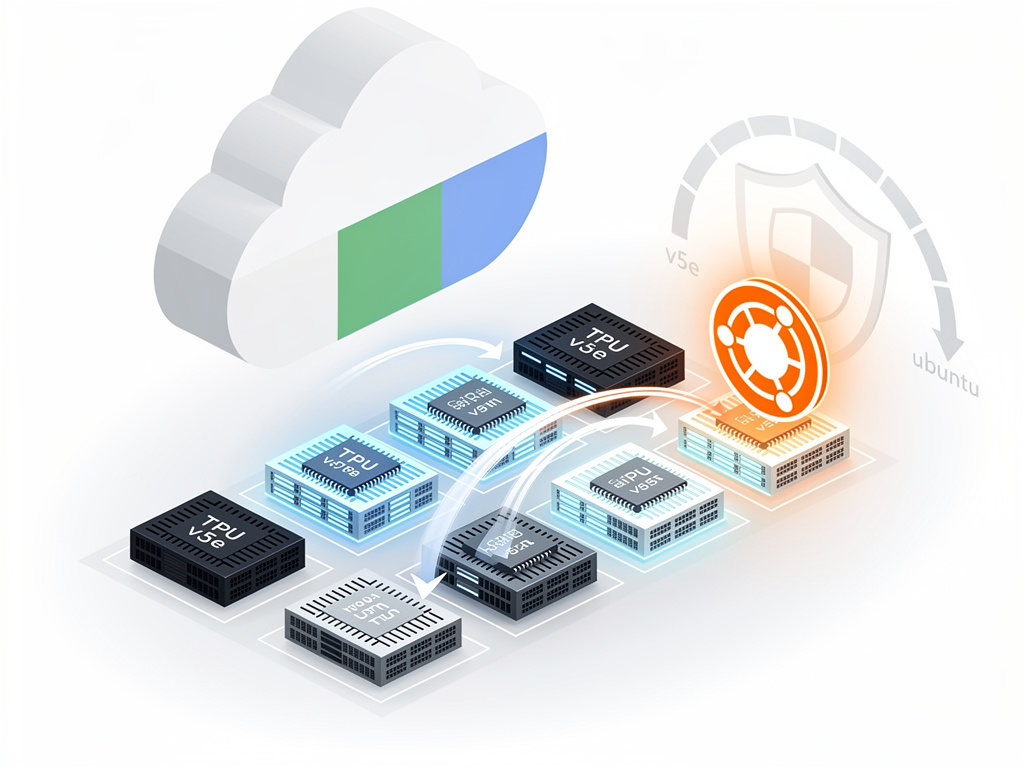
Google Cloud customers launching Tensor Processing Unit virtual machines now get Canonical-certified Ubuntu images by default. The change, announced May 28, 2026, covers TPU models from the v5e introduced in 2023 through the latest v6e, v5p and TPU7x variants.
Upstream shift ends custom builds.
Prior to this release, users on TPU v5 and v6 instances ran a modified version of Ubuntu 22.04 managed directly by Google. Hugo Huang, Canonical’s public cloud alliance director, told The Register that those instances now run Canonical-certified and supported Ubuntu 22.04 LTS releases. Compatibility with existing production setups remains intact. Migration, Huang explained, should occur without workload interruption. TPU7x instances will use Ubuntu 24.04 LTS instead. Both 22.04 and 24.04 LTS releases received testing across the three TPU generations. Customers gain flexibility to match the distribution to specific workload demands.
The announcement arrived via a Canonical blog post. “Ubuntu LTS gives enterprises the stable, secure foundation they need to move AI workloads from experimentation into production on Google’s most advanced accelerator hardware,” Huang stated in an email to The Register. “This launch makes Cloud TPU as accessible as any other VM on Google Cloud — same console, same experience, backed by up to 15 years of Canonical security maintenance and support commitment.”
Canonical worked directly with Google engineers. The certified images integrate with standard machine learning tools already present in TPU VMs. JAX, PyTorch and TensorFlow run as expected. So do orchestration layers such as Kubernetes and package management through Snap. These builds qualify as long-term support releases. They carry five years of standard security maintenance. That timeline matches typical Ubuntu LTS commitments and provides predictability for teams running long training jobs.
But the story runs deeper than default images. It reflects a deliberate return of responsibility to the upstream provider. Google previously invested engineering effort to adapt Ubuntu for its specialized TPU hardware. Now Canonical assumes ownership of certification, testing and ongoing support. The arrangement frees Google teams to focus on silicon innovation while Canonical handles the operating system layer. Enterprises benefit from a single throat to choke for OS-level issues. They also inherit Ubuntu’s broad package ecosystem without the friction of custom distributions.
TPU VMs themselves simplify AI infrastructure. Developers gain root access on instances that attach directly to Google’s custom accelerators. No more wrestling with network-attached TPU slices for many workloads. The v5e brought cost-efficient training and inference at scale. Later generations added SparseCores, improved interconnects and higher energy efficiency. Trillium, also known as v6, delivered 4.7 times higher peak compute performance per chip than v5e along with 67 percent better energy efficiency, according to Google Cloud documentation. TPU7x, referred to internally as Ironwood, extends that trajectory toward the demands of agentic AI systems that mix general compute with accelerated inference.
Canonical’s blog post emphasized operational consistency. Platform and MLOps teams can apply familiar tools for monitoring, automation and configuration. The lightweight Ubuntu footprint reduces overhead so more cycles reach the models themselves. When paired with Google’s carbon-free energy operations in data centers, the combination supports sustainability goals that increasingly appear in enterprise RFPs. “This new release brings the stability, security, and expansive ecosystem of Ubuntu to Cloud TPU virtual machines on Google Cloud,” the Canonical announcement stated. It positions the images as a bridge between experimental model work and production deployment at scale.
Security enhancements arrive in stages. Ubuntu Pro, already available on Google Compute Engine, will extend to TPU VMs during Q3 2026. The premium offering adds live kernel patching without reboots, a feature particularly valuable for long-running training jobs that cannot tolerate downtime. Expanded Security Maintenance will cover more than 30,000 open-source packages for up to 15 years when customers choose the Legacy add-on. Huang noted that organizations seeking early Ubuntu Pro access on TPU instances can contact Canonical sales or their Google Cloud account team directly.
The collaboration builds on years of joint work. Canonical previously optimized Ubuntu for Google’s Arm-based Tau T2A VMs and delivered Ubuntu Pro images across Google Cloud. This TPU effort completes the picture for accelerated workloads. It also arrives at a moment when hyperscalers race to capture AI infrastructure spending. Google promotes its TPU lineup as a cost-effective alternative to GPU clusters for certain model architectures, especially those built around JAX. Certified Ubuntu support removes one more adoption barrier for conservative enterprises that standardize on the distribution.
Getting started requires little more than a modified gcloud command. Users specify the ubuntu-os-accelerator-images project and select an appropriate TPU machine type and zone. The instance launches with a preinstalled, certified image that mirrors the experience of spinning up any other Compute Engine VM. That simplicity matters. Teams already proficient with Ubuntu tooling on CPU or GPU instances face no new learning curve when they add TPU capacity.
Yet questions remain about performance tuning. The blog post from Canonical highlighted validation of key frameworks but offered no side-by-side benchmarks against the prior custom images. Huang’s comments to The Register stressed compatibility and zero-disruption migration. Real-world gains may surface first in reduced support tickets and easier compliance audits rather than raw throughput. For organizations already running large TPU fleets, the immediate value lies in predictable patching cadences and a clearer division of responsibility between Google and Canonical.
Recent coverage reinforces the announcement’s timing. The Register article published hours after the Canonical blog provided the most detailed third-party analysis available as of May 29. No competing hyperscaler has announced equivalent certification for its AI accelerators on Ubuntu in the past week. The move appears strategic. It strengthens Google’s position in enterprise AI while giving Canonical a prominent win in the accelerated computing segment.
Enterprises evaluating AI infrastructure now have another data point. Certified Ubuntu on TPU VMs offers the familiarity of a distribution that powers everything from developer laptops to supercomputers. It pairs that comfort with direct access to Google’s latest Ironwood silicon. The combination could accelerate production deployments that previously stalled on operating system concerns. And for teams already invested in the Google Cloud AI Hypercomputer vision, the default images remove one more integration step.
The partnership signals maturity. Custom silicon and open source operating systems no longer exist in separate silos. Instead they converge through deliberate engineering collaboration. Google handles the accelerators. Canonical handles the OS. Customers receive a tighter, more supportable stack. That outcome, more than any single benchmark number, may prove the announcement’s lasting impact.


 WebProNews is an iEntry Publication