
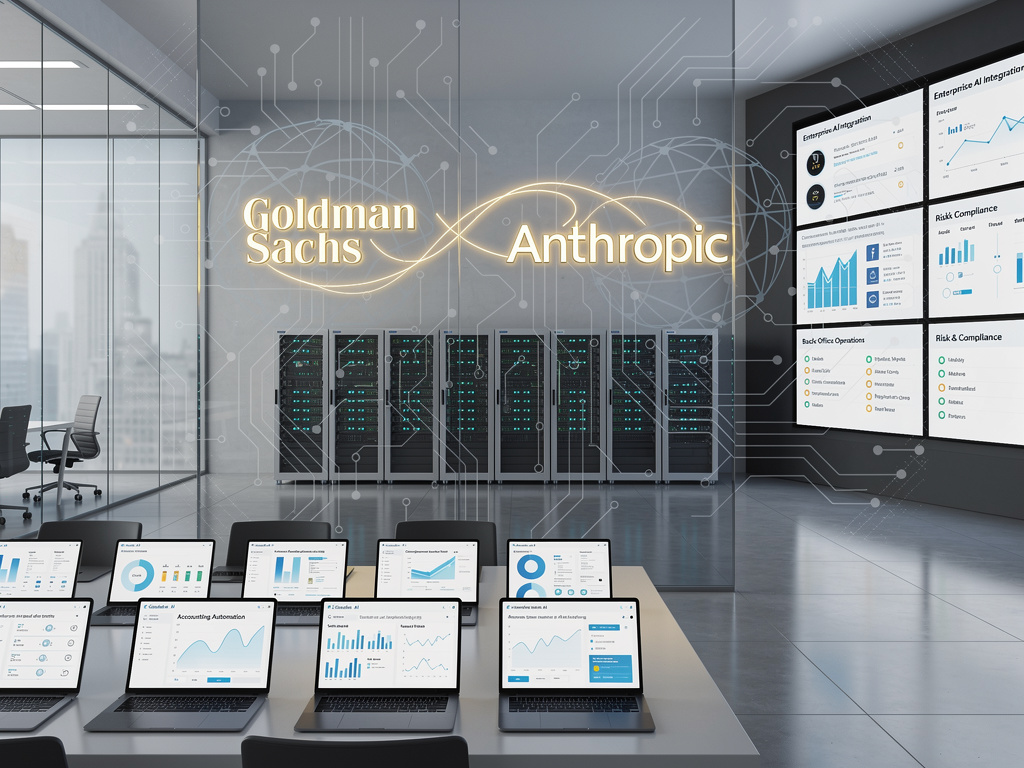
In what may prove to be one of the most consequential partnerships between a major Wall Street bank and an artificial intelligence company, Goldman Sachs has announced a sweeping deal with Anthropic to deploy the AI startup’s Claude model across its accounting and compliance operations. The move signals a dramatic acceleration in how the financial services industry is embracing generative AI — not merely as a productivity tool for front-office traders and bankers, but as a fundamental replacement for labor-intensive back-office functions that have long employed thousands of professionals.
The partnership, reported by CNBC, represents one of the largest enterprise AI deployments in the banking sector to date. Goldman Sachs plans to integrate Anthropic’s Claude model into workflows that span regulatory compliance checks, financial statement reconciliation, audit preparation, and internal reporting — tasks that currently require armies of junior accountants, compliance officers, and analysts working around the clock to meet regulatory deadlines and internal controls requirements.
A Strategic Pivot Toward AI-First Operations
Goldman Sachs has long positioned itself as the most technologically forward-thinking institution on Wall Street. The firm famously declared years ago that it was a “technology company,” and its engineering headcount has at times rivaled that of major Silicon Valley firms. But the Anthropic deal marks a qualitative shift in ambition. Rather than building proprietary AI tools in-house — an approach Goldman has pursued aggressively with its own internal platforms — the bank is now looking to one of the most prominent AI startups in the world to supply the foundational intelligence layer for mission-critical financial operations.
The decision to partner with Anthropic, rather than rivals like OpenAI or Google DeepMind, is itself telling. Anthropic has cultivated a reputation for building AI systems with a strong emphasis on safety, interpretability, and reliability — qualities that are non-negotiable in a regulated financial environment where errors in compliance or accounting can result in billions of dollars in fines and reputational damage. Claude’s ability to process and reason over long documents, maintain context across complex multi-step workflows, and provide citations for its outputs appears to have been a decisive factor in Goldman’s selection process.
Inside the Back Office: Where AI Meets Regulatory Reality
To understand the magnitude of this partnership, it helps to appreciate the sheer scale and complexity of back-office operations at a firm like Goldman Sachs. The bank operates across dozens of legal entities in multiple jurisdictions, each subject to its own regulatory regime. Compliance teams must monitor an ever-expanding universe of rules from regulators including the Securities and Exchange Commission, the Federal Reserve, the Financial Conduct Authority in London, and the Monetary Authority of Singapore, among many others. The volume of regulatory change alone — new rules, amendments, guidance documents, and enforcement actions — runs into thousands of pages per year.
Accounting operations are similarly daunting. Goldman’s finance teams must reconcile millions of transactions daily, prepare financial statements under both U.S. GAAP and IFRS standards depending on the jurisdiction, and ensure that internal controls satisfy the requirements of the Sarbanes-Oxley Act. Much of this work has traditionally been performed by junior staff who manually review documents, cross-reference data across systems, and flag discrepancies for senior review. It is precisely this kind of repetitive, document-heavy, rules-based work that large language models like Claude are increasingly capable of performing at scale — and at a fraction of the cost.
The Economics of Automation: Billions at Stake
The financial implications of the deal are staggering. Goldman Sachs spends billions of dollars annually on its technology and operations infrastructure, a significant portion of which goes toward compensation for back-office personnel. While the bank has not disclosed specific cost-saving targets associated with the Anthropic partnership, industry analysts estimate that the automation of even a fraction of compliance and accounting workflows could yield hundreds of millions of dollars in annual savings. More importantly, AI-driven processes can operate continuously without fatigue, reducing the risk of human error that has historically been a major source of regulatory breaches and financial restatements.
The deal also has significant implications for Anthropic’s business trajectory. The San Francisco-based startup, founded by former OpenAI executives Dario and Daniela Amodei, has been aggressively pursuing enterprise customers as it seeks to justify a valuation that has soared into the tens of billions of dollars. Landing Goldman Sachs as a flagship client in the financial services sector provides Anthropic with a powerful reference case that could open doors at other major banks, asset managers, and insurance companies. According to CNBC, the partnership includes provisions for Goldman to provide feedback that will help Anthropic fine-tune Claude for financial services use cases, creating a virtuous cycle of improvement.
Workforce Disruption: The Elephant in the Room
Perhaps the most sensitive aspect of the Goldman-Anthropic partnership is its potential impact on employment. The back office of a major investment bank has long served as an entry point for tens of thousands of young professionals, many of whom use roles in accounting, compliance, and operations as stepping stones to more senior positions in finance. If AI can perform a substantial portion of these entry-level tasks, the pipeline of talent into the industry could be fundamentally altered.
Goldman Sachs has been careful to frame the partnership in terms of augmentation rather than replacement. Senior executives have emphasized that AI will handle routine, repetitive tasks, freeing human employees to focus on higher-value judgment calls, relationship management, and strategic decision-making. But this narrative, while reassuring, does not fully address the arithmetic. If an AI system can do the work of five junior compliance analysts, the firm does not need to hire five junior compliance analysts — regardless of how the remaining work is characterized. Industry observers expect that the net effect will be a meaningful reduction in back-office headcount over the next several years, even if the transition is managed gradually through attrition and redeployment rather than mass layoffs.
Regulatory Scrutiny and the Question of Trust
The deployment of AI in compliance and accounting functions will itself attract regulatory scrutiny. Financial regulators around the world have been grappling with how to oversee the use of AI in banking, and the prospect of a major institution delegating compliance checks to a machine learning model raises profound questions about accountability. If an AI system fails to flag a regulatory violation, who is responsible — the bank, the AI vendor, or the individual who relied on the system’s output?
Goldman and Anthropic appear to be anticipating these concerns. The partnership reportedly includes robust governance frameworks, including human-in-the-loop review processes for high-stakes decisions, comprehensive audit trails for AI-generated outputs, and regular model validation exercises to ensure that Claude’s performance does not degrade over time or develop blind spots. Anthropic’s emphasis on AI safety and its development of constitutional AI techniques — which aim to make models more transparent and controllable — is likely a key reason Goldman chose the startup over competitors whose models may be more powerful in raw benchmarks but less interpretable in practice.
The Competitive Ripple Effect Across Wall Street
Goldman’s move is almost certain to accelerate AI adoption across the financial services industry. JPMorgan Chase, Morgan Stanley, Bank of America, and Citigroup have all been investing heavily in AI capabilities, but none has announced a partnership of this scope with a leading AI lab. The competitive pressure to match Goldman’s efficiency gains could trigger a wave of similar deals, potentially benefiting not only Anthropic but also OpenAI, Google, and other AI providers vying for enterprise contracts in finance.
The broader implications extend beyond banking. The accounting and compliance functions that Goldman is automating exist in virtually every large corporation, from pharmaceutical companies to energy firms to technology conglomerates. If the Goldman-Anthropic partnership proves successful, it could serve as a template for AI-driven transformation of back-office operations across the entire corporate world. The Big Four accounting firms — Deloitte, PwC, EY, and KPMG — which derive substantial revenue from audit and compliance services, may find their business models under pressure as clients increasingly turn to AI for tasks that were previously outsourced to human auditors.
What This Means for the Future of Finance
The Goldman Sachs-Anthropic partnership is not occurring in isolation. It is part of a broader and accelerating trend in which the most sophisticated institutions in the world are concluding that generative AI has crossed a threshold of reliability sufficient for deployment in regulated, high-stakes environments. This is a fundamentally different proposition from using AI to draft marketing copy or summarize meeting notes. When a bank uses AI to verify compliance with securities law or reconcile billions of dollars in transactions, the margin for error is essentially zero — and the fact that Goldman is willing to bet on Anthropic’s technology for these purposes speaks volumes about how far the technology has come.
For Anthropic, the deal validates a strategic bet on enterprise safety and reliability over raw consumer-facing capabilities. For Goldman Sachs, it represents a calculated wager that the future of finance belongs to institutions that can most effectively harness artificial intelligence — not just in the glamorous front office, but in the unglamorous but essential back office where the real operational leverage lies. And for the tens of thousands of professionals who currently perform the work that Claude is being trained to automate, the partnership is a stark reminder that the AI revolution is no longer a theoretical future event. It is happening now, and it is happening at the very heart of global finance.


 WebProNews is an iEntry Publication