
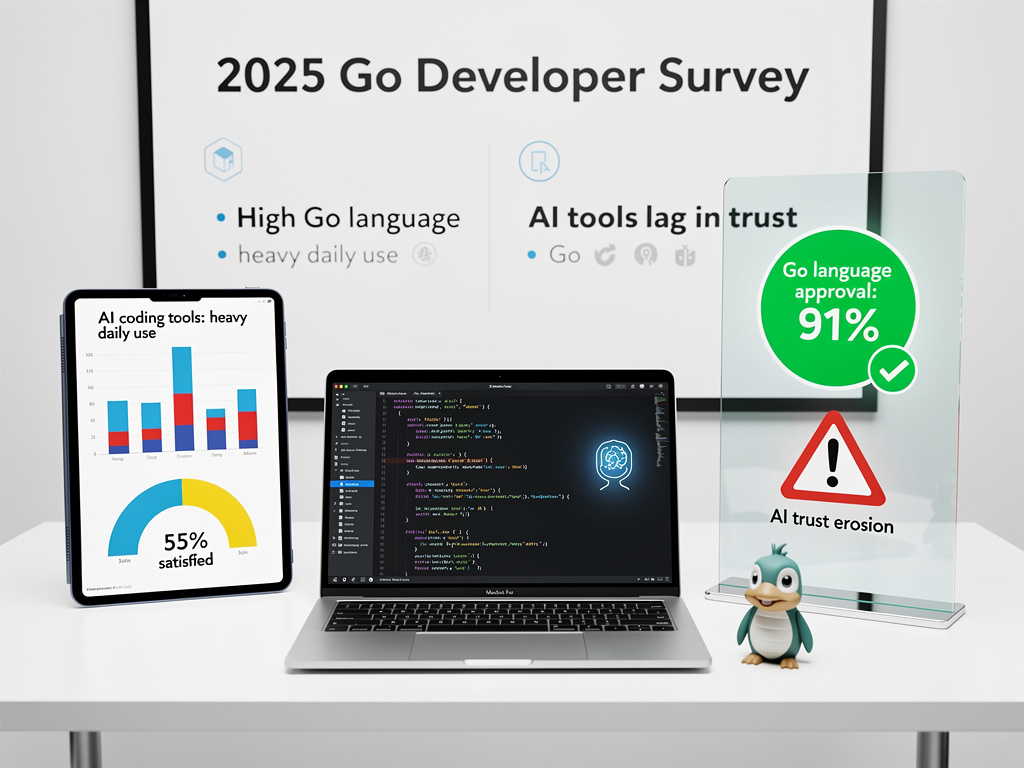
In the high-stakes world of systems programming, Go developers are diving headfirst into AI-powered coding tools, yet persistent quality issues are curbing their enthusiasm. The 2025 Go Developer Survey, released January 21, 2026, by the Go team, reveals a community deeply satisfied with the language itself—91% report satisfaction—but far more ambivalent about AI aids, with only 55% satisfied overall.
Conducted from September 9 to 30, 2025, the survey drew 5,379 valid responses from a pool of over 7,000 submissions, sourced via the Go blog, social media, and in-product prompts in VS Code and GoLand. Respondents, predominantly professionals (87%), hailed from diverse industries, with 46% in technology and the rest spread across sectors like energy and finance. Daily AI tool usage stands at 53%, while 29% rarely or never touch them, highlighting a polarized adoption pattern.
The Go team’s analysis notes: “Most Go developers are now using AI-powered development tools when seeking information (e.g., learning how to use a module) or toiling (e.g., writing repetitive blocks of similar code), but their satisfaction with these tools is middling due, in part, to quality concerns.” This mirrors broader industry trends, as seen in the Stack Overflow 2025 Developer Survey, where positive sentiment for AI dropped to 60% from over 70% in prior years.
AI Adoption Surges Amid Familiar Tools
ChatGPT leads at 45% usage, followed by GitHub Copilot (31%), Claude Code (25%), Claude (23%), and Gemini (20%), per the Go survey. These figures echo the 2024 H2 survey from go.dev, where 70% used AI assistants, with ChatGPT (68%) and Copilot (50%) dominating. Less experienced developers—those with under two years in Go—show higher uptake (75% vs. 67% for veterans), often leveraging AI for learning tasks like explaining code or resolving compiler errors.
Benefits shine in rote tasks: generating unit tests, boilerplate code, enhanced autocompletion, refactoring, and documentation. High-adoption areas include bridging knowledge gaps on APIs or test configs, with low resistance for local code improvements. “The tasks with most adoption and least resistance deal with bridging knowledge gaps, improving local code, and avoiding toil,” the Go team observed.
Yet, for code generation, 66% use or hope to use AI, but 25% oppose it outright, citing the need for rigorous review. This caution aligns with prior surveys; the 2024 H2 edition highlighted discrepancies between desired uses (e.g., 49% wanted test-writing AI in 2023) and actual adoption (29% in 2024).
Quality Concerns Dominate Developer Gripes
The top gripe? Non-functional code, flagged by 53% of respondents. Another 30% decry poor quality even in working output. Open-ended responses paint a vivid picture: “All AI tools tend to hallucinate quickly when working with medium-to-large codebases (10k+ lines of code).” Another lamented, “Despite numerous efforts to make it write code in an established codebase, it would take too much effort to steer it to follow the practices in the project.”
Satisfaction breaks down to 42% “somewhat satisfied” and just 13% “very satisfied,” a stark contrast to Go’s 64% “very satisfied” rate. This middling response tracks with InfoWorld’s coverage by Paul Krill, which dubbed developer sentiment “meh” due to these persistent flaws.
Broader data reinforces the divide. Stack Overflow’s survey cites 66% frustration with “AI solutions that are almost right, but not quite,” and 45% find debugging AI-generated code more time-consuming. A heise online report echoes: developers frequently use AI for info retrieval and coding but remain only moderately satisfied.
Go’s Strengths Shine Through AI Turbulence
Amid AI ambivalence, Go itself thrives. Developers praise its simplicity and standard library for HTTP, crypto, and sync tools. One respondent gushed: “Go is by far my favorite language; other languages feel far too complex and unhelpful. The fact that Go is comparatively small, simple… plays a massive role in making it such a good long-lasting foundation.” Another: “The entire reason I use Go is the great tooling and standard library.”
Project types skew toward command-line tools (74%) and API/RPC services (73%), with libraries at 49%. Deployment favors Linux/containers (96%), AWS (46%), and company servers (44%). Editors? VS Code (37%) edges GoLand/IntelliJ (28%) and Vim/Neovim (19%). Frustrations center on enforcing idioms (33%), missing features like enums (28%), and vetting modules (26%).
AI integration in projects wanes: 66% report no AI functionality, up from 59% in 2024, signaling a pivot back to core strengths. The Go team plans raw data release in Q1 2026 for deeper community analysis.
Evolving Tools and Future Horizons
Previous surveys show evolution. The 2024 H2 poll from InfoWorld noted 70% AI use but challenges in coding standards due to varied experience levels. Coding standards remain a pain point, exacerbated by AI’s tendency to stray from idioms.
Looking ahead, the Go team commits to better AI support, as outlined in a November 2025 update covered by InfoWorld: improvements for AI coding agents and an overhauled ‘go fix’ command in Go 1.26. This aims to provide “well-lit paths” for human and AI developers alike.
Industry-wide, studies like METR’s early-2025 RCT found experienced developers 19% slower with AI on familiar repos, despite perceived gains. GitHub’s 2024 survey showed 97% usage but mixed productivity. As Go developers navigate these tools, their feedback underscores a truth: AI accelerates toil but stumbles on nuance, demanding human oversight in production code.


 WebProNews is an iEntry Publication