
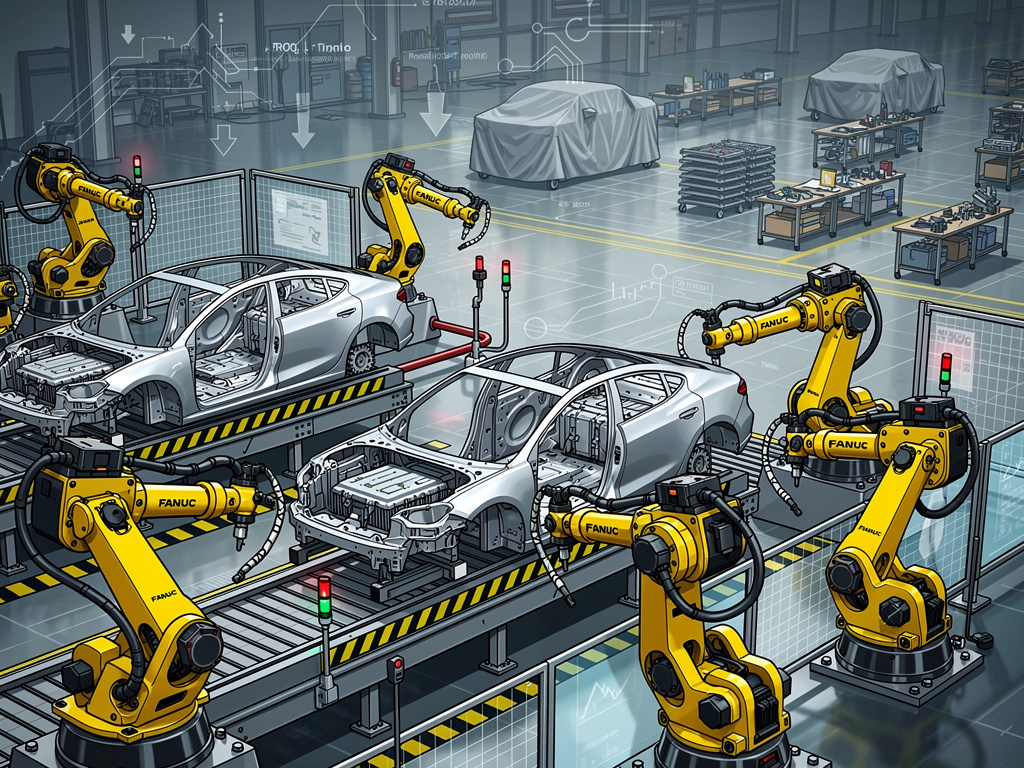
General Motors installed about 50 collaborative robots at its flagship Factory Zero plant in Detroit. The FANUC-made arms help attach body panels on the assembly line. Yet more than 1,300 union workers laid off months earlier have not returned. The move has ignited fresh friction with the United Auto Workers.
The timing stings. GM had described the March layoffs at the former Detroit-Hamtramck facility as temporary. Production of electric trucks slowed amid soft demand. Those workers remain sidelined. Now the robots stand in place. Union leaders call it a clear signal of priorities.
“Our manpower is being taken away from us,” UAW Local 22 President James Cotton told Crain’s Detroit Business. “From top to bottom, we’re disgusted that they have cobots in our plants.”
Another UAW voice struck a broader note. Andrew Bergman, an organizer, argued that such technology could shorten the workweek. Instead, he said, companies use it to protect profits and justify cuts. The remarks came as automation talk heats up across the industry.
GM pushes back. The company insists the cobots, which work alongside humans, boost safety and reduce ergonomic strain. They do not replace people outright. Officials point to competitive pressure in a market where electric-vehicle sales have cooled faster than expected. But the optics fuel suspicion. And the numbers tell part of the story.
Factory Zero has absorbed multiple blows. GM announced more than 1,200 job reductions there late last year. Another round of roughly 1,300 temporary layoffs followed in March, according to Reuters. Some earlier cuts were permanent. The plant, once central to GM’s aggressive EV ambitions under CEO Mary Barra, now operates below capacity. Production pauses have become routine.
But automation continues. GM has expanded its use of these collaborative systems, often called cobots, across lines. The latest batch brings the total to dozens at the site. FANUC, the Japanese supplier, specializes in such flexible arms that operate safely near people without full cages. They handle repetitive tasks. Workers still oversee the process. Yet the union sees a pattern.
UAW filed grievances over the installations. Local leaders worry the robots threaten future call-backs. One direct quote captured the mood. “It’s always a concern when you see a robot coming to a plant, especially after they have laid off over a thousand people,” Cotton said in the Autoblog report on the story. “They say it’s the wave of the future, and if that’s so, they’re taking away jobs from people.”
The broader backdrop makes the clash sharper. GM scaled back its EV rollout after slower-than-hoped adoption. Federal policy shifts, high interest rates and consumer hesitation played roles. Battery plants tied to the Ultium joint venture have idled shifts and delayed recalls, Reuters reported in May. White-collar cuts hit the company too. GM trimmed hundreds of IT jobs earlier this year while hunting AI talent, according to The Detroit News.
Still, investment in machines persists. Barra has spoken of smarter factories. Partnerships with NVIDIA aim to train AI models for manufacturing optimization. The company views robotics as essential to hit cost targets on EVs, where labor expenses rose after the costly 2023 UAW contract. Assembly labor hours have dropped dramatically from levels common in the 1980s. Robots help close the gap without constant contract battles.
Critics inside the union take a different view. At a recent UAW convention, President Shawn Fain warned against mass automation and humanoid robots. He argued the technology risks widening inequality if it simply displaces workers rather than sharing gains. The Factory Zero episode brings that warning home. Real jobs. Real machines. Right now.
Industry watchers note similar moves elsewhere. Toyota has deployed humanoid robots at a RAV4 plant. BMW expands its pilot programs. In China, factories from Jetour to Xiaomi push toward “lights-out” operations with minimal human presence. FANUC itself pioneered such facilities in Japan decades ago. The U.S. auto sector lags but follows the same logic. Labor costs climb. Product cycles accelerate. Margins matter.
Yet limits exist. Robots still need human oversight for complex problems, quality checks and unexpected glitches. Cybersecurity vulnerabilities grow with connected systems. And demand for skilled technicians who program and maintain the equipment rises even as traditional assembly roles shrink. Retraining matters. So far, the conversation at GM centers more on grievances than pathways back to work.
The 1,300 idled workers wait. Some may return if EV sales rebound. Others face uncertainty as the plant integrates more automation. GM has not detailed how many positions the new cobots might displace over time. Officials stress collaboration. The union hears replacement. Tension simmers. And the robots keep moving down the line.
Recent coverage highlights the stakes. Ars Technica framed the story against global dark-factory trends and U.S. EV pullback. The New York Post captured worker anger with the headline quote: “We’re disgusted.” Yahoo Finance and others echoed the Crain’s reporting, noting the grievances filed. No single article connects all threads. The picture that emerges shows a company hedging its EV bet through technology while labor pushes for guarantees.
Factory Zero once symbolized GM’s electric future. Hummer EVs and Silverado electrics rolled out with fanfare. Now it stands as a test case for how traditional manufacturers balance machines and people in a market that refuses to move in straight lines. The robots have arrived. The question is whether the workers will too.


 WebProNews is an iEntry Publication