
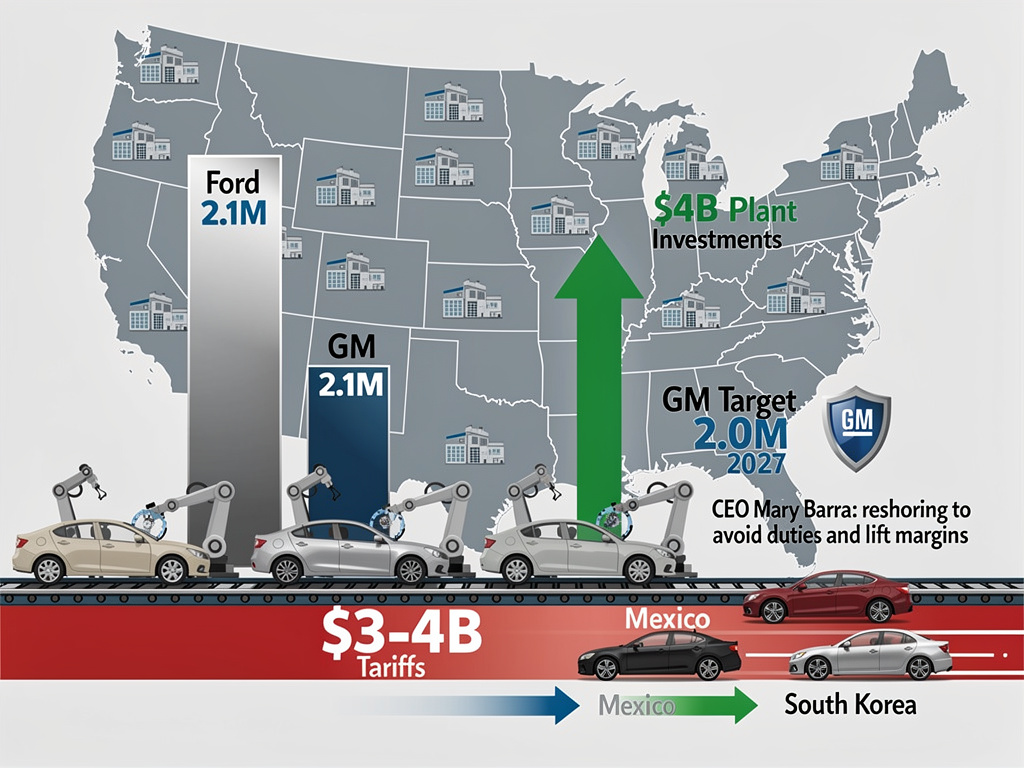
General Motors Co. is positioning itself to overtake Ford Motor Co. as the leading assembler of vehicles in the U.S., targeting an annual production run rate of 2 million units even as it braces for up to $4 billion in tariff expenses this year. The ambition, unveiled by CEO Mary Barra during the company’s fourth-quarter earnings call on January 27, 2026, underscores a strategic pivot toward domestic manufacturing amid President Donald Trump’s aggressive trade policies. “As we look further ahead, our annual production in the U.S. is expected to rise to an industry-leading 2 million units,” Barra declared, according to a CNBC report.
In 2024, Ford held the crown with 2.1 million vehicles assembled domestically, powering 80% of its U.S. sales and fueling marketing campaigns touting its American credentials, as detailed on Ford’s official site. GM, by contrast, emerged as the largest importer of new vehicles to the U.S. that year, shipping in about 1.23 million units—nearly half its sales—primarily from Mexico and South Korea, per a Bloomberg newsletter cited in the CNBC piece. Tariffs imposed since April 2025 have already stung GM with $3.1 billion in costs last year, despite partial-year implementation, setting the stage for this year’s $3 billion to $4 billion projection.
The escalation ties directly to uncertainties over South Korean imports, where GM sources entry-level models like the Chevrolet Trax and Buick Envista. Barra expressed hope for a U.S.-South Korea trade pact capping duties at 15%, the rate baked into GM’s forecast, but Trump announced a hike to 25% after Seoul’s legislature stalled approval. “We’re really encouraging the countries to get the trade deal done that they agreed to last October,” Barra told CNBC’s Phil LeBeau.
Reshoring Production to Dodge Duties
GM’s response hinges on a $4 billion investment across three U.S. plants through 2027, shifting gas-powered crossovers from Mexico to facilities in Kansas and Tennessee, while repurposing the idled Orion Assembly plant in Michigan for full-size SUVs and pickups starting in 2026. The Chevrolet Blazer will fully migrate to Spring Hill, Tennessee, by 2027, and the Equinox will ramp up at Fairfax, Kansas, mid-year, enabling the 2 million-unit goal potentially by 2027, as outlined in a June 2025 CNBC article.
“We proactively managed our net tariff exposure, reducing it well below our initial expectations, thanks to self-help initiatives and policy actions that support companies like GM that have substantial and growing commitments to American manufacturing,” Barra added in the earnings release covered by CNBC. These moves align with broader industry trends, where tariffs have prompted reshoring; Ford, for instance, cut its 2025 tariff hit estimate to $1 billion from $2 billion through U.S. sourcing and credits, per various reports including The New York Times.
Financially, GM posted Q4 2025 adjusted EPS of $2.51, topping estimates of $2.20, though revenue dipped 5.1% to $45.3 billion amid a $6 billion EV-related charge. Full-year adjusted EBIT hit $12.7 billion, with 2026 guidance at $13 billion to $15 billion, buoyed by regulatory rollbacks saving up to $750 million in compliance costs, according to a Reuters report.
Ford’s Domestic Stronghold Under Pressure
Ford’s edge stems from its entrenched U.S. footprint, with F-Series trucks—nearly 1 million built in 2024—produced across Michigan, Missouri, Kentucky, and Ohio plants employing 57,000 hourly workers. Yet GM’s surge challenges this, especially as Ford grapples with its own tariff mitigations, including added shifts at Dearborn for F-150 demand and tariff offsets via USMCA compliance, as noted in X posts from industry watchers and Ford executives.
Posts on X highlighted Ford’s robust sales, with CEO Jim Farley crediting U.S. production for record quarters, while Trump touted plant expansions during a Michigan visit: “They’ve never seen what’s happening now.” GM’s imports left it more exposed initially, but 2025 sales rose 5.5%, per CNBC, signaling resilience.
Analysts note tariffs have spurred investments without crippling Detroit; GM trimmed early $5 billion forecasts, and Ford absorbed $1.5 billion in 2025, with stocks soaring—GM up 47%, Ford 36% since April 2025 lows, as reported by Daily Mail.
Tariff Headwinds and Profit Pivots
GM’s 2026 outlook incorporates South Korea at 15%, but a 25% rate could inflate costs; Barra remains optimistic. Broader pressures include chip shortages and commodity rises denting profits by $1-1.5 billion, offset by SUV/pickup demand and frozen emissions penalties under Trump policies.
EV retreats dominate: GM’s $7.2 billion Q4 charges reflect pullbacks, echoing Ford’s F-150 Lightning halt amid fading demand post-$7,500 tax credit elimination. “From an EV perspective, we do believe that that is the end game. We’re continuing to work on cost improvements,” Barra told Reuters.
Shareholder returns underscore confidence: a 20% dividend hike to 18 cents quarterly and $6 billion buyback, reducing shares to under 900 million. North America earned $10.45 billion in 2025, down 28%, but international ops improved.
Strategic Shifts Reshaping Detroit Rivalry
GM’s plant reallocations—from EVs at Orion to profitable gas vehicles—mirror industry hybrids push, with Ford scaling Maverick and F-150 electrified variants. UAW President Shawn Fain praised GM’s moves: “The race to the bottom is over,” tying tariffs to union jobs.
X chatter reflects optimism, with users noting Ford’s 24/6 operations and GM’s sales momentum into 2026. Projections show U.S. sales at 15.6-16.2 million units, per Detroit News, amid USMCA renegotiations looming.
As GM closes in on Ford’s assembly lead, tariffs emerge less as apocalypse—initial $42 billion Big Three hit fears faded—and more as catalyst for U.S. revival, blending pain with production gains and policy tailwinds.


 WebProNews is an iEntry Publication