
General Motors is putting $2 billion into its Canadian operations, a massive capital commitment that lands at a moment when the North American auto industry is being reshaped by tariffs, electrification pressures, and a political environment in Washington that is demanding companies bring production home — or at least closer to home.
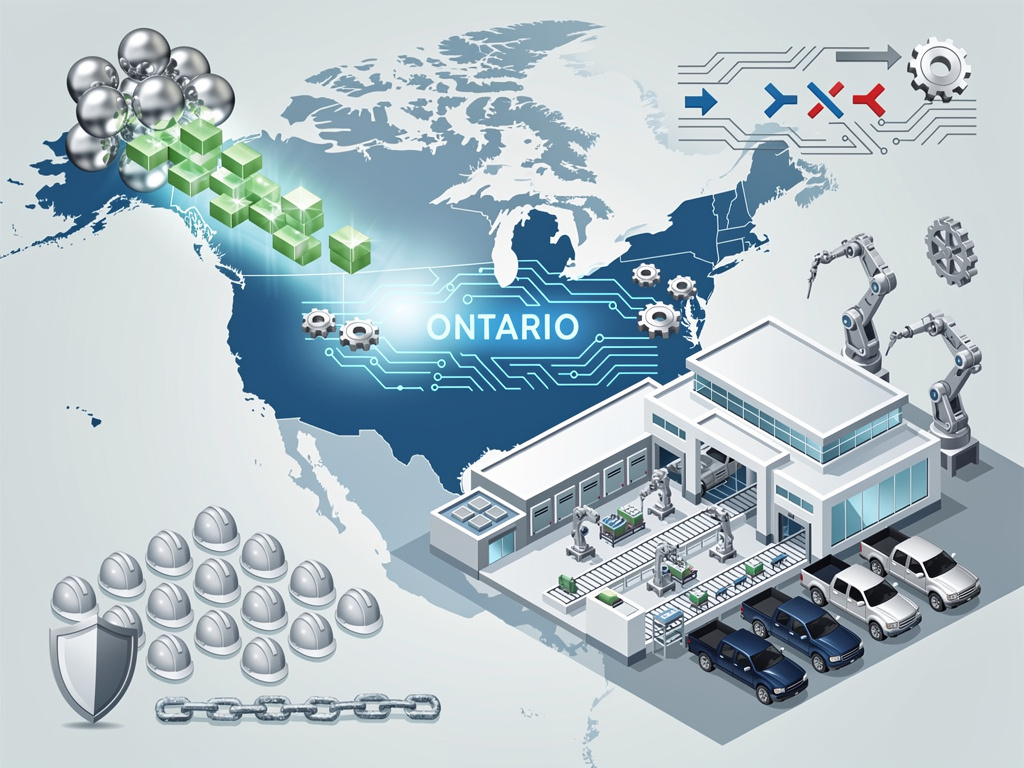
The investment, announced on June 18, 2025, will flow into GM’s CAMI Assembly plant in Ingersoll, Ontario, and its Oshawa Assembly plant, also in Ontario. The CAMI facility will be retooled to build a new midsize internal combustion engine pickup truck, while Oshawa will receive upgrades to expand its current truck production capacity. According to Yahoo Finance, the combined investment exceeds $2 billion Canadian dollars and is expected to secure approximately 4,000 jobs across the two plants.
This isn’t charity. It’s strategy.
GM’s move comes as automakers scramble to adjust supply chains and production footprints in response to the Trump administration’s 25% tariffs on imported vehicles and auto parts. The tariffs, which took effect earlier this year, have fundamentally altered the cost calculus for every major automaker operating in North America. Vehicles assembled in Canada and Mexico face steep levies when crossing into the United States, the continent’s largest market. For GM, which has long relied on its Canadian plants as integral nodes in its North American manufacturing network, the tariffs created an urgent need to demonstrate that Canadian production still makes economic sense — or to restructure so that it does.
The new midsize pickup slated for CAMI Assembly is particularly telling. GM has been without a strong midsize truck contender for years, ceding ground in the segment to Toyota’s Tacoma and Ford’s Ranger. Bringing a new model to Ingersoll signals confidence that the plant can produce a vehicle competitively even under the current tariff regime. The truck will use a traditional internal combustion powertrain, a reflection of where consumer demand actually sits in 2025 rather than where policy aspirations suggested it would be five years ago.
At Oshawa, the calculus is simpler. The plant already builds full-size pickup trucks, and expanding that capacity is a bet on sustained demand for GM’s most profitable vehicles. Full-size trucks and SUVs remain the profit engine for Detroit’s automakers, generating margins that subsidize investments in electric vehicles and advanced technology. More Oshawa capacity means more trucks available for both the Canadian domestic market and for export, with the tariff math presumably worked into GM’s planning.
The Canadian government isn’t a passive observer here. Ottawa has been aggressively courting auto investment, offering incentives and subsidies to ensure that the country’s manufacturing base doesn’t erode under tariff pressure. Canada’s auto sector supports hundreds of thousands of jobs and represents a significant share of the country’s manufacturing GDP. Losing major assembly operations to the United States or Mexico would be an economic and political blow that neither the federal government nor Ontario’s provincial government is willing to absorb.
GM CEO Mary Barra has been threading a needle for months. The company needs to maintain good relations with the Trump administration, which has used tariffs as both an economic weapon and a political tool to pressure automakers into expanding U.S. production. At the same time, GM’s Canadian operations are deeply embedded in its supply chain, and abandoning them would be enormously expensive and disruptive. The $2 billion investment is, in part, a message to both governments: GM is committed to manufacturing on both sides of the border.
But there’s tension beneath the surface.
Earlier this year, GM announced plans to invest billions in U.S. manufacturing as well, including expanding production at its Fort Wayne, Indiana, truck plant and investing in its Spring Hill, Tennessee, facility. The company has been careful to announce U.S. and Canadian investments in tandem, or at least in close sequence, to avoid the appearance of favoring one country over the other. It’s a balancing act that every major automaker with cross-border operations is performing right now. Ford, Stellantis, Toyota, and Honda are all making similar calculations, weighing tariff costs against existing infrastructure, workforce capabilities, and government incentives.
The broader context matters. North American auto production has been organized around integrated cross-border supply chains since NAFTA was signed in 1994. Parts and vehicles cross the U.S.-Canada and U.S.-Mexico borders multiple times during the manufacturing process. The 25% tariffs disrupt this model at a fundamental level. Some analysts have estimated that tariffs add thousands of dollars to the cost of a vehicle assembled outside the United States, a cost that must be absorbed by the manufacturer, passed on to consumers, or offset through restructuring.
GM’s stock has reflected the uncertainty. Shares have been volatile in 2025, buffeted by tariff announcements, shifting EV demand signals, and broader macroeconomic concerns. The Canadian investment announcement was received positively by markets, with investors interpreting it as a sign that GM has a coherent plan for managing the tariff environment rather than simply reacting to each new policy development.
The decision to invest in ICE truck production rather than electric vehicles at these Canadian plants is notable. GM has poured billions into EV development, including its Ultium battery platform and a network of U.S. battery plants built in partnership with LG Energy Solution. But EV sales growth has slowed from the torrid pace of 2022-2023, and consumer appetite for electric trucks in particular has been tepid. The Ford F-150 Lightning has seen price cuts and production adjustments. Rivian continues to burn cash. Even Tesla’s Cybertruck, despite strong initial demand, has faced quality and production challenges.
So GM is doing what Detroit has always done when the future gets murky: it’s doubling down on what sells today. Trucks sell. Specifically, internal combustion trucks sell in enormous volumes with fat margins. The CAMI retooling for a midsize ICE pickup is a pragmatic acknowledgment that the transition to electric vehicles will be longer and messier than the industry’s most optimistic projections suggested.
That doesn’t mean GM is abandoning electrification. The company continues to ramp production of the Chevrolet Equinox EV, which has been one of the more successful affordable EV launches in recent memory. And GM’s Ultium-based trucks — the GMC Hummer EV, Chevrolet Silverado EV, and GMC Sierra EV — continue to roll out, albeit at volumes well below what was initially projected. The Canadian investments are complementary, not contradictory. They ensure that GM’s most reliable revenue stream keeps flowing while the EV transition proceeds at whatever pace the market dictates.
The 4,000 jobs secured by this investment carry significant political weight in Ontario. The province’s auto sector has been battered over the past two decades by plant closures, restructurings, and the gradual migration of production to lower-cost jurisdictions. GM itself closed its Oshawa car assembly operations in 2019, only to reopen the plant for truck production in 2021 when demand surged. The whiplash left workers and communities wary. A $2 billion commitment with a clear product mandate — new trucks, expanded capacity — offers more stability than the industry has provided in years.
Unifor, the union representing Canadian auto workers, has been negotiating aggressively for exactly this kind of investment commitment. The union’s leadership has argued that Canadian workers are among the most productive in the global auto industry and that the country’s universal healthcare system gives Canadian plants a structural cost advantage over U.S. facilities, where employer-provided health insurance adds significant per-vehicle costs. Whether that advantage is sufficient to offset a 25% tariff is the central question, and GM’s investment suggests the company believes it can make the numbers work — likely with help from government incentives.
The competitive dynamics in the midsize truck segment add another dimension. Toyota’s Tacoma has dominated for years, and the recently redesigned 2024 model has only strengthened its position. Ford’s Ranger returned to the U.S. market with a new generation that has been selling well. Chevrolet’s Colorado, GM’s current midsize offering, has been a solid but unspectacular performer. A new midsize truck from CAMI — potentially a next-generation Colorado or an entirely new nameplate — would give GM a fresh entry in a segment that’s growing as consumers look for alternatives to increasingly expensive full-size trucks.
And those full-size trucks are getting expensive. The average transaction price for a new full-size pickup now exceeds $60,000, pushing some buyers toward midsize alternatives that offer much of the capability at a lower price point. GM sees this trend. The CAMI investment is a response to it.
From a supply chain perspective, Ontario offers advantages that are hard to replicate. The province has a dense network of parts suppliers, a skilled manufacturing workforce, proximity to major U.S. markets, and established logistics infrastructure. GM’s Oshawa and CAMI plants sit within a few hours’ drive of the company’s U.S. assembly operations in Michigan and Indiana, facilitating the kind of just-in-time parts delivery that modern auto manufacturing requires.
The tariff situation remains fluid. The Trump administration has shown willingness to adjust, exempt, or escalate tariffs based on political considerations, trade negotiations, and industry lobbying. There’s no guarantee that the current 25% rate will persist indefinitely, and some industry observers believe that a U.S.-Canada trade agreement could eventually reduce or eliminate auto tariffs between the two countries. GM’s investment could look even smarter if tariffs come down, giving the company expanded capacity in a lower-cost jurisdiction without the tariff penalty.
Or the tariffs could get worse. That’s the risk.
GM is not alone in making big bets on Canadian auto manufacturing. Honda announced a massive investment in Ontario for EV and battery production. Stellantis has committed to its Windsor, Ontario, assembly plant. The pattern suggests that major automakers view Canada as a viable production base despite the tariff headwinds, particularly when government incentives are factored in.
For GM specifically, the $2 billion Canadian investment is one piece of a larger capital allocation puzzle. The company is simultaneously investing in U.S. plants, funding EV and autonomous vehicle development through its Cruise subsidiary, managing a share buyback program, and maintaining its dividend. Capital discipline has been a recurring theme in Barra’s tenure as CEO, and the Canadian investment will be judged partly on whether it delivers returns that justify the outlay in a tariff-complicated environment.
The market will be watching closely. GM’s next few quarterly earnings reports will reveal whether the company’s tariff mitigation strategies — including production shifts, pricing adjustments, and supply chain reorganizations — are working. The Canadian investment won’t bear fruit immediately; retooling CAMI for a new truck will take time, and the expanded Oshawa capacity will ramp gradually. But the commitment itself sends a signal about where GM sees the North American auto industry heading: toward a future that is more regional, more politically influenced, and more dependent on the kind of large-scale manufacturing bets that defined the industry’s first century.
Two billion dollars. Four thousand jobs. Two plants. One very complicated trade environment. GM is placing its chips on the table, betting that trucks — built in Canada, sold across North America — will remain the foundation of its business for years to come. Given what we know about consumer preferences and profit margins in the auto industry, it’s a bet that’s hard to argue with. The execution, as always, will determine whether the strategy was brilliant or merely expensive.


 WebProNews is an iEntry Publication