
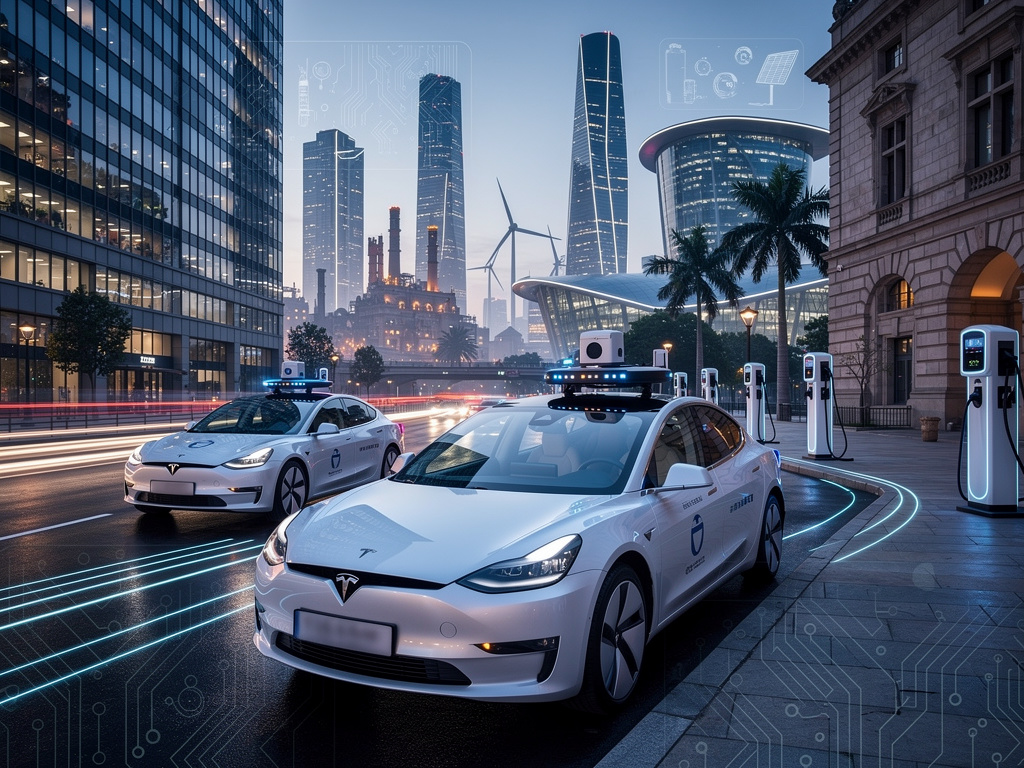
In the bustling streets of San Francisco, where Waymo’s sleek autonomous vehicles glide silently among human-driven cars, a revolution in urban mobility is unfolding. Ride-hailing giants and tech innovators are pushing the boundaries of self-driving technology, with robotaxi services expanding from experimental pilots to full-scale operations in major cities worldwide. This surge is not just about convenience; it’s reshaping economies, challenging regulatory frameworks, and redefining how people interact with transportation. According to a recent report from Reuters, companies like Uber and WeRide are leading the charge in deploying Level 4 autonomous taxis, which operate without human intervention in specific areas, signaling a pivotal shift toward widespread adoption Reuters.
The momentum is palpable in regions like China, where Baidu’s Apollo Go has already logged millions of miles in driverless mode, serving passengers in cities such as Beijing and Wuhan. These vehicles rely on advanced AI algorithms, lidar sensors, and high-definition mapping to navigate complex urban environments. Industry analysts note that regulatory approvals in China have been more aggressive than in the West, allowing for rapid scaling. For instance, Pony.ai recently announced partnerships to expand its fleet in the Middle East, capitalizing on the region’s push for sustainable transport solutions.
Meanwhile, in the United States, Waymo, a subsidiary of Alphabet, has emerged as a frontrunner. With operations in Phoenix, Los Angeles, and now Austin, the company reported over 100,000 paid rides per week in late 2025, demonstrating reliability and consumer trust. This progress comes amid setbacks for competitors; Tesla, despite bold promises from CEO Elon Musk, has faced delays in its unsupervised robotaxi rollout, achieving only a fraction of its targeted deployments by year’s end.
Accelerating Deployments in Key Markets
Tesla’s journey highlights both the promise and pitfalls of autonomous tech. Initially hyped with announcements of a dedicated Cybercab vehicle, the company aimed for thousands of units on roads by 2025 but delivered far fewer, hampered by software glitches and regulatory scrutiny. Posts on X from industry observers reflect growing skepticism, with some users pointing out that Tesla’s vision-only approach, eschewing lidar for cameras and neural networks, has yet to match the safety records of rivals. Yet, incremental updates to its Full Self-Driving software continue to inch closer to true autonomy.
Across the Atlantic, European cities are cautiously embracing the trend. In the United Kingdom, companies like Oxa are testing driverless shuttles in Oxford, while Germany’s Volkswagen-backed MOIA plans robotaxi services in Hamburg by 2026. These initiatives are bolstered by EU regulations that emphasize safety and data privacy, creating a more measured pace compared to Asia’s aggressive timelines. A CNBC analysis underscores Waymo’s global expansion strategy, noting its partnerships with insurers and city planners to mitigate risks CNBC.
The Middle East, particularly the UAE, is becoming a hotbed for innovation. WeRide’s collaboration with Uber launched fully driverless rides in Abu Dhabi in November 2025, aiming for 1,000 units by 2028. This move aligns with the region’s vision for smart cities, reducing oil dependency through electric autonomous fleets. Baidu and Pony.ai are also testing in Gulf states, leveraging local investments in AI infrastructure.
Technological Hurdles and Breakthroughs
At the core of these rollouts are cutting-edge technologies that blend machine learning with sensor fusion. Waymo’s vehicles, for example, use a combination of lidar, radar, and cameras to achieve 360-degree perception, allowing them to handle unpredictable scenarios like jaywalkers or construction zones. Recent advancements in edge computing enable real-time decision-making, reducing latency to milliseconds. However, challenges persist: adverse weather conditions, such as heavy rain or fog, can impair sensor accuracy, prompting ongoing R&D investments.
Tesla’s approach, detailed in posts on X by enthusiasts and critics alike, relies solely on visual data processed through neural networks trained on billions of miles of driving data. While this method promises scalability and lower costs—eliminating expensive lidar hardware—it has drawn criticism for higher error rates in edge cases. A report from InsideEVs notes that Tesla’s 2025 promises for widespread robotaxi fleets fell flat, with only about 30 vehicles operational by year-end, far below the 1,500 targeted InsideEVs.
Competitors like Zoox, acquired by Amazon, are innovating with purpose-built vehicles designed from the ground up for autonomy. Zoox’s bidirectional pods, which debuted public rides in 2025, feature no steering wheel or pedals, emphasizing passenger comfort and efficiency. This design philosophy contrasts with retrofitted cars used by many players, potentially offering a safer, more integrated experience.
Economic Implications for Urban Mobility
The economic ripple effects are profound. Robotaxis could slash transportation costs by up to 50%, according to market projections, making rides more affordable than owning a personal vehicle. In dense urban areas, this might reduce traffic congestion and parking demands, freeing up space for green initiatives. Ride-hailing firms like Uber stand to benefit enormously, transitioning from driver-dependent models to automated fleets that operate 24/7 without labor costs.
However, job displacement looms large. Millions of drivers worldwide, from taxi operators to truckers, face uncertainty as autonomy scales. Governments are responding with retraining programs; for instance, California’s initiatives aim to transition workers into tech maintenance roles. A Guardian piece on 2026 tech trends highlights this tension, predicting that datacenters powering AI for autonomy will create new jobs in data science and infrastructure The Guardian.
Investor sentiment is mixed. While Waymo’s parent company has seen stock boosts from successful expansions, Tesla’s delays have fueled skepticism, as evidenced by a WebProNews article detailing regulatory and technical hurdles pushing full rollouts to 2026 WebProNews. Venture capital continues to pour in, with Chinese firms like WeRide securing billions to fuel international growth.
Regulatory Frameworks Shaping Progress
Regulations remain a critical gatekeeper. In the U.S., the National Highway Traffic Safety Administration has approved limited deployments but demands rigorous safety data. China’s more permissive stance has allowed Baidu to operate in over 10 cities, amassing valuable real-world data. A South China Morning Post report details how Chinese giants are exporting this expertise to the Middle East, steering regions toward driverless futures South China Morning Post.
Ethical considerations are gaining traction. Who bears responsibility in accidents? How is passenger data protected? Industry insiders advocate for standardized global protocols, similar to aviation safety standards. Europe’s GDPR compliance adds layers of complexity, ensuring AI systems are transparent and bias-free.
Public perception is evolving too. Surveys show increasing acceptance, with 60% of urban dwellers willing to try robotaxis, up from 40% two years ago. High-profile incidents, like a 2025 Cruise vehicle mishap in San Francisco, underscore the need for trust-building measures.
Innovation Ecosystems and Future Trajectories
Collaboration is key to acceleration. Partnerships between automakers, tech firms, and governments are fostering ecosystems for shared data and infrastructure. For example, Uber’s tie-up with WeRide in the UAE combines ride-hailing expertise with autonomous tech, potentially setting a model for global expansion.
Looking ahead, advancements in 5G connectivity and V2X (vehicle-to-everything) communication could enable fleets to coordinate seamlessly, optimizing routes and reducing emissions. Electric robotaxis align with sustainability goals, with projections indicating a 20% drop in urban carbon footprints by 2030.
Challenges like cybersecurity threats and infrastructure readiness persist. Hackers targeting autonomous systems could disrupt services, prompting investments in quantum-resistant encryption. Rural areas lag behind, where mapping and connectivity are sparse, suggesting urban-centric growth initially.
Global Competition and Strategic Shifts
The race is intensifying among nations. China’s dominance in manufacturing and AI gives it an edge, with exports to emerging markets. The U.S. leads in innovation but grapples with litigation; Europe prioritizes ethics. Posts on X from tech analysts predict that by 2026, unsupervised operations could expand to 30 U.S. cities, though Waymo might maintain a lead over Tesla.
Supply chain dynamics are crucial. Battery and chip shortages have delayed some rollouts, but diversification efforts are underway. Tesla’s pivot to in-house production aims to mitigate this, though critics argue it’s contributed to missed targets.
Ultimately, the driverless future hinges on balancing speed with safety. As robotaxis proliferate, they promise not just mobility but a reimagined society where time saved in transit fuels productivity and leisure. Industry leaders must navigate these waters carefully to realize this vision without unintended consequences.


 WebProNews is an iEntry Publication