
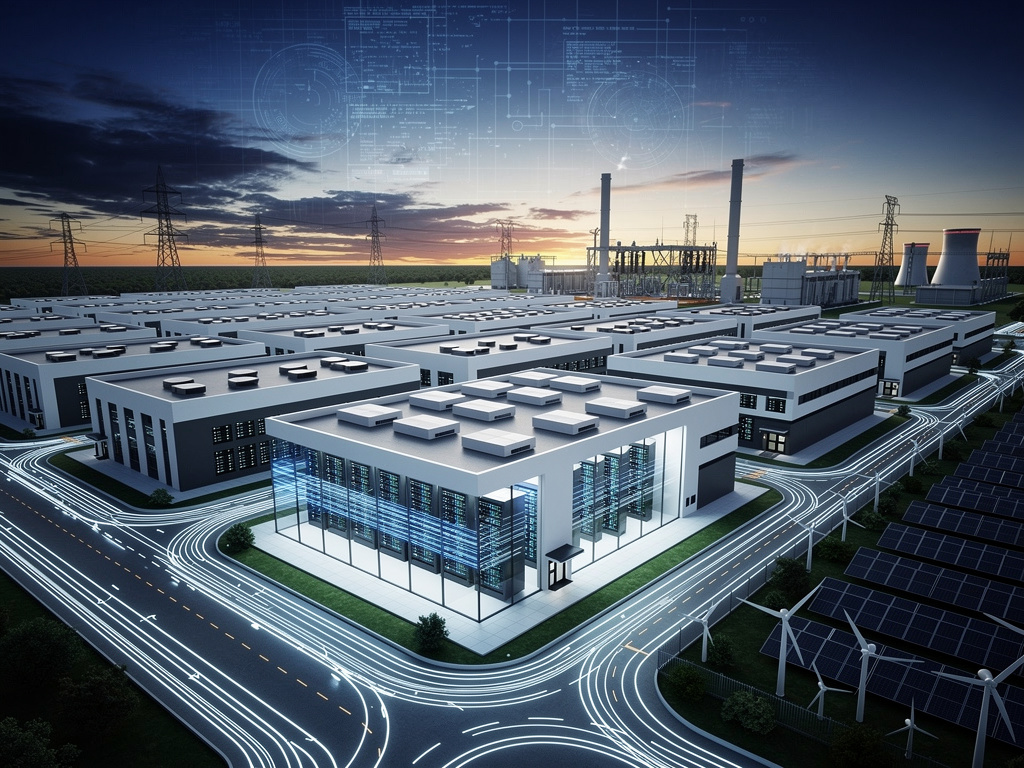
In the whirlwind of technological advancement, 2025 has marked a pivotal moment for the data center sector, with global investments surging to an unprecedented $61 billion. This figure, drawn from a comprehensive report by S&P Global, underscores a frenzied push by tech giants and infrastructure developers to meet the insatiable demand for computing power driven by artificial intelligence. As companies like Microsoft, Amazon, and Google pour resources into expansive facilities, the sector’s growth reflects not just economic momentum but also the underlying pressures of an AI-fueled era.
The deals encompassing this massive sum include mergers, acquisitions, and direct investments in building and upgrading data centers worldwide. According to details in a CNBC article, hyperscalers—those massive cloud service providers—are increasingly relying on external debt to finance these energy-hungry operations, highlighting a shift from internal funding to broader capital markets. This record-breaking year surpasses previous highs, signaling that fears of an AI investment bubble have done little to dampen enthusiasm.
Beyond the headline numbers, the investment spree is tied closely to the exponential needs of AI training and inference tasks. Reports indicate that more than 100 transactions contributed to the $61 billion total, with a significant portion directed toward hyperscale facilities capable of handling vast datasets and complex algorithms. Industry analysts point to this as evidence of a “global construction frenzy,” where new campuses are sprouting up in regions with ample power supplies and regulatory support.
The AI Imperative Fueling Expansion
This boom isn’t happening in isolation; it’s propelled by the relentless march of AI technologies that require immense computational resources. For instance, projections from consulting firm McKinsey suggest that by 2030, the cost of scaling data centers for AI could approach $7 trillion globally, with a substantial chunk allocated to hardware and infrastructure. Such forecasts emphasize how current investments are merely the tip of the iceberg, as companies race to secure their positions in an increasingly competitive field.
Social media platforms like X have buzzed with discussions on this trend, where users highlight the staggering capital expenditures planned by major players. Posts from industry observers note that U.S. hyperscalers alone are expected to double their spending from recent years, potentially reaching $1.15 trillion between 2025 and 2027. These sentiments reflect a broader optimism, tempered by concerns over grid capacity and sustainable energy sources to power these behemoths.
Geographically, the investments are concentrating in key hotspots. Virginia and Texas in the U.S. lead the pack, as mapped out in recent analyses, benefiting from tax incentives and existing infrastructure. Internationally, regions in Europe and Asia are seeing similar influxes, with developers catering to local demands for low-latency AI services. This distribution illustrates how the sector is adapting to regional strengths while navigating challenges like land availability and environmental regulations.
Shifting Ownership and Financing Models
A notable evolution in the sector involves the changing dynamics of ownership. Traditional tech titans are no longer the sole architects of these mega-projects; a new cadre of specialized developers is emerging to handle the complexities of site selection, construction, and operations. Insights from a Bloomberg graphic reveal that this shift is democratizing access to AI infrastructure, allowing smaller entities to participate through partnerships and leased capacity.
Financing these ventures has become a high-stakes game, with debt playing a starring role. As outlined in coverage by The Guardian, the surge in deals reflects analysts’ views of an unstoppable momentum, yet it comes amid investor jitters about overvaluation in AI stocks. Hyperscalers are tapping into bond markets and private equity to avoid straining their balance sheets, a strategy that echoes past tech booms but with higher energy stakes.
Moreover, the integration of renewable energy sources is becoming a critical factor. With data centers projected to consume a significant portion of national power grids—up to 40% of U.S. capacity by 2035 for AI alone, as per some estimates—the push for sustainable practices is intensifying. Developers are exploring nuclear power, solar farms, and advanced cooling technologies to mitigate environmental impacts, turning what was once a peripheral concern into a core investment criterion.
Challenges on the Horizon
Despite the enthusiasm, hurdles loom large. Energy constraints are a recurring theme in industry discourse, with posts on X warning that the U.S. grid may not keep pace with the projected demand. Economists have even attributed a substantial part of recent GDP growth to data center investments, yet this reliance raises questions about long-term viability if power shortages materialize.
Regulatory landscapes are also evolving, particularly in the U.S., where states are balancing economic opportunities with community pushback. McKinsey’s insights into public-sector navigation highlight how policymakers are crafting incentives to attract these facilities while addressing water usage and noise pollution concerns. In some areas, this has sparked political debates, turning data centers into flashpoints for local elections.
On the innovation front, advancements in chip technology and modular designs are helping to optimize these investments. Companies are investing in next-generation GPUs and efficient architectures to maximize output per watt, reducing the overall footprint required for AI workloads. This technical progress is crucial, as it allows the $61 billion influx to translate into tangible performance gains rather than just physical expansion.
Global Implications and Market Dynamics
Looking abroad, the investment wave is reshaping international tech ecosystems. In Europe, stringent data privacy laws are influencing site selections, while Asia’s rapid urbanization provides fertile ground for new builds. A Reuters report via Investing.com notes that the AI boom has driven dealmaking to these heights, with tech giants planning billions more in the coming years to support global AI adoption.
Market sentiment, as gleaned from various online discussions, mixes bullish projections with cautious realism. For example, estimates circulating on social platforms suggest that AI-specific infrastructure could account for trillions in cumulative spending by decade’s end, dwarfing current figures. This forward-looking view is supported by reports indicating that data center utilization rates are climbing, from around 59% to potentially 69% by 2035, driven by AI demands.
Yet, not all voices are uniformly positive. Some industry watchers on X draw parallels to the dot-com era, pointing to risky financing like zero-coupon convertibles that could amplify vulnerabilities if AI returns fall short. This undercurrent of skepticism adds depth to the narrative, reminding stakeholders that while the $61 billion milestone is impressive, it’s built on assumptions of continued AI growth.
Strategic Responses from Industry Leaders
In response to these dynamics, leading firms are adopting multifaceted strategies. Microsoft and its peers are not only expanding physical footprints but also investing in software optimizations to enhance efficiency. Partnerships with energy providers are becoming standard, ensuring that new centers align with green initiatives and avoid bottlenecks.
The role of smaller players is expanding too, as niche developers secure funding to build specialized facilities for edge computing and AI inference. This diversification is fostering innovation, with startups introducing liquid cooling systems and AI-optimized layouts that promise to lower operational costs over time.
Economically, the ripple effects are profound. Job creation in construction, engineering, and maintenance is surging in investment hotspots, contributing to local economies. However, this growth isn’t without trade-offs, as communities grapple with increased power demands that could strain residential supplies.
Emerging Trends in Sustainability and Innovation
Sustainability efforts are gaining traction, with investments channeling toward carbon-neutral designs. Reports indicate that a portion of the $61 billion has gone into retrofitting existing centers with energy-efficient technologies, extending their lifespans and reducing waste.
Innovation in data center architecture is another key trend, where modular and prefabricated units allow for faster deployment. This approach is particularly appealing in regions with limited space, enabling rapid scaling without the delays of traditional builds.
As the sector matures, collaborations between tech firms and governments are likely to intensify, shaping policies that support expansion while mitigating risks. This interplay could define the next phase of growth, ensuring that the momentum from 2025 carries forward.
The Path Ahead for Data Center Evolution
Peering into the future, experts anticipate that the $61 billion benchmark will be eclipsed as AI applications proliferate. With global data center markets projected to reach hundreds of billions by 2030, the focus will shift toward integration with emerging technologies like quantum computing.
Challenges such as cybersecurity and supply chain disruptions remain, prompting investments in resilient designs. Firms are bolstering defenses against potential threats, recognizing that these centers house critical data for economies worldwide.
Ultimately, the story of 2025’s record investments is one of ambition meeting reality, where the drive for AI supremacy is reshaping infrastructure on a grand scale. As stakeholders navigate this terrain, the outcomes will influence not just tech but broader societal progress.


 WebProNews is an iEntry Publication