
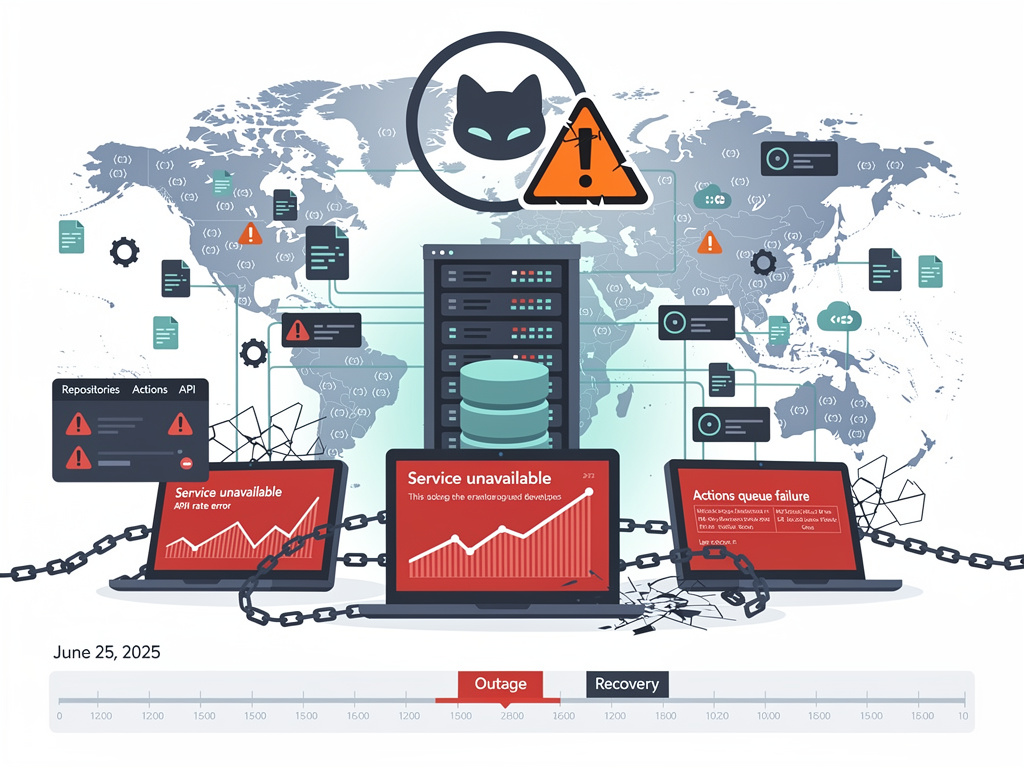
On the morning of June 25, 2025, millions of software developers around the world encountered an unwelcome sight: GitHub, the world’s largest code hosting platform and the backbone of modern software development, was experiencing significant service degradation. What began as a planned database migration spiraled into a multi-hour incident that disrupted repositories, pull requests, GitHub Actions, and a constellation of dependent services — laying bare the fragility that can lurk beneath even the most robust infrastructure.
The incident, formally tracked on GitHub’s status page under incident identifier 54hndjxft5bx, marked one of the more consequential outages the Microsoft-owned platform has experienced in 2025. For the legions of engineers, DevOps teams, and open-source maintainers who depend on GitHub as the central nervous system of their workflows, the disruption was a stark reminder that even trillion-dollar ecosystems rest on infrastructure that can buckle under unexpected stress.
A Migration That Went Sideways: The Timeline of Events
According to the official incident report published on GitHub’s status page, the trouble began during a scheduled database migration — a routine but inherently risky operation in which data is moved or restructured across database systems. GitHub’s engineering team initiated the migration during what was intended to be a low-traffic window, a standard practice designed to minimize user impact. However, the migration triggered unanticipated load patterns on the platform’s primary database clusters, causing cascading failures across multiple services.
The first signs of trouble appeared when users began reporting elevated error rates on Git operations — the fundamental push, pull, and clone commands that developers rely on thousands of times per minute across the platform. Within minutes, the degradation spread to GitHub Actions, the platform’s continuous integration and continuous deployment (CI/CD) service that automates software testing and deployment pipelines for millions of repositories. GitHub Pages, Codespaces, and the platform’s API endpoints were also affected, according to updates posted to the status page throughout the incident window.
The Ripple Effect Across the Software Supply Chain
GitHub’s engineering team acknowledged the incident and began investigating within approximately 15 minutes of the first alerts. Status page updates indicated that the team identified the database migration as the root cause and began executing rollback procedures. However, rolling back a large-scale database migration on a platform serving over 100 million developers is not a trivial operation. The process required careful coordination to avoid data loss or corruption, which extended the recovery timeline beyond what many users — and their automated systems — could tolerate.
The downstream consequences were immediate and far-reaching. GitHub Actions is deeply embedded in the software delivery pipelines of enterprises, startups, and open-source projects alike. When Actions went down, automated test suites stopped running, deployment pipelines stalled, and release schedules slipped. For companies practicing continuous deployment — where code changes are automatically pushed to production multiple times per day — the outage effectively froze their ability to ship software. Engineering teams at companies large and small found themselves in an uncomfortable holding pattern, unable to merge code, run tests, or deploy updates.
The incident also highlighted the concentration risk inherent in the modern software development ecosystem. GitHub is not merely a code repository; it is a platform upon which an enormous portion of the global software supply chain depends. Package registries, dependency resolution systems, and automated security scanning tools all interface with GitHub’s infrastructure. When that infrastructure falters, the effects propagate outward like ripples in a pond, touching systems and organizations that may not even realize their dependency on a single platform.
Developer Frustration and the Question of Redundancy
On social media platforms, particularly X (formerly Twitter), developers voiced their frustration in real time. Many noted that this was not the first significant GitHub outage in recent memory, and some questioned whether the platform’s reliability had kept pace with its growing centrality to the software industry. “Every GitHub outage is a reminder that we’ve built a single point of failure for the entire industry,” one widely shared post on X read. Others pointed out that while GitHub offers a 99.9% uptime service level agreement for its Enterprise customers, even brief outages can have outsized consequences given the platform’s role in automated workflows.
The frustration was compounded by the nature of the incident’s communication. While GitHub’s status page provided regular updates, some developers noted that the updates were vague about the technical specifics of what had gone wrong. The initial updates confirmed that a database migration was involved and that the team was working on remediation, but granular details about which database systems were affected, the nature of the cascading failure, and the specific rollback strategy were not disclosed during the incident. This is a common tension in incident communication: engineering teams must balance transparency with the need to focus on resolution, and premature disclosure of technical details can sometimes create more confusion than clarity.
Microsoft’s Stewardship Under the Microscope
GitHub’s parent company, Microsoft, acquired the platform in 2018 for $7.5 billion, and since then has invested heavily in expanding GitHub’s feature set and infrastructure. The addition of GitHub Copilot, the AI-powered coding assistant, and the expansion of GitHub Actions into a full-featured CI/CD platform have made GitHub more indispensable than ever. But that indispensability cuts both ways: the more critical GitHub becomes, the higher the stakes when something goes wrong.
Microsoft has positioned GitHub as a cornerstone of its developer ecosystem strategy, integrating it tightly with Azure cloud services and Visual Studio development tools. The June 2025 outage raises questions about whether the pace of feature development and platform expansion has outstripped investment in the underlying infrastructure’s resilience. Database migrations, while routine, are among the most common causes of major outages across the technology industry. The fact that a migration could trigger cascading failures across so many GitHub services suggests that there may be architectural coupling between systems that ideally would be more isolated from one another.
Industry analysts have noted that GitHub’s outage frequency, while not dramatically different from other major cloud platforms, is more visible because of the platform’s unique position. When Amazon Web Services or Google Cloud experiences an outage, the impact is distributed across thousands of different applications and services, making it harder for any single narrative to coalesce. When GitHub goes down, every developer on the planet notices simultaneously, and the conversation on social media is immediate and unified.
Lessons for Enterprise Teams and Platform Architects
For enterprise engineering leaders, the incident serves as a case study in the importance of multi-platform resilience strategies. While GitHub’s dominance makes it the default choice for most organizations, the outage underscores the value of maintaining at least some degree of redundancy. Some organizations mirror their repositories to secondary platforms such as GitLab or Bitbucket, ensuring that core development operations can continue even if GitHub is unavailable. Others maintain local Git server infrastructure as a fallback, though this approach carries its own operational overhead.
The incident also reinforces the importance of robust incident response and communication practices. GitHub’s status page, hosted at githubstatus.com, served as the primary communication channel during the outage, and the team’s regular updates — while sometimes lacking in technical specificity — provided a consistent cadence of information that helped users understand the scope and trajectory of the incident. For organizations that operate their own platforms, the GitHub outage is a useful benchmark for evaluating their own incident communication practices.
The Road to Recovery and What Comes Next
GitHub’s engineering team ultimately resolved the incident by completing the database rollback and implementing additional safeguards to stabilize the affected services. In the hours following the resolution, the team confirmed that no customer data had been lost during the incident — a critical assurance given the sensitivity of the code and intellectual property hosted on the platform. The status page was updated to reflect full operational status, and GitHub indicated that a more detailed post-incident review would be published in the coming days.
Post-incident reviews, or “postmortems” in industry parlance, are a critical component of the incident management lifecycle. They provide an opportunity for engineering teams to analyze what went wrong, identify contributing factors, and implement changes to prevent recurrence. GitHub has historically published detailed postmortems following major incidents, and the developer community will be watching closely for the review of this event. Key questions include: What specific aspect of the database migration triggered the cascading failure? Were there monitoring gaps that delayed detection? And what architectural changes will be made to improve isolation between services?
The June 2025 outage will likely accelerate conversations within the industry about the risks of platform concentration and the need for more resilient software supply chains. As GitHub continues to expand its feature set and deepen its integration with the broader Microsoft ecosystem, the platform’s reliability will remain under intense scrutiny. For the 100 million-plus developers who depend on GitHub every day, the message is clear: the platform that powers the world’s software is, itself, software — and software, as every developer knows, is never perfect.


 WebProNews is an iEntry Publication