
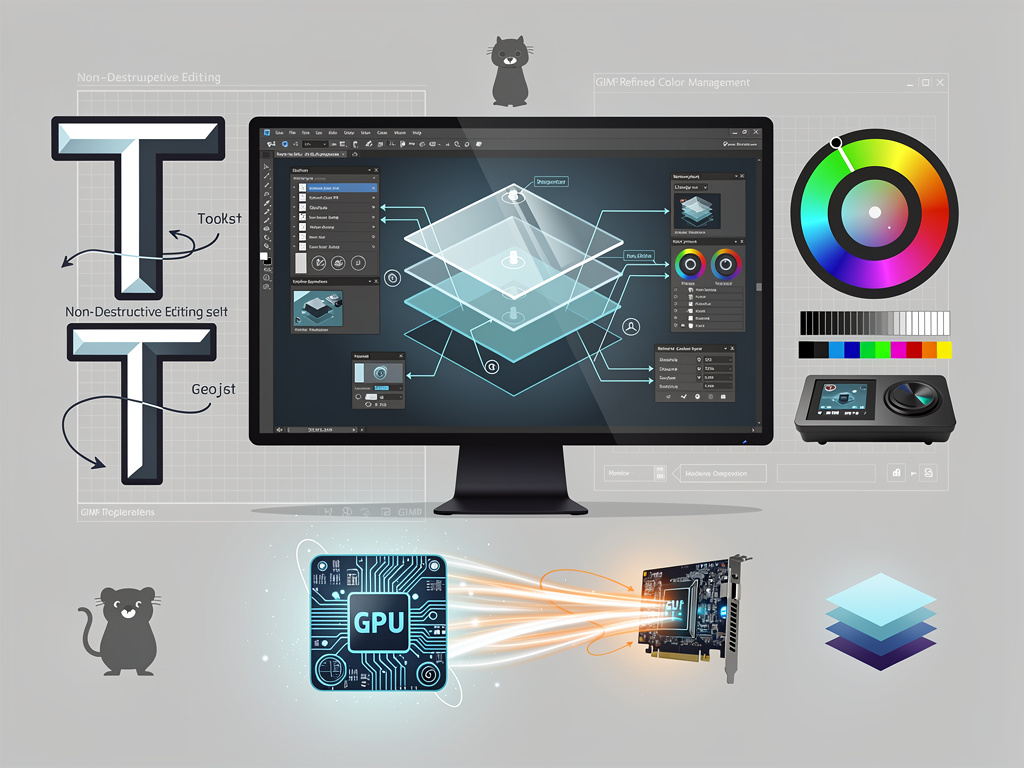
For more than three decades, the GNU Image Manipulation Program—better known as GIMP—has served as the open-source world’s answer to Adobe Photoshop. But after years of incremental updates and a notoriously slow development cycle, the project’s contributors are now charting a course that could fundamentally reshape the application’s capabilities. A newly published roadmap of features planned for versions beyond GIMP 3.2 reveals sweeping ambitions: non-destructive editing, advanced text tools, a revamped color management pipeline, and deep integration with cutting-edge graphics technologies. For industry professionals who have long dismissed GIMP as a hobbyist’s tool, these plans merit serious attention.
The disclosure, first reported by Phoronix, draws from discussions among GIMP’s core development team about priorities once the forthcoming 3.2 release ships. While GIMP 3.0—the long-awaited migration to GTK3—represented a foundational overhaul of the application’s interface toolkit, and version 3.2 is expected to bring further stabilization and refinements, the post-3.2 era is where the project’s most transformative features are being staged. These are not idle wishes on a mailing list; they represent a structured development agenda that reflects both user demand and the maturation of GIMP’s underlying architecture, particularly its use of the GEGL (Generic Graphics Library) image-processing framework.
Non-Destructive Editing: The Feature That Could Change Everything
Perhaps the single most consequential item on the post-3.2 roadmap is the full implementation of non-destructive editing. This is the capability that has long separated professional-grade tools like Adobe Photoshop and Affinity Photo from GIMP in the eyes of working designers and photographers. Non-destructive editing allows users to apply filters, adjustments, and transformations to image layers without permanently altering the underlying pixel data. Changes can be revisited, reordered, and removed at any point in the workflow—a paradigm that is essentially table stakes in modern professional image editing.
GIMP’s developers have been laying the groundwork for non-destructive editing for years through the GEGL integration that began in earnest with GIMP 2.10. GEGL operates as a graph-based image processing framework, meaning operations are represented as nodes in a pipeline rather than as irreversible pixel manipulations. The transition to GEGL was always intended to enable non-destructive workflows, but the complexity of retrofitting such a system into GIMP’s decades-old codebase has made progress painstaking. According to the development discussions cited by Phoronix, the post-3.2 cycle is when this work is expected to reach a user-facing state, with non-destructive filters and adjustment layers becoming accessible through the standard interface.
Text Handling Gets a Long-Overdue Overhaul
Another area of significant planned improvement is GIMP’s text tool, which has been a persistent source of frustration for users who need to do anything beyond the most rudimentary typographic work. The current text tool in GIMP, while functional for basic label placement, lacks the sophistication found in competing applications—features like on-canvas text editing with full formatting controls, advanced kerning and tracking adjustments, text-on-a-path refinements, and support for OpenType features such as ligatures, stylistic alternates, and variable fonts.
The post-3.2 plans indicate that text handling will receive substantial attention, with the goal of making GIMP a more viable tool for design work that involves significant typographic elements. This is a critical gap to close. For graphic designers who might otherwise consider GIMP for web graphics, social media assets, or print collateral, the weakness of the text tool has historically been a deal-breaker. Improving it would expand GIMP’s addressable user base considerably, moving it from a tool primarily used for photo retouching and digital painting into territory more commonly associated with design-oriented applications.
Color Management and High-Bit-Depth Workflows Mature
GIMP’s color management system is also slated for further enhancement in the post-3.2 timeframe. While GIMP 2.10 introduced support for high-bit-depth editing—allowing users to work in 16-bit and 32-bit floating-point precision per channel—the color management workflow has remained somewhat cumbersome compared to what professionals expect. The planned improvements aim to streamline ICC profile handling, improve soft-proofing capabilities, and ensure that GIMP’s color pipeline behaves predictably across different output targets, whether those are calibrated monitors, offset printing presses, or wide-gamut digital displays.
For photographers and prepress professionals, robust color management is not optional—it is the foundation upon which all other editing decisions rest. An image that looks correct on a designer’s monitor but shifts dramatically when printed or viewed on a different device represents a fundamental workflow failure. GIMP’s developers appear to recognize that closing the gap with commercial tools in this area is essential for the application’s credibility in professional environments. The GEGL framework’s native support for high-precision color data provides a strong technical foundation, but the user-facing tools for managing color workflows need to match that underlying capability.
Hardware Acceleration and Performance Gains on the Horizon
Performance is another area where the post-3.2 roadmap promises meaningful advances. GIMP has historically been criticized for sluggish performance when working with very large files or applying computationally intensive filters. The planned improvements include better utilization of GPU acceleration through OpenCL, more efficient multi-threaded processing, and optimizations to GEGL’s rendering pipeline that should reduce the latency users experience when applying complex operations to high-resolution images.
The importance of hardware acceleration cannot be overstated in an era when photographers routinely work with 50-megapixel and even 100-megapixel raw files, and when digital artists create canvases with dozens or hundreds of layers. Adobe has invested heavily in GPU acceleration for Photoshop, and Affinity Photo was designed from the ground up with hardware-accelerated rendering. For GIMP to compete credibly with these tools, it must be able to handle large, complex projects without the interface becoming unresponsive. The development team’s focus on this area suggests an awareness that performance parity—or at least performance adequacy—is a prerequisite for professional adoption.
Plug-In Ecosystem and Extensibility Remain Core Strengths
GIMP’s extensibility through its plug-in architecture has always been one of its distinguishing strengths, and the post-3.2 plans indicate continued investment in this area. The GIMP 3.0 release brought a modernized plug-in API built around GObject Introspection, which allows plug-ins to be written in a wider variety of programming languages, including Python 3 and JavaScript, in addition to the traditional Script-Fu and C interfaces. Future versions are expected to further refine this API, making it easier for third-party developers to create sophisticated extensions that integrate seamlessly with GIMP’s evolving non-destructive workflow.
This is strategically important because a vibrant plug-in ecosystem can compensate for gaps in the core application’s feature set. Photoshop’s dominance has been reinforced not just by Adobe’s own development efforts but by the vast ecosystem of third-party plug-ins, presets, and extensions that have grown up around it. If GIMP can lower the barrier to plug-in development and attract a larger community of extension authors, it could accelerate its feature development in ways that the relatively small core team could not achieve alone.
What This Means for the Open-Source Graphics Community
The broader significance of GIMP’s post-3.2 roadmap extends beyond the application itself. GIMP is a cornerstone of the open-source creative software stack, alongside tools like Inkscape for vector graphics, Krita for digital painting, Blender for 3D modeling and animation, and Darktable and RawTherapee for raw photo processing. Improvements to GIMP’s core capabilities—particularly non-destructive editing and better color management—would strengthen the entire ecosystem by making it more feasible for creative professionals to adopt an all-open-source workflow.
There are, of course, reasons for cautious optimism rather than unbridled enthusiasm. GIMP’s development history is littered with ambitious plans that took far longer to materialize than initially hoped. The migration from GTK2 to GTK3, for instance, was discussed for years before GIMP 3.0 finally reached release candidate status. The project relies heavily on volunteer contributors, and while institutional support from organizations like the GNOME Foundation and occasional grant funding have helped, the development pace remains constrained by available resources. Whether the post-3.2 features arrive in two years or five will depend on factors that are difficult to predict.
A Credible Path Forward for Professional Users
Nevertheless, the existence of a coherent, technically grounded roadmap is itself significant. It signals that GIMP’s development community is thinking strategically about what the application needs to become, not just patching what it already is. The focus on non-destructive editing, improved text tools, professional color management, and hardware-accelerated performance addresses the precise shortcomings that have historically prevented GIMP from being taken seriously in professional production environments.
For organizations evaluating their software costs—particularly in education, government, and nonprofit sectors where licensing fees for Adobe Creative Cloud represent a significant budget line—GIMP’s trajectory is worth monitoring closely. If the post-3.2 features materialize as planned, GIMP could transition from a capable but limited alternative into a genuinely competitive option for a wide range of professional imaging tasks. The open-source image editor that has always promised to be “good enough” may finally be setting its sights on being simply good.


 WebProNews is an iEntry Publication