
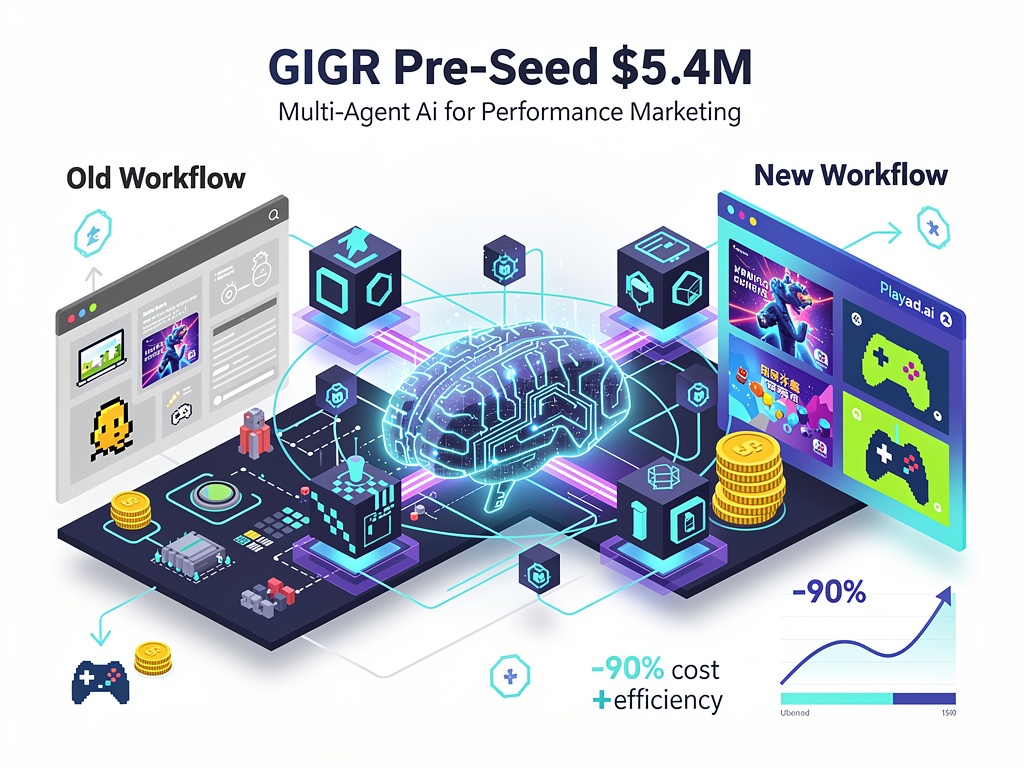
San Francisco startup GIGR, operating as Playad.ai, has secured $5.4 million in pre-seed funding to pioneer multi-agent AI systems that automate the advertising creative process from inception to optimization. The round, announced January 22, 2026, was led by BRV Capital Management and Mirae Asset Venture Investment, with angels Bora Chung—a Krafton board member and former Bill.com executive—Jihun Yu, founder of Epic Games-acquired Hyprsense, and Krew Capital joining in. This capital injection arrives amid surging demand for AI-driven tools in performance marketing, where creative quality increasingly dictates return on ad spend.
Playad.ai, launched in the third quarter of 2025, targets the inefficiencies plaguing ad production: slow iteration cycles reliant on human guesswork and costly specialists. The platform employs multi-agent AI workflows to handle briefing, generation, testing, measurement, and refinement, enabling marketers to produce variants rapidly. Early adopters report up to 90% cuts in production expenses and boosted acquisition efficiency, according to the company’s press release distributed via PRNewswire.
Interactive Ads as the Entry Point
GIGR zeroes in on interactive ads, particularly for gaming, where these formats shine by letting users sample products through taps, swipes, and choices—yielding higher conversions at reduced cost per install, or CPI. Unlike static images or videos, interactives capture detailed engagement data, clarifying what drives performance. Playad.ai simplifies their creation, stripping away the need for developers and high costs that historically sidelined them.
The site’s enterprise tier promises 3-5x engagement lifts via playable ads, alongside tools like AI UGC generators, avatar creators, and image-to-video converters. Trusted by gaming giants Nexon, Krafton, Kabam, and Devsisters—as well as Match Group and Kakao Style—the platform spans gaming, dating, beauty, and e-commerce, per details from Playad.ai.
Founders’ Pedigrees Fuel Ambition
CEO Jay Jaeyeon Cho, who scaled Bagelcode’s AI game studios to over 50 million users and $70 million in annual revenue, anchors the product vision at the nexus of gaming, AI, and marketing. Co-founder Steve Nam Hyuk Chung, with MIT and Wharton credentials plus stints at Bank of America, PlayStation, YouTube, and 20th Century Fox, drives business strategy. Engineering lead Jayden Hyun Jae Park honed scalable AI at Devsisters, while Simon, Arthur, Daniel, and Youn contribute elite training from Stanford and POSTECH.
“Marketing performance increasingly depends on how quickly teams can learn from creative—and act on it,” Mr. Chung said. “We’re building AI agents that make iteration the default, so teams can quickly apply what’s already working across the market to their next creative without sacrificing quality.” Such expertise positions GIGR to tackle creative as marketing’s pivotal lever, as outlined in MarTech Cube.
Why Interactive Dominates Gaming UA
Industry data underscores the rationale: playable ads hit record performance in 2025, often slashing CPI while boosting conversions up to sevenfold versus standard formats, as noted in analyses like AppAgent’s mid-year review. They filter high-intent users, yielding quality installs despite potentially higher upfront costs. GIGR’s innovation lies in AI acceleration, generating endless variations for A/B testing without manual toil.
Playad.ai’s pipeline—Discover top competitor ads, Create on-brand variants, Edit and scale—integrates premium models like Sora 2 Pro and Veo 3.1. Pricing tiers from free (25 credits) to enterprise custom plans support solo creators up to teams, with credits charged only on downloads.
Platform Features Unlock Scale
Beyond interactives, features like Ad Clone recreates winners in custom styles, Brand DNA analyzes sites for voice alignment, and Prompt Enhancer refines inputs for superior AI outputs. These tools centralize assets, track competitors, and support 70+ languages, democratizing pro-level production. Gaming firms, facing CPI exceeding $30 for traditional campaigns, stand to gain most, mirroring sector shifts toward playables.
“We’re not trying to simply produce ‘more assets,’” Mr. Cho stated. “We’re building a system where every launch creates learning—and that learning directly improves the next creative decision. Creative is the most important lever for improving ROAS in modern marketing.” This feedback loop, powered by multi-agent orchestration, promises to eliminate uncertainty, per Yahoo Finance.
Investor Backing Signals Confidence
BRV Capital and Mirae Asset’s leadership reflects belief in AI’s role amid maturing ad tech. Angels like Mr. Chung of Krafton—deep in gaming—and Mr. Yu, whose Hyprsense exit proves acquisition savvy, add strategic heft. Krew Capital rounds out a syndicate blending VC firepower with operator insights.
Recent X posts from trackers like @raisingfi highlight the deal’s buzz in AI funding circles, positioning GIGR among fresh entrants tackling $200 billion-plus digital ad spends.
Broader Implications for MarTech
GIGR arrives as AI reshapes marketing workflows, with platforms like Playad.ai extending beyond gaming to video and images. Cost savings—90% in extremes—coupled with data-rich iteration could redefine ROAS optimization. While enterprise interactives remain gated, freemium access lowers barriers, accelerating adoption across SMBs and scales.
Challenges persist: ensuring AI outputs evade platform bans, maintaining brand fidelity, and scaling multi-agent reliability. Yet, with 2025’s playable surge and GIGR’s traction via logos like Pocket Gems and NHN, the firm eyes expansion into full AI marketing agents, per PRNewswire disclosures.
Funding in AI Ad Tech Surge
This pre-seed fits a pattern where AI tools snag early capital for niche dominance. Unlike broader plays, GIGR’s gaming wedge leverages proven format edges—higher retention, better LTV—before generalizing. Site metrics tout 10x creative volume in 100x less time, validated by customer efficiencies.


 WebProNews is an iEntry Publication