
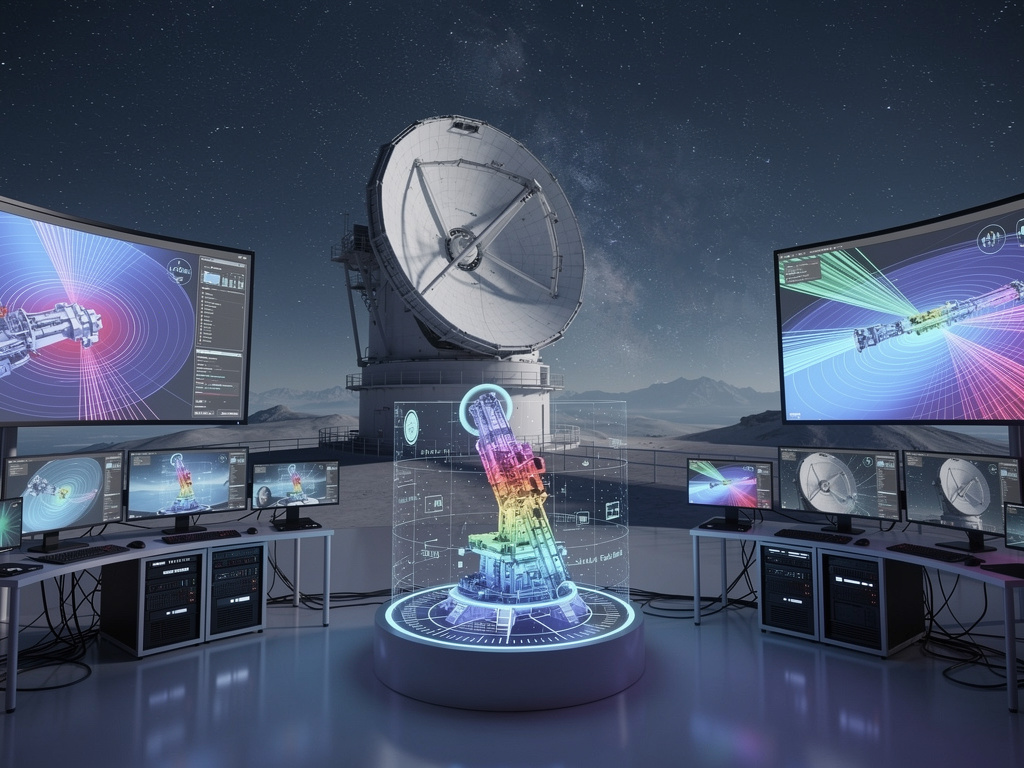
Virtual Frontiers: Gaming Tech’s Leap into Astronomical Simulation
In the high-stakes world of astronomical engineering, where precision can mean the difference between groundbreaking discoveries and costly failures, a surprising tool from the video game industry is making waves. The Giant Magellan Telescope (GMT), one of the most ambitious observatory projects underway, has turned to Unreal Engine—a platform best known for powering immersive games like Fortnite—to create a sophisticated simulation called BOB. This digital twin isn’t just a fancy visualization; it’s a critical testing ground for the telescope’s complex systems before they’re built in the real world.
BOB, which stands for “Build, Operate, Break,” allows engineers to construct virtual models of the GMT, operate them under various conditions, and even intentionally “break” components to study failures. This approach draws from gaming technology’s strengths in real-time rendering and physics simulation, adapting them for scientific rigor. By leveraging Unreal Engine’s capabilities, the GMT team can iterate designs rapidly, saving millions in potential rework costs.
The integration of such technology highlights a broader trend where entertainment software crosses over into serious scientific applications. For the GMT, slated for completion in the late 2020s atop Las Campanas Peak in Chile, BOB provides a sandbox to test everything from mirror alignments to wind effects on the structure. It’s a testament to how virtual environments can accelerate development in fields traditionally reliant on physical prototypes.
Engineering the Stars: Unreal Engine’s Role in Telescope Design
Unreal Engine, developed by Epic Games, offers photorealistic graphics and robust physics engines that make it ideal for simulating real-world scenarios. In the case of BOB, engineers input precise data about the GMT’s seven massive mirrors—each 8.4 meters in diameter—and simulate how they collect light from distant galaxies. This isn’t mere animation; it’s a physics-based model that accounts for variables like atmospheric distortion and mechanical vibrations.
Sources close to the project describe BOB as a game-changer for risk management. According to a report from TechRadar, the simulation enables the team to “build the telescope virtually, operate it as if it were real, and break it to see what happens.” This capability is crucial for a project with a budget exceeding $1 billion, where errors in the physical build could delay operations by years.
Beyond cost savings, BOB facilitates collaboration among international teams. Scientists from institutions like the Carnegie Institution for Science and Harvard University can access the simulation remotely, tweaking parameters and observing outcomes in real time. This democratizes the design process, allowing input from experts worldwide without the need for travel or physical models.
From Pixels to Planets: Bridging Gaming and Astronomy
The GMT isn’t the first scientific endeavor to borrow from gaming tech, but its use of Unreal Engine sets a new benchmark. Recent searches on platforms like X (formerly Twitter) reveal astronomers buzzing about similar applications, such as NASA’s use of game engines for Mars rover simulations. One tweet from an astrophysicist at Caltech noted how these tools could “revolutionize exoplanet detection by modeling light curves in virtual observatories.”
In BOB, the simulation extends to environmental factors, like how seismic activity in Chile might affect the telescope’s stability. Engineers can run thousands of scenarios overnight, identifying weak points that would take months to test physically. This predictive power is invaluable for a telescope designed to peer back to the universe’s earliest moments, potentially unveiling secrets about dark matter and black holes.
Moreover, Unreal Engine’s blueprint system allows non-programmers to script complex behaviors, lowering the barrier for astronomers to engage directly with the model. This user-friendly aspect, honed in the gaming world, now empowers scientists to focus on discovery rather than coding hurdles.
Challenges in Virtual Replication: Accuracy Meets Imagination
Yet, adapting a game engine for astronomical precision isn’t without hurdles. Unreal Engine excels at creating believable worlds, but astronomical simulations demand exacting fidelity to physical laws. The GMT team has customized the engine with plugins for high-precision optics simulation, ensuring that virtual light rays behave as they would in reality.
A deeper look into recent web articles, such as one from Space.com, discusses how BOB integrates real data from wind tunnels and material tests to refine its models. This hybrid approach blends empirical data with computational power, creating a feedback loop that enhances both the simulation and the actual design.
Critics, however, point out potential limitations. Some experts on X argue that while game engines handle macro-scale physics well, they might falter on quantum-level phenomena relevant to telescope optics. The GMT project counters this by layering in specialized software, ensuring BOB’s outputs align with rigorous scientific standards.
Global Collaborations: Building a Telescope in the Cloud
The international scope of the GMT— involving partners from the U.S., Australia, Brazil, Chile, Israel, and South Korea—benefits immensely from BOB’s cloud-based accessibility. Teams can collaborate in virtual reality sessions, walking through the digital telescope as if it were already constructed. This fosters innovation, with ideas from diverse perspectives shaping the final product.
Financially, the simulation justifies its investment by preempting expensive mistakes. For instance, early BOB runs identified issues with the enclosure’s aerodynamics, leading to redesigns that could save tens of millions. As reported in Nature, such virtual prototyping is becoming standard in large-scale science projects, from particle accelerators to space telescopes.
On social media, discussions on X highlight enthusiasm from the gaming community, with developers suggesting further enhancements like AI-driven anomaly detection. This cross-pollination could lead to even more advanced tools, blurring lines between entertainment and exploration.
Pushing Boundaries: Future Applications Beyond GMT
Looking ahead, BOB’s success could inspire similar simulations for other mega-telescopes, like the Extremely Large Telescope in Europe or the Thirty Meter Telescope in Hawaii. Unreal Engine’s scalability makes it adaptable for modeling entire observatory networks, potentially simulating coordinated observations across multiple sites.
Industry insiders speculate that this technology might extend to space-based instruments. A recent post on X from a SpaceX engineer pondered using game engines to simulate satellite constellations, drawing parallels to GMT’s approach. Such applications could accelerate missions to study cosmic phenomena like gravitational waves or habitable exoplanets.
Furthermore, educational outreach is a byproduct. The GMT organization plans to release simplified versions of BOB for public use, allowing students to explore telescope operations virtually. This could inspire the next generation of astronomers, much like how gaming has popularized STEM fields.
Innovation at the Edge: Technical Deep Dive into BOB
Delving into the technical weeds, BOB utilizes Unreal Engine’s Niagara system for particle effects to model atmospheric turbulence, creating realistic distortions in starlight. Custom shaders simulate the adaptive optics that will correct for Earth’s atmosphere, a key feature for ground-based telescopes aiming to rival Hubble’s clarity.
Integration with other tools, such as MATLAB for data analysis, ensures that simulation results feed directly into engineering workflows. According to insights from Astronomy Magazine, this setup allows for Monte Carlo simulations, running probabilistic models to assess long-term reliability.
Challenges in scaling arise with the GMT’s enormous data requirements—each mirror segment generates terabytes of positional data. The team has optimized Unreal’s rendering pipeline to handle this, using level-of-detail techniques borrowed from open-world games to maintain performance without sacrificing accuracy.
Ethical and Practical Considerations in Simulated Science
As with any cutting-edge tool, ethical questions emerge. Ensuring that virtual models don’t lead to overconfidence in untested designs is paramount. The GMT project mitigates this through rigorous validation against physical prototypes, blending digital and analog testing.
Practically, the energy demands of running high-fidelity simulations pose environmental concerns, especially for a project focused on understanding the cosmos. Efforts to optimize code and use green computing resources are underway, aligning with broader sustainability goals in astronomy.
Public engagement via X shows growing interest, with threads debating how such tech could democratize science. One viral post suggested open-sourcing parts of BOB, potentially accelerating global research efforts.
Horizons Expanded: The Broader Impact on Discovery
The ripple effects of BOB extend to fundamental research. By enabling faster iterations, the GMT could begin operations sooner, contributing to quests like mapping the universe’s expansion or detecting biosignatures on distant worlds.
Collaborations with tech giants like Epic Games hint at future synergies. Recent web searches uncover partnerships where game developers contribute to scientific visualizations, enhancing tools for data interpretation.
Ultimately, this fusion of gaming and astronomy underscores a pivotal shift: virtual worlds aren’t just for play; they’re portals to unlocking the universe’s deepest mysteries, one simulated star at a time.


 WebProNews is an iEntry Publication