
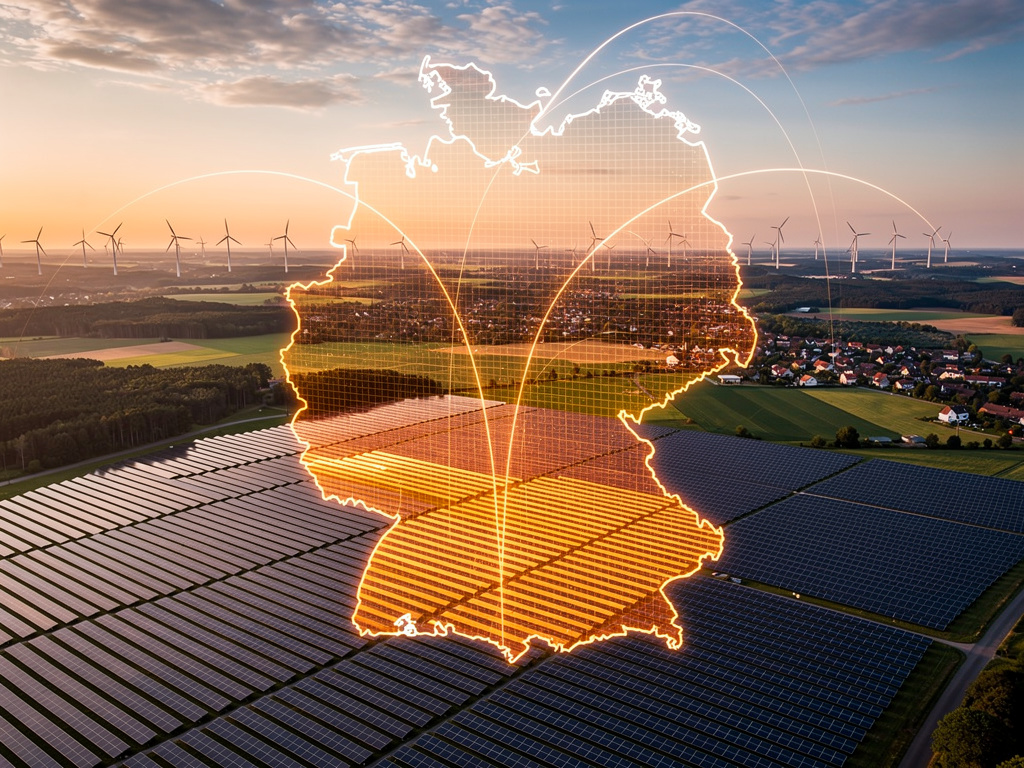
Germany’s push toward a sustainable energy future reached a notable milestone in 2025, with renewable sources accounting for nearly 56% of the country’s gross electricity consumption. This achievement, detailed in preliminary figures from energy industry group BDEW and research institute ZSW, reflects a modest 0.7 percentage point increase from the previous year. Despite setbacks like historically low wind production in the first quarter and a drop in hydropower, the expansion of solar capacity propelled this growth, underscoring the nation’s ongoing transition away from fossil fuels.
The data highlights solar power’s standout performance, with output surging by 18.7% year-over-year, fueled by the addition of more than 17 gigawatts of new capacity. This buildup continues a trend from prior years, where Germany has aggressively scaled up photovoltaic installations. Wind power, however, faced headwinds—literally—with a 5.2% decline in output due to unusually calm conditions, including the least windy March on record since 1950. Yet, stronger winds in the later quarters helped mitigate some losses, allowing renewables as a whole to edge forward.
This progress builds on 2024’s record, where renewables covered over 60% of net public electricity generation for the first time, according to the Fraunhofer Institute for Solar Energy Systems. Carbon dioxide emissions in the electricity mix hit historic lows that year, setting a foundation for 2025’s advancements. Industry observers note that while the 56% share for 2025 might seem incremental, it represents resilience amid fluctuating weather patterns and economic pressures.
Solar Surge and Wind Challenges
In the first half of 2025, renewables supplied 54% of electricity consumption, a slight dip from 57% in the same period of 2024, primarily due to weak winds. However, onshore wind expansion accelerated, marking the strongest growth since 2017, as reported by the Clean Energy Wire. This uptick in installations signals a potential rebound, with industry groups emphasizing that licensing and buildout paces are now at levels not seen in nearly a decade.
The third quarter proved particularly strong, with renewables contributing nearly two-thirds—64.1%—of public grid electricity, up from 63.5% the year before. Wind production jumped over 10%, claiming a 26.8% share, while solar rose 3.2% to 24.1%, per preliminary data from Germany’s statistical office Destatis, also covered in the Clean Energy Wire. Total renewable output grew 3% amid a 2% increase in overall electricity production, highlighting how capacity additions are translating into real gains during favorable seasons.
These quarterly variations illustrate the intermittency issues inherent in renewables, yet Germany’s grid has managed them effectively through a mix of storage solutions, demand management, and imports. Analysts point out that the country’s Energiewende policy, aimed at 80% renewables by 2030, remains on track, though challenges like grid expansion lag persist. The government has resisted calls to slow renewable rollout, opting instead to prioritize both generation and transmission upgrades.
Policy Stability and Industry Relief
Recent political developments have bolstered confidence in this trajectory. Following a September 2025 “reality check” report commissioned by the economy ministry, there were fears of scaled-back targets. The report urged fast renewable buildout but raised concerns about grid bottlenecks. Economy Minister Katherina Reiche’s suggestion to possibly temper expansion sparked uncertainty, but a subsequent agreement among coalition parties reaffirmed commitment to ambitious goals, as noted in another Clean Energy Wire article.
This stability has been welcomed by the energy sector, which had added a record 20 gigawatts of capacity in 2024—17 gigawatts from solar and 3.3 from wind. For 2025, the focus shifts to maintaining momentum, with warnings from researchers that policy disruptions could derail progress. The agreement emphasizes “continued strong expansion of electricity generation capacity” alongside grid enhancements, ensuring the transition supports industrial needs without compromising reliability.
Beyond domestic figures, Germany’s performance aligns with broader European trends. In the EU’s third quarter of 2025, renewables hit 49.3% of net electricity generation, a 3.8% rise from 2024, according to Eurostat. Countries like Estonia and Latvia saw even sharper increases, but Germany’s scale makes it a bellwether for the continent’s green shift.
Economic Implications and Cost Considerations
While the 56% milestone is celebrated, it comes with economic nuances. Power prices have fluctuated, influenced by renewable intermittency and reliance on gas-fired backups. Posts on X (formerly Twitter) from users like energy analysts highlight mixed sentiments: some praise the rapid decarbonization, noting wind overtaking coal in prior years, while others point to higher costs for consumers. For instance, discussions reference Germany’s 2023 renewable investment surge to 36.6 billion euros, underscoring the financial commitment required.
Critics, as echoed in various X threads, argue that reliability suffers, with fossil fuels briefly outpacing renewables in Q1 2025 for the first time since early 2023. That quarter saw fossil output rise 19.3% to 50.5% share, while renewables fell 17% to 49.5%, driven by weather anomalies. Yet, proponents counter that overall emissions are down, and the system’s adaptability—through measures like heat pumps and geothermal contributing 12.5% to heating—demonstrates long-term viability.
Looking ahead, security of supply remains a priority, with analysts forecasting a need for new gas plants to bridge gaps until full decarbonization. A Clean Energy Wire preview for 2026 stresses moving quickly on these while scaling renewables, maintaining the Energiewende’s core pillars: phasing out polluting sources, massive renewable deployment, and electrification.
Innovation and Global Context
Technological innovations are key to sustaining this progress. Germany’s emphasis on solar has benefited from advancements in panel efficiency and storage, with companies investing heavily in battery systems to smooth output variability. The Renewables Now report confirms that new solar facilities offset declines in wind and hydro, pushing the share forward despite adverse conditions.
Internationally, Germany’s model is watched closely. As a major economy, its ability to integrate 56% renewables without widespread blackouts challenges skeptics who doubt high-penetration feasibility. Comparisons to the U.S., where renewables reached about 23% in 2024 per some estimates, highlight Europe’s lead, though Germany’s higher industrial demand adds complexity.
Public sentiment, gleaned from X posts, shows enthusiasm for records like 62.7% renewables in 2024, with wind at 33% and solar at 14%. Users share graphs from sources like Agora Energiewende, projecting 80% by 2030 and full renewable dominance before 2040. This optimism is tempered by calls for balanced approaches, ensuring affordability amid global energy volatility.
Future Horizons and Strategic Shifts
As Germany eyes 2030 targets, grid modernization emerges as critical. Delays in transmission infrastructure have bottlenecked renewable integration, prompting calls for accelerated permitting and investment. The government’s stance, post the recent coalition pact, prioritizes harmony between expansion and infrastructure, avoiding past pitfalls where rapid additions outpaced grid capacity.
Sector coupling—linking power with heating and transport—further amplifies impacts. Renewables’ role in electricity is spilling over, with electric vehicles and heat pumps gaining traction. Data from the U.S. International Trade Administration outlines market opportunities in Germany’s energy sector, noting it as a top prospect for trade and innovation.
Ultimately, the 2025 figures encapsulate a narrative of perseverance. From a “historically weak” wind start to a robust third-quarter finish, Germany’s renewable journey illustrates the blend of policy resolve, technological prowess, and adaptive strategies needed for a low-carbon future. As debates on X and in industry forums continue, the consensus leans toward acceleration, positioning Germany as a blueprint for others navigating similar transitions.


 WebProNews is an iEntry Publication