
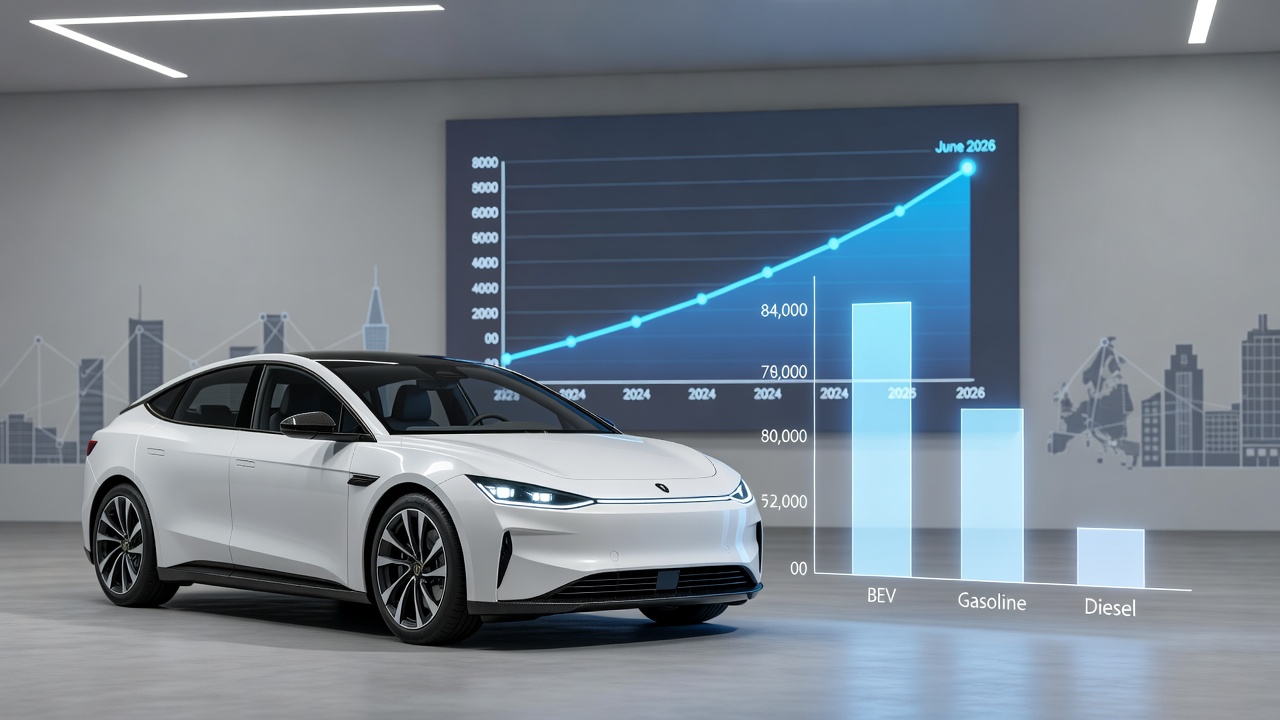
Germany just crossed a threshold few inside its auto industry saw coming so soon. In June 2026, battery-electric vehicles became the single most popular powertrain for new car buyers. They edged out hybrids. They left gasoline and diesel far behind.
From ICE Heartland to EV Leader
The numbers tell a stark story. Battery electrics racked up 84,057 registrations. Conventional hybrids managed 83,315. Gasoline cars came in at 60,796. Diesel lagged with 33,862. Plug-in hybrids added another 32,212. Total new passenger car registrations hit 296,378, up 15.7% from the year before. Battery electrics claimed 28.4% of the market. Electrek reported the details drawn from ADAC, Germany’s largest automobile club, which tracks Federal Motor Transport Authority (KBA) data.
But. This wasn’t some overnight sensation. It followed a brutal 2024. That year, the sudden end to federal purchase subsidies in late 2023 triggered a collapse. Battery-electric market share fell to 13.5% from 18.4% the prior year. Registrations of pure electrics dropped sharply. Analysts called it a hangover. Sales barely exceeded 2023 levels even after recovery began.
Then policy and market forces aligned. Company-car tax breaks remained favorable for electrics. More affordable models reached showrooms. Average battery-electric prices fell about 6%. Sales roared back in 2025. The International Energy Agency’s Global EV Outlook 2026 put German electric car sales at roughly 850,000 for the full year, a 50% jump, pushing the combined electric share near 30%. Other tallies from industry trackers put pure battery electrics at 545,142 for 2025, or about 19-20% of the market. Numbers vary slightly by definition of “electric.” The direction does not.
The Next Web first highlighted the June 2026 crossover in detail. Battery electrics outsold both gasoline and diesel combined for the first time. Hybrids nearly matched them but fell just short. Tesla’s Model Y led the electric pack with 6,023 units. Volkswagen’s ID.3 and Skoda’s Enyaq followed. The Next Web noted the symbolic weight. Germany, birthplace of the internal combustion engine, now registers more zero-emission cars in a single month than vehicles burning traditional fuels.
And the broader European picture adds weight. The IEA recorded 4.2 million electric cars sold across Europe in 2025, up more than 30% and reaching 28% of new-car sales. Twenty-four of 27 EU countries saw their electric share rise. Germany, as the largest market, drove much of that momentum once subsidies and lower prices kicked in. France held steady around 25%. Italy, Poland and Spain posted gains of 65%, 125% and 80% respectively after restarting purchase incentives.
Yet skeptics point to the installed base. Only about 4.1% of Germany’s 61 million passenger vehicles are fully electric. The vast majority still run on gasoline. Even with strong monthly gains, the fleet turns over slowly. CO2 emissions from road transport fell 13.6% year-over-year in recent readings, per some analyses, but decades of legacy vehicles will keep pumping pollutants.
Automakers feel the pressure. EU carbon-dioxide fleet standards tighten relentlessly toward 2035. Carmakers responded with more battery-electric launches. Affordable entries from Renault, Hyundai and others helped close the price gap. In Germany, company fleets embraced the tax advantages. Private buyers followed once total cost of ownership improved.
June’s result still carries caveats. One strong month does not guarantee a trend. Fuel prices spiked amid global oil market tensions, tilting some decisions toward electrics. Summer buying patterns may differ from winter. But the trajectory looks clear. Battery-electric sales in the first quarter of 2026 already showed 41% growth in some reports. March alone saw battery electrics hit 24% share in one reading.
Global context sharpens the view. China sold more than 13 million electrics in 2025, over half the world’s total. The United States held near 10% share but faced policy whiplash. Europe stands out for consistent regulatory push even after incentive cuts in certain countries. Germany’s rebound proves resilience. When lower prices meet stable incentives for fleets, buyers shift.
Industry executives have stayed mostly quiet on the exact milestone. No major German brand issued a victory statement. Volkswagen, still the domestic leader in electrics, continues to invest billions in its ID platform and new small-car projects. BMW and Mercedes push luxury battery offerings. All watch China closely. Imports and local production from Chinese brands add competitive heat.
What comes next matters most. Berlin plans fresh subsidies this year. EU officials debate flexibility in 2030 and 2035 targets. Charging infrastructure must expand. Range anxiety lingers for some segments. Yet the data shows progress. Every fifth new car in Germany last year carried a plug. In June, that ratio approached one in three when counting all plug-ins.
The shift carries economic stakes. Germany’s auto sector employs hundreds of thousands. Transition means retraining, new supply chains, battery plants. Suppliers tied to internal combustion components face tough choices. Some have already announced job cuts. Others pivot to electric components.
So the June figures represent more than a scoreboard victory. They signal accelerating change in the world’s original car-making powerhouse. Battery electrics didn’t just outsell gasoline and diesel. They topped the combined conventional options in a single month. For an industry built on diesel efficiency and gasoline performance, that counts as a historic handoff. The road ahead stays long. But the direction now looks unmistakable.


 WebProNews is an iEntry Publication