
Beaming Bits Across the Quantum Void: Teleportation Meets Everyday Internet
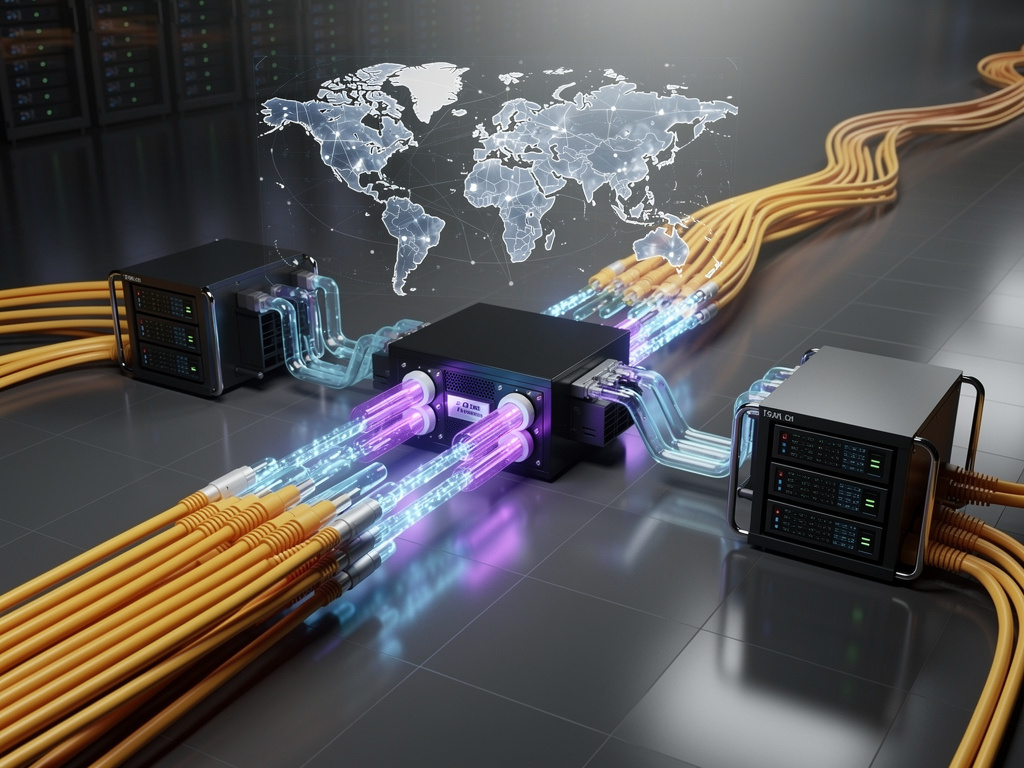
In the hushed labs of Germany’s Ferdinand-Braun-Institut, a team of physicists has turned what was once the stuff of science fiction into a tangible feat: quantum teleportation over standard internet infrastructure. This breakthrough, detailed in a recent study, involves transmitting quantum information between two devices using the same fiber-optic cables that carry everyday web traffic. The researchers, led by Stephan Reitzenstein, achieved this by teleporting data at wavelengths compatible with ordinary telecom networks, marking a pivotal step toward integrating quantum technologies into existing systems.
The experiment hinges on quantum entanglement, a phenomenon where particles become linked such that the state of one instantly influences the other, regardless of distance. In this case, the team used indium gallium arsenide quantum dots to generate entangled photons. These photons were then sent through 79 kilometers of optical fiber, with the quantum state successfully teleported from one end to the other. What sets this apart is the compatibility with current infrastructure—no need for specialized, ultra-cold setups or dedicated lines. As reported in CORDIS, the European Commission’s research portal, this work under the Quantum Flagship program demonstrates that quantum signals can coexist with classical data without interference.
This isn’t just a lab curiosity; it has profound implications for secure communications. Traditional encryption can be vulnerable to future quantum computers, but quantum key distribution promises unbreakable security. By proving teleportation over standard cables, the German team is paving the way for a hybrid network where quantum and classical data flow side by side.
Entanglement’s Practical Leap
Building on this, recent developments elsewhere echo the excitement. For instance, a team at Northwestern University in the U.S. achieved quantum teleportation over 30 kilometers of fiber optic cable amid live internet traffic. Their work, highlighted in ScienceAlert, involved entangling photons and transmitting quantum states without disrupting normal data flows. This feat underscores a growing consensus: quantum teleportation isn’t confined to isolated experiments but can integrate with the bustling digital world.
Posts on X (formerly Twitter) reflect the buzz, with users like Mario Nawfal sharing updates on how such advancements could lead to unhackable communications. One post noted that Northwestern’s engineers eliminated the need for dedicated lines by using entangled photons, a sentiment echoed across tech communities. Similarly, Oxford University’s breakthrough in connecting quantum processors via entanglement, as covered in WIRED, shows scalable quantum computing inching closer.
These strides address a core challenge: noise and loss in transmission. In the German study, the team mitigated this by operating at telecom wavelengths around 1550 nanometers, which are less prone to absorption in standard fibers. This choice not only boosts efficiency but also reduces costs, making quantum networks more feasible for widespread adoption.
From Dots to Networks
Delving deeper, the use of quantum dots—tiny semiconductor particles that emit single photons on demand—represents a technological cornerstone. The Paderborn University collaboration, as detailed in The Quantum Insider, achieved the first teleportation of photon states between spatially separated quantum dots. This involved transferring the polarization state of a photon from one dot to another, a key enabler for quantum repeaters.
Quantum repeaters are essential for long-distance quantum communication, acting as boosters to extend entanglement over vast distances. Popular Mechanics explored this in a piece on how such repeaters could form the backbone of a quantum internet, noting that recent teleportation successes clear paths for information relay without decoherence. Their article, found at Popular Mechanics, emphasizes that perfecting these devices is crucial for global-scale quantum networks.
Industry insiders are watching closely, as this could disrupt sectors like finance and defense. Imagine stock trades secured by quantum keys or military comms impervious to eavesdropping. The BBC Science Focus Magazine, in an article at BBC Science Focus, described how these ‘impossible’ feats are now reality, potentially leading to a quantum internet that outperforms classical ones in speed and security.
Overcoming Quantum Hurdles
Yet, challenges remain. Quantum states are fragile, easily disrupted by environmental factors like temperature fluctuations or vibrations. The German researchers tackled this by stabilizing their quantum dots at cryogenic temperatures, but scaling this to room-temperature operations is the next frontier. ScienceDaily reported on a related breakthrough in identifying the W state of entanglement, which could enhance teleportation protocols. Their coverage, available at ScienceDaily, explains how solving this decades-old problem opens doors to more robust quantum technologies.
On X, discussions highlight real-world applications, with posts praising the coexistence of quantum and classical signals. One user pointed out a 10-meter teleportation with over 90% success rate, illustrating progress in reliability. Phys.org detailed a similar achievement by the University of Stuttgart team, teleporting states between photons from different sources, as seen in Phys.org. This first-of-its-kind experiment used frequency conversion to match photon properties, a technique that could standardize quantum hardware.
For businesses, the economic angle is compelling. Integrating quantum tech into existing fiber networks avoids the trillions in infrastructure costs that a full overhaul would entail. Innovation News Network discussed Oxford’s teleportation work advancing quantum computing, noting its potential in cryptography and AI. Their insights, at Innovation News Network, suggest that as techniques refine, industries from materials science to electric vehicles could benefit.
The Road to Quantum Ubiquity
Looking ahead, collaborations like those under the EU’s Quantum Flagship are accelerating progress. The CORDIS article mentioned earlier highlights how funding has enabled such integrations, with the German team’s work showing quantum teleportation at efficiencies rivaling classical systems. This could lead to hybrid clouds where quantum processors handle complex simulations while classical networks manage data transfer.
StudyFinds.org covered physicists pulling off teleportation using existing internet tech, emphasizing light-emitting devices sending info over cables. Their report, at StudyFinds, notes the elimination of special infrastructure needs, a game-changer for accessibility.
X posts from accounts like Ashton Forbes underscore the surprise factor—no one thought existing lines could handle quantum info alongside standard comms. This sentiment aligns with broader trends, where quantum tech is demystified from sci-fi to practical tool.
Bridging Theory and Application
The theoretical underpinnings trace back to Einstein’s “spooky action at a distance,” but today’s applications are far from abstract. By teleporting quantum states, researchers enable protocols like quantum key distribution, which could secure everything from banking to healthcare data. ScienceDaily’s piece on teleporting information between photons from quantum dots, at another ScienceDaily entry, details how nearly identical semiconductor sources and frequency tweaks make this possible.
In the U.S., the Northwestern breakthrough, as per ScienceAlert’s world-first confirmation at ScienceAlert, involved photons from separate sources, bringing a quantum internet nearer. This mirrors global efforts, with X users buzzing about implications for AI-driven security.
For insiders, the metrics matter: fidelity rates above 90% in some tests, distances up to 79 km, and compatibility with 1550 nm wavelengths. These figures, drawn from the studies, indicate readiness for pilot programs.
Envisioning a Quantum Future
As these technologies mature, ethical considerations arise. Who controls quantum networks? How do we ensure equitable access? The Popular Mechanics article referenced earlier warns of the need for quantum repeaters to span continents, a hurdle being addressed through international partnerships.
X conversations often tie this to cybersecurity, with posts noting quantum’s role in countering AI-enhanced hacks. Mario Nawfal’s threads, for example, frame it as a defense against evolving threats.
Ultimately, this wave of advancements positions quantum teleportation as a cornerstone of next-gen tech. From the labs in Germany to U.S. universities, the fusion of quantum mechanics with everyday internet is not just possible—it’s happening now, promising a more secure, efficient digital world.


 WebProNews is an iEntry Publication