
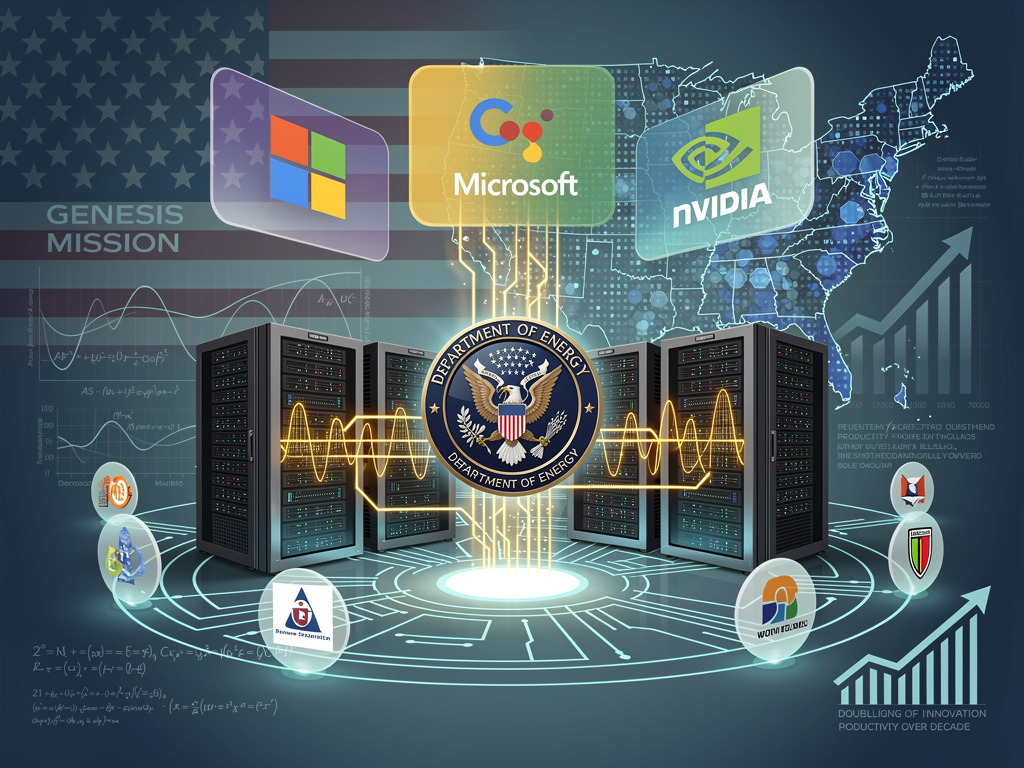
The U.S. Department of Energy has forged landmark agreements with 24 organizations, including Microsoft, Google and Nvidia, to propel the Genesis Mission forward—a bold initiative aimed at harnessing artificial intelligence to revolutionize scientific discovery and energy innovation. Announced on December 18, these pacts mark a pivotal escalation in the Trump administration’s push to dominate the global AI race through public-private synergy.
Launched via presidential executive order on November 24, the Genesis Mission seeks to integrate DOE’s supercomputers, AI systems and quantum technologies into the world’s most potent scientific platform. The collaborations, detailed in a Reuters report, position tech titans as key partners in accelerating breakthroughs across energy, national security and fundamental research.
Energy Secretary Chris Wright hailed the move as a ‘Manhattan Project-level leap,’ emphasizing its potential to double U.S. scientific productivity within a decade. Posts on X from the DOE account underscore the mission’s ambition, describing it as mobilizing all 17 national laboratories alongside industry and academia.
Roots of the Genesis Initiative
President Trump’s executive order ignited the Genesis Mission, framing it as a response to intensifying competition in AI-driven science. A DOE press release from November 25 portrays the platform as connecting supercomputers, AI and quantum systems to catalyze new industries and high-skill jobs.
The mission builds on prior DOE investments, including over $320 million announced on December 11 for AI capabilities, as reported by the department itself in an official update. This funding targets rapid advancements in AI for scientific computing, setting the stage for Big Tech’s involvement.
Early X posts from DOE, dating back to November 25, generated massive engagement, with one announcing ‘Genesis Mission has arrived’ amassing over 561,000 views. These communications positioned the effort as rivaling historic programs like Apollo.
Big Tech’s Strategic Entry
Microsoft, Google, Nvidia, Amazon and others signed memorandums of understanding to collaborate on AI infrastructure and R&D. A Bloomberg article notes the partnerships focus on boosting AI for scientific discovery and energy projects under the Trump administration.
Nvidia’s role, highlighted in a MarketScreener dispatch, involves outlining priorities for AI infrastructure investments. Amazon, Google and Microsoft aim to drive innovations in discovery science and national security, per Seeking Alpha.
These deals align with Big Tech’s broader energy strategies, as Reuters reported on December 11, where firms expand into nuclear and gas to fuel AI data centers.
Technical Backbone and Investments
The Genesis platform will leverage DOE’s 17 national labs, including Fermilab, which detailed the mission in a November 25 announcement. It promises to transform research in particle physics, materials science and beyond.
Recent DOE X activity ties Genesis to nuclear revival, with Secretary Wright stating at Idaho National Lab: ‘This is ground zero for the nuclear renaissance.’ A December 12 post linked AI advancements to powering new reactors.
Inside HPC reported on December 18 that the 24 agreements advance the mission’s goal of an integrated discovery platform, drawing from its coverage.
Implications for Energy and Security
Genesis prioritizes national priorities: energy innovation, scientific breakthroughs and security. DOE’s December 15 X post affirmed focus on these fronts to secure America’s future.
The initiative dovetails with efforts to slash NEPA regulations, as a December 15 DOE post declared: ‘BUILD, BABY, BUILD!’ This aims to expedite energy infrastructure amid nuclear base rebuilding.
A MarketScreener update on December 18 confirmed the 24 pacts, including tech giants, to enhance Genesis capabilities.
Broader Industry Ripples
DOE’s X posts from December 17 spotlight nuclear’s role in Trump’s energy agenda, promising record production and lower costs through reopened infrastructure.
The mission’s scale evokes historical precedents, with DOE comparing it to Manhattan and Apollo. Engagement metrics on X—such as 616,000 views on a launch post—signal strong public and industry buzz.
As of December 19, these developments position the U.S. at the forefront of AI-augmented science, with Big Tech’s commitments ensuring robust computational muscle.


 WebProNews is an iEntry Publication