
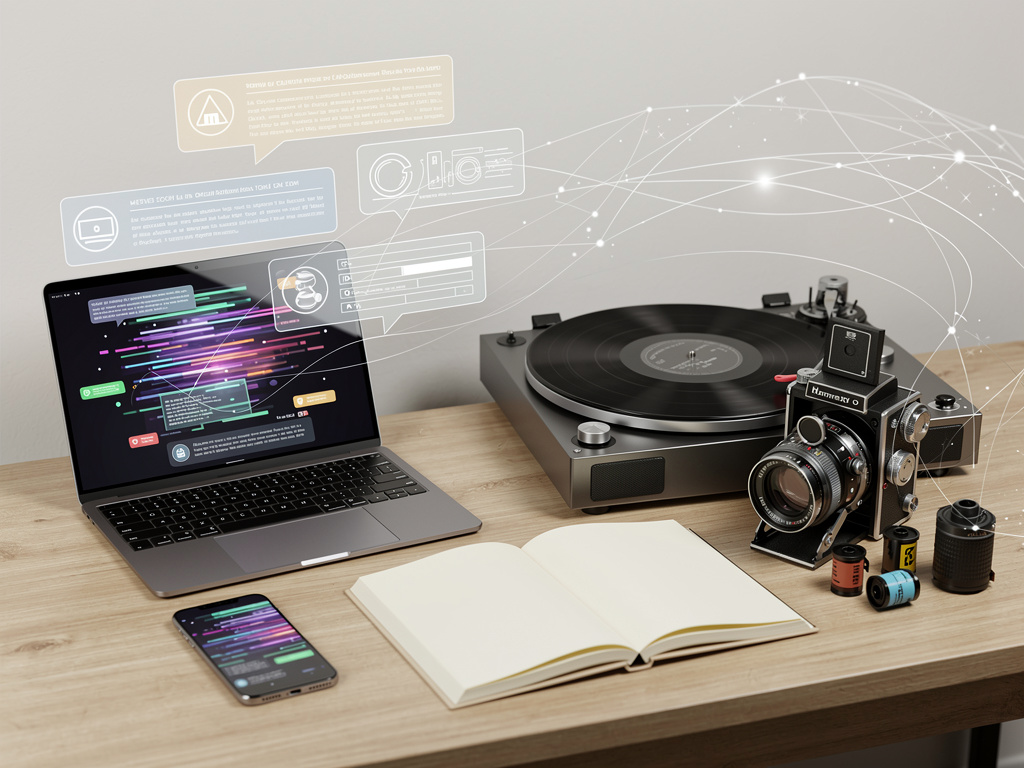
Echoes of Authenticity: Navigating the Shift from Digital Overload to Analog Depth
In an era where screens dominate daily life and algorithms curate our experiences, a quiet revolution is underway. Consumers, particularly younger generations, are turning away from the endless stream of digital content toward tangible, analog alternatives. This shift isn’t mere nostalgia; it’s a response to the fatigue induced by digital abundance. As reported in a recent piece on Medium, Gen Z is leading the charge in reviving vinyl records, film photography, and handwritten journals, seeking meaning in a world saturated with pixels and notifications.
The data underscores this trend. Vinyl sales have surged, with the Recording Industry Association of America noting a 17% increase in 2025 alone, driven largely by those under 25. This demographic, often labeled digital natives, is paradoxically craving the imperfections of analog media. Scratches on a record or the grain of a Polaroid photo offer a authenticity that polished digital files lack. Experts point to “digital fatigue” as the culprit—a term describing the mental exhaustion from constant connectivity and information overload.
Beyond music and photography, this movement extends to everyday practices. Bookstores report booming sales of physical books, while stationery brands like Moleskine see demand for notebooks skyrocketing. It’s not just about consumption; it’s about creation. People are rediscovering the joy of analog processes, from darkroom developing to manual typewriting, as ways to disconnect and reconnect with the physical world.
The Roots of Digital Discontent
This pivot stems from broader societal pressures. The pandemic accelerated digital adoption, but post-2023, many felt the downsides: shortened attention spans, increased anxiety, and a sense of isolation despite hyper-connectivity. A study by the Pew Research Center in 2025 found that 62% of young adults feel overwhelmed by social media, prompting a backlash. Analog experiences provide a counterbalance, fostering mindfulness and presence.
In the workplace, similar patterns emerge. Tech companies, once champions of all-digital environments, are incorporating analog elements. Google, for instance, has introduced “unplugged” zones in offices where employees use whiteboards and paper for brainstorming, citing improved creativity. This isn’t anti-technology; it’s a hybrid approach, blending digital efficiency with analog depth.
Cultural commentators argue this reflects a deeper quest for meaning. In a world where AI generates art and music instantaneously, the human touch becomes premium. As one industry insider noted, “Digital abundance has commoditized creativity; analog restores its soul.” This sentiment echoes across sectors, from fashion—where vintage clothing revivals thrive—to cuisine, with a return to heirloom recipes over app-delivered meals.
Economic Ripples of the Analog Revival
The economic implications are significant. Markets for analog goods are projected to grow robustly through 2030. According to a report from OpenPR, while digital converters advance technologically, the demand for pure analog experiences fuels niche industries. Vinyl pressing plants, once on the brink of extinction, now operate at capacity, with new facilities opening in the U.S. and Europe.
Investors are taking note. Venture capital flows into startups like those producing high-end turntables or artisanal film cameras. One such company, Analog Revival Inc., raised $50 million in 2025, betting on the longevity of this trend. Retailers adapt too; chains like Urban Outfitters stock analog tech alongside smart devices, blurring lines between old and new.
However, challenges persist. Supply chains for analog materials—think vinyl pellets or photographic film—are strained, leading to higher prices. Environmental concerns also arise; producing physical media consumes resources, prompting calls for sustainable practices. Brands respond with eco-friendly innovations, such as recycled vinyl or biodegradable film.
Generational Drivers and Global Variations
Gen Z’s influence is pivotal, but it’s not uniform. In Asia, particularly Japan, the analog resurgence manifests in “kawaii” stationery culture and a boom in mechanical watches. A post on X highlighted how young professionals there prefer analog timepieces for their tactile feedback, contrasting with smartwatch dominance elsewhere. This global variation shows the trend’s adaptability to cultural contexts.
In Europe, policy plays a role. The EU’s Digital Services Act, effective from 2024, curbs algorithmic overreach, indirectly boosting analog alternatives by encouraging mindful consumption. Meanwhile, in the U.S., educational institutions integrate analog methods; some schools ban devices in classrooms, opting for chalkboards to enhance focus.
Critics argue this is a fleeting fad, but data suggests otherwise. A 2026 survey by IBM predicts sustained growth, linking it to AI’s rise. As machines handle digital tasks, humans seek uniquely human experiences. This duality—AI for efficiency, analog for emotion—defines the emerging paradigm.
Technological Intersections and Innovations
Ironically, technology enables this analog comeback. Apps like Discogs connect vinyl collectors worldwide, while 3D printing revives obsolete camera parts. Hybrid devices, such as digital-analog synthesizers, merge worlds, appealing to musicians who value both precision and warmth.
Emerging tech like analog computing, as discussed in posts on X, promises efficiency gains. Researchers at Peking University have developed resistive devices that process data analog-style, potentially revolutionizing AI by reducing energy use. This isn’t a rejection of digital but an enhancement, where analog principles inform cutting-edge innovation.
In consumer electronics, companies experiment with analog interfaces. Samsung’s 2026 lineup includes smartphones with haptic feedback mimicking vinyl grooves, blending sensory experiences. Such innovations suggest the shift isn’t binary but a spectrum, where digital abundance yields to meaningful integration.
Cultural and Psychological Dimensions
Psychologically, analog appeals to our innate need for tangibility. Neuroscientists explain that physical interactions activate different brain regions than digital ones, enhancing memory and satisfaction. A study in the Journal of Consumer Research found that people derive more joy from analog purchases, viewing them as investments in well-being.
Culturally, this revival influences art and media. Independent films shot on celluloid gain prestige at festivals, while podcasts explore analog histories. Literature sees a surge in memoirs about unplugging, with authors like Cal Newport expanding on his “digital minimalism” philosophy.
Socially, analog fosters community. Record stores host listening parties, and photography clubs organize film walks, countering digital isolation. This communal aspect is vital, especially amid rising mental health concerns linked to screen time.
Market Challenges and Future Trajectories
Despite enthusiasm, barriers remain. Accessibility is an issue; analog hobbies can be costly, excluding lower-income groups. Efforts like community darkrooms aim to democratize access, but scalability is key.
Looking ahead, experts foresee deeper integration. A piece in The Guardian outlines how 2026 trends will emphasize balanced tech use, with analog playing a starring role. Predictions include augmented reality apps that simulate analog experiences, making them more inclusive.
Sustainability will shape the narrative. Brands adopting circular economies—recycling old records or refurbishing cameras—could mitigate environmental impacts, ensuring the trend’s longevity.
Voices from the Frontlines
Industry voices amplify the story. In an article from Monterey Herald, writers describe “analog islands” as refuges from digital seas, where people escape polarization and automation. This metaphor captures the essence: analog as sanctuary.
Entrepreneurs share insights too. A founder of a film revival startup notes, “We’re not fighting digital; we’re complementing it.” Such perspectives highlight collaboration over competition.
On X, sentiments echo this, with users predicting analog’s huge comeback amid tech fatigue. Posts discuss everything from vinyl’s tactile allure to analog computing’s potential, painting a picture of optimistic evolution.
Sustaining the Analog Momentum
To sustain momentum, education is crucial. Workshops teaching analog skills—from calligraphy to cassette taping—empower new generations. Museums curate exhibits on analog history, preserving knowledge.
Policy could accelerate this. Incentives for analog manufacturing, similar to green tech subsidies, might bolster the sector. International cooperation on standards could ease global trade in analog goods.
Ultimately, this shift redefines progress. It’s not about regressing but enriching lives through balanced choices. As digital tools advance, analog reminds us of our humanity, offering depth in an age of abundance.
Reflections on a Hybrid Horizon
Reflecting on hybrid models, the future looks promising. Innovations like ultra-high-speed analog-to-digital converters, as detailed in a report on OpenPR, bridge gaps, enabling seamless transitions between worlds.
Consumer behavior evolves accordingly. Surveys show increasing preference for “phygital” experiences—physical items enhanced by digital features, like smart journals that digitize handwriting.
This convergence suggests a mature phase, where analog isn’t a rebellion but a vital component of modern life, fostering creativity and connection in unexpected ways.
Emerging Narratives and Broader Impacts
Broader impacts span health and wellness. Analog practices like journaling reduce stress, per wellness experts. Fitness trends incorporate analog elements, such as mechanical bikes over app-driven ones, emphasizing effort over metrics.
In education, analog tools aid learning. Studies indicate better retention from handwriting notes versus typing, influencing curricula worldwide.
Narratives from diverse regions enrich the discourse. In Africa, analog radio remains a lifeline, blending with digital podcasts for hybrid media consumption.
Pathways to Inclusive Growth
For inclusive growth, affordability initiatives are essential. Subsidized analog kits for schools could bridge divides, ensuring the trend benefits all.
Technological equity matters too. As AI democratizes creation, analog provides an accessible counterpoint, requiring no electricity or updates.
This inclusive approach strengthens the movement, making analog a universal pursuit rather than an elite hobby.
Visions of Tomorrow’s Balance
Visions of tomorrow see analog embedded in daily routines. Smart homes might include analog nooks, free from devices, promoting balance.
Corporate strategies adapt, with firms like Apple exploring analog-inspired designs in future products.
In essence, the return to analog signifies a recalibration, where meaning trumps abundance, guiding us toward a more intentional future.


 WebProNews is an iEntry Publication