
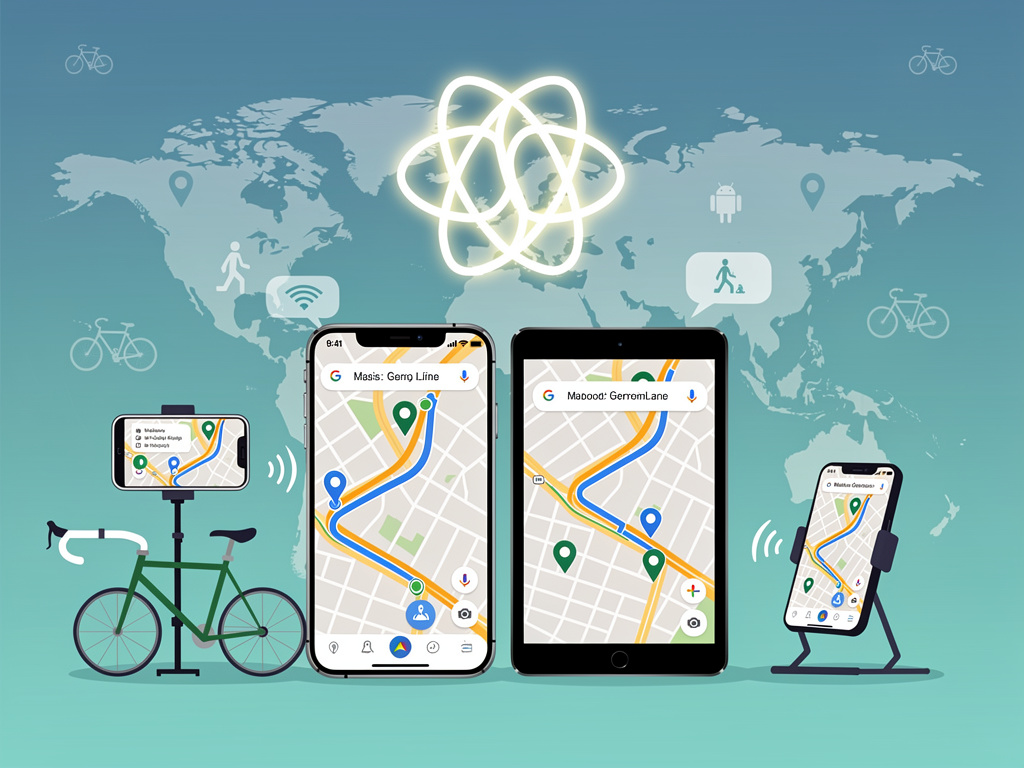
Google has extended its Gemini AI’s conversational prowess to walking and cycling navigation in Google Maps, marking a pivotal shift in how users interact with the app during pedestrian travel. Announced on January 29, 2026, the update allows hands-free queries worldwide on iOS where Gemini is available, with Android rollout underway. Users can now summon Gemini via voice commands or a top-right icon, transforming static directions into dynamic dialogues.
This expansion builds on Gemini’s driving-mode debut in November 2025, as detailed in Google’s blog post. For walkers, Gemini serves as a “personal walking tour guide,” responding to prompts like “OK Google, what neighborhood am I in?” or “What are top-rated restaurants nearby?” with route-tailored suggestions drawn from Maps’ real-world data. Cyclists gain safety-focused aids, querying “What’s my ETA?” or commanding “Text Sarah I’m 10 minutes behind” to send messages without releasing handlebars—though texting is Android-only, per 9to5Google.
Conversational AI Reshapes On-Foot Navigation
The feature supports multi-turn conversations, enabling follow-ups such as “Is there a budget-friendly restaurant with vegan options along my route?” followed by “What’s parking like there?” as reported by TechCrunch. Activation occurs through “Hey Google” hotwords or tapping the blue Gemini spark icon, replacing the legacy four-color microphone in many instances. Google likens the experience to “talking to a friend in the passenger seat,” a phrase echoed across announcements in CNET.
Prompts extend beyond navigation: “What’s my next turn?,” “Play some jazz,” “When does {Place Name} close?,” or “Show alternative routes.” Gemini integrates calendar checks (“When’s my next meeting?”) and music controls, all contextualized to the user’s path. This hands-free paradigm addresses the impracticality of typing mid-stride or pedal stroke, prioritizing safety and flow.
From Driving Debut to Pedestrian Power
The rollout clarifies prior ambiguities; while November 2025 updates hinted at broad navigation support—including walking and cycling in testing, as noted by 9to5Google—the January expansion explicitly dedicates conversational depth to non-driving modes. Earlier phases focused on driving, with features like incident reporting (“I see an accident”) rolling out via Google’s November blog. Now, pedestrian users benefit fully, with iOS live immediately and Android serverside deployment progressing.
Technical integration leverages Gemini’s reasoning over Maps’ dataset of 250 million places, enabling nuanced responses like bathroom-equipped cafes or must-see attractions en route. Limitations persist: Google Assistant lingers on some devices, and full Gemini availability ties to regional support. Android-exclusive actions highlight platform variances.
Safety and Utility in Motion
For cyclists, the update emphasizes road focus, delivering ETAs, meeting reminders, and outbound texts without device handling. Walkers explore neighborhoods via queries like “Tell me more about the neighborhood I’m in” or “Are there cafes with a bathroom along my route?,” per TechCrunch. This mirrors driving enhancements but adapts to lower speeds and urban intricacies.
Broader context reveals Google’s AI push: Recent Maps additions include Gemini-powered “know before you go” tips, EV charger predictions, and an enhanced Explore tab, as covered by TechCrunch. The timing aligns with Chrome’s Gemini sidebar and Gmail AI inbox previews, signaling ecosystem-wide embedding.
Industry Echoes and Early Reactions
Web coverage from Mashable and Chrome Unboxed in late 2025 anticipated full-mode rollout, confirming Gemini’s replacement of Assistant across driving, walking, cycling, and transit. Reddit threads on r/GooglePixel mixed enthusiasm with beta-era lag complaints, though 2026 refinements appear smoother. No widespread user backlash emerged post-January launch.
Analysts view this as Google’s bid to dominate multimodal navigation amid rising urban cycling—requests up historically, per older data—and walking amid remote-work flexibility. Integration with calendars, messaging, and media positions Maps as a mobility hub, challenging rivals like Apple Maps’ voice upgrades.
Technical Backbone and Rollout Nuances
Gemini’s context-awareness processes multi-step requests without navigation interruption, supporting commands like “Navigate home,” “Add stop,” or “Mute guidance.” Visual cues include a transient four-color ring settling to blue, per 9to5Google. Availability hinges on Gemini-enabled regions, with worldwide iOS precedence.
Future implications loom large: As Assistant phases out by March 2026, per Sammy Fans, Gemini cements dominance. Expansions could incorporate real-time bike-lane data or weather-adjusted ETAs, building on Europe’s low-emission alerts.
Strategic Stakes in AI Mapping


 WebProNews is an iEntry Publication