
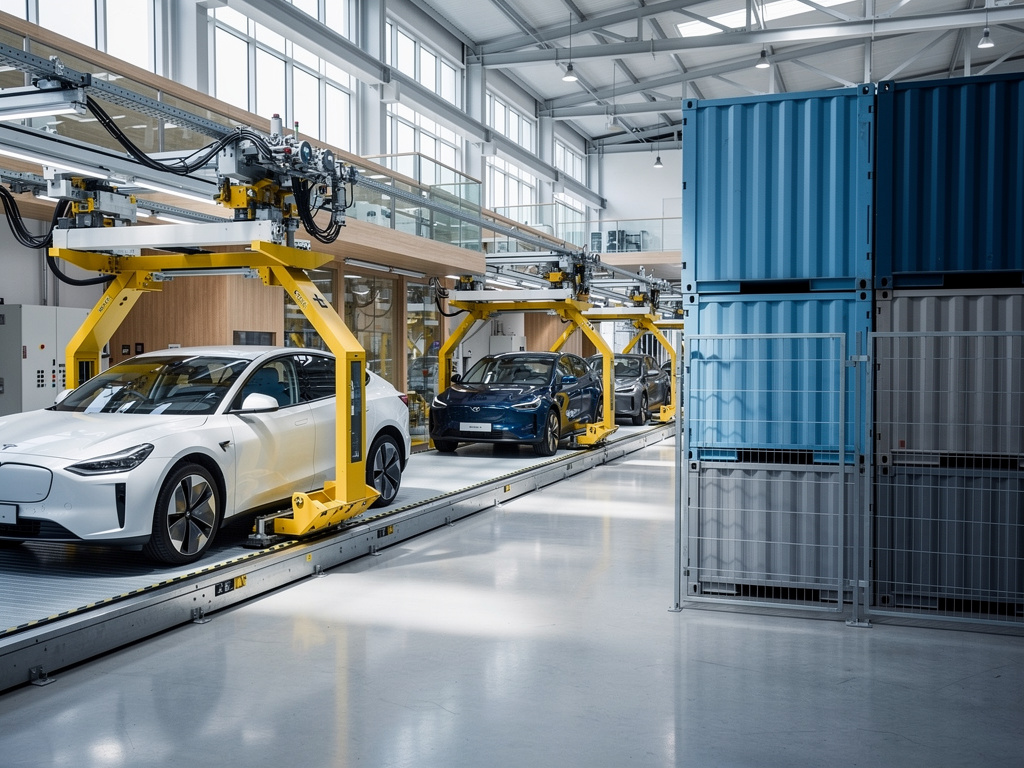
While Washington and Brussels race to erect tariff walls against Chinese electric vehicles, Zhejiang Geely Holding Group is doing something deceptively simple. It’s making cars where the customers are.
The Chinese automotive conglomerate — parent company of Volvo Cars, Polestar, Lotus, and the fast-growing Zeekr brand — is accelerating plans to shift production of key models into existing European factories, effectively sidestepping the trade barriers that threaten to lock Chinese-made vehicles out of Western markets. The strategy isn’t new in concept. But the speed and scale of Geely’s execution set it apart from virtually every other Chinese automaker.
According to The Next Web, Geely is preparing to use Volvo’s established manufacturing footprint in Belgium and Sweden to produce vehicles that would otherwise face punishing import duties. The move turns what critics have long called Chinese automotive overcapacity into something more like a distributed manufacturing advantage — one that plays by Europe’s own rules.
The Tariff Squeeze and Geely’s Counter
The pressure on Chinese automakers has been building for over a year. The European Union imposed provisional countervailing duties on Chinese-made EVs in July 2024, with rates reaching as high as 37.6% for some manufacturers. Geely-linked entities faced a 19.3% tariff. The United States, meanwhile, quadrupled its tariff on Chinese EVs to 100% earlier in 2024, making direct exports from China to America economically absurd.
These aren’t subtle signals. They’re walls.
But Geely’s corporate structure gives it options that BYD, NIO, and other Chinese competitors simply don’t have — at least not yet. When Geely acquired Volvo Cars from Ford Motor Company in 2010 for $1.8 billion, many industry observers viewed the deal with skepticism. A relatively unknown Chinese company buying one of Europe’s most storied automotive brands? The culture clash alone seemed insurmountable.
Fifteen years later, that acquisition looks like one of the shrewdest moves in modern automotive history. Volvo’s factory in Ghent, Belgium, and its facilities in Gothenburg and Torslanda, Sweden, give Geely something no amount of money can buy quickly: established, EU-based manufacturing capacity with trained workforces, supplier networks, and regulatory compliance already in place.
As The Next Web reported, Geely is now looking to produce Zeekr models — its premium EV brand that has gained significant traction in China — at Volvo’s European plants. This would allow Zeekr vehicles sold in Europe to qualify as European-manufactured, dodging the import tariffs entirely. The Ghent plant, which currently produces the Volvo XC40 and its electric variant, the EX40, has available capacity that could accommodate additional models.
Smart. Maybe even inevitable.
The logic extends beyond tariff avoidance. European consumers, politicians, and unions are increasingly sensitive to the origin of the vehicles on their roads. “Made in Belgium” or “Made in Sweden” carries a very different political valence than “Made in China,” regardless of who owns the company. Geely understands this.
And it’s not just about perception. EU rules of origin requirements mean that vehicles assembled in member states using a sufficient proportion of locally sourced components can qualify for tariff-free treatment within the bloc. Geely’s existing Volvo supply chains in Europe provide a head start on meeting those thresholds — something a greenfield factory built by BYD in Hungary or Turkey would take years to replicate.
The competitive implications are significant. BYD, which has announced plans for a factory in Hungary, won’t have vehicles rolling off that line until 2026 at the earliest. SAIC, which owns the MG brand, faces even steeper EU tariffs at 37.6% and has no comparable European manufacturing base. Chery has discussed partnerships and plant possibilities in Spain and Italy, but nothing is operational.
Geely, by contrast, can move now.
Overcapacity as Strategy, Not Problem
The Western narrative around Chinese automotive manufacturing has centered on overcapacity — the idea that massive state-subsidized investment has created far more factory output than domestic demand can absorb, forcing Chinese companies to dump cheap EVs on foreign markets. The European Commission cited this explicitly when justifying its tariff investigation.
There’s truth in the overcapacity argument. China’s auto industry can produce roughly 40 million vehicles per year, but domestic sales hover around 25 to 28 million. That gap has to go somewhere.
But Geely’s approach reframes the problem. Rather than trying to export its way out of domestic oversupply, the company is relocating production to match demand geography. It’s a strategy borrowed from the playbook of Japanese and Korean automakers who, decades ago, responded to trade friction by building Camrys in Kentucky and Sonatas in Alabama.
Toyota didn’t stop being a Japanese company when it opened its Georgetown, Kentucky plant in 1988. And Geely won’t stop being a Chinese company because it builds Zeekrs in Ghent. But the political and economic calculus changes dramatically when jobs, tax revenue, and supplier contracts flow to local communities.
Geely’s European ambitions also dovetail with the EU’s own industrial policy goals. The European Green Deal and associated regulations are pushing hard for EV adoption, but Europe’s own automakers — Volkswagen, Stellantis, Renault — have struggled with the transition’s cost and complexity. Volkswagen announced plans to close German factories for the first time in its history in late 2024. Stellantis has been cutting shifts across multiple European plants.
Into that vacuum, Geely can position itself not as a foreign invader but as an investor sustaining European manufacturing employment. It’s a narrative the company is clearly cultivating.
The financial mechanics deserve scrutiny too. Volvo Cars, in which Geely holds a controlling stake, reported improved margins in recent quarters partly because of its EV push, but the company has also warned about cost pressures from the transition. Sharing factory lines between Volvo and Zeekr models could improve plant utilization rates, spreading fixed costs across more units and boosting profitability for both brands. Factory economics reward volume. Idle capacity is expensive capacity.
There are risks, of course. Quality control across brands sharing a production line requires discipline. Brand differentiation between Volvo and Zeekr — one a century-old Swedish safety icon, the other a born-in-China tech-forward EV brand — could blur in ways that hurt both. And European unions, while generally supportive of manufacturing investment, may bristle if they perceive Geely as using European plants primarily as tariff-avoidance vehicles rather than genuine long-term commitments.
Then there’s the geopolitical dimension. EU-China relations remain tense across multiple fronts, from trade to Taiwan to technology transfer. A shift in political winds could bring new forms of scrutiny — investment screening, local content requirements, or outright restrictions on Chinese-owned companies operating critical infrastructure. Automotive manufacturing isn’t typically classified as critical infrastructure, but in an era of economic security anxiety, categories can expand quickly.
Still, Geely’s position is stronger than most. Volvo has operated in Europe for nearly a century. Its Swedish identity is deeply embedded. Polestar, another Geely subsidiary, is headquartered in Gothenburg. These aren’t fly-by-night operations. They’re legacy brands with deep roots.
The broader question is whether Geely’s model becomes the template for Chinese automotive expansion — or remains the exception. Not every Chinese automaker has a Volvo in its portfolio. BYD, despite its enormous scale and cost advantages, is essentially building its international manufacturing presence from scratch. That takes time, capital, and political goodwill that isn’t guaranteed.
What Comes Next
Several developments bear watching in the coming months. First, the specific models Geely chooses to produce in Europe will signal how aggressively it intends to compete. If Zeekr’s high-volume models — like the Zeekr 7X or the upcoming Zeekr MIX — end up on Belgian or Swedish assembly lines, it would indicate a full-scale market assault rather than a token gesture.
Second, supplier localization will matter enormously. EU rules of origin don’t just look at final assembly; they examine where key components — batteries, motors, electronic systems — are sourced. Geely will need to build or contract with European battery suppliers, a process that’s already underway across the continent as companies like Northvolt (despite its recent financial troubles), CATL’s German plant, and Samsung SDI’s Hungarian facility ramp up.
Third, the competitive response from European incumbents will shape the playing field. Volkswagen, already reeling from its restructuring, has publicly warned about the threat from Chinese competition. Stellantis CEO Carlos Tavares — before his departure from the company in late 2024 — called for a “level playing field” and lobbied hard for tariffs. But tariffs designed to keep Chinese-made cars out don’t help much when Chinese-owned companies are making cars inside Europe.
That’s the irony at the heart of this story. The EU’s tariff strategy was designed to protect European industry. But it may end up accelerating Chinese manufacturers’ physical presence on European soil — exactly the kind of deep industrial integration that’s harder to reverse than trade flows.
For Geely, the math is straightforward. It owns the factories. It owns the brands. It has the technology. And now, with tariffs making the export model untenable, it has every incentive to produce where it sells.
The rest of China’s auto industry is watching closely. So is Detroit. And so is Brussels, which may soon discover that the walls it built have a very large door — and Geely already has the key.


 WebProNews is an iEntry Publication