
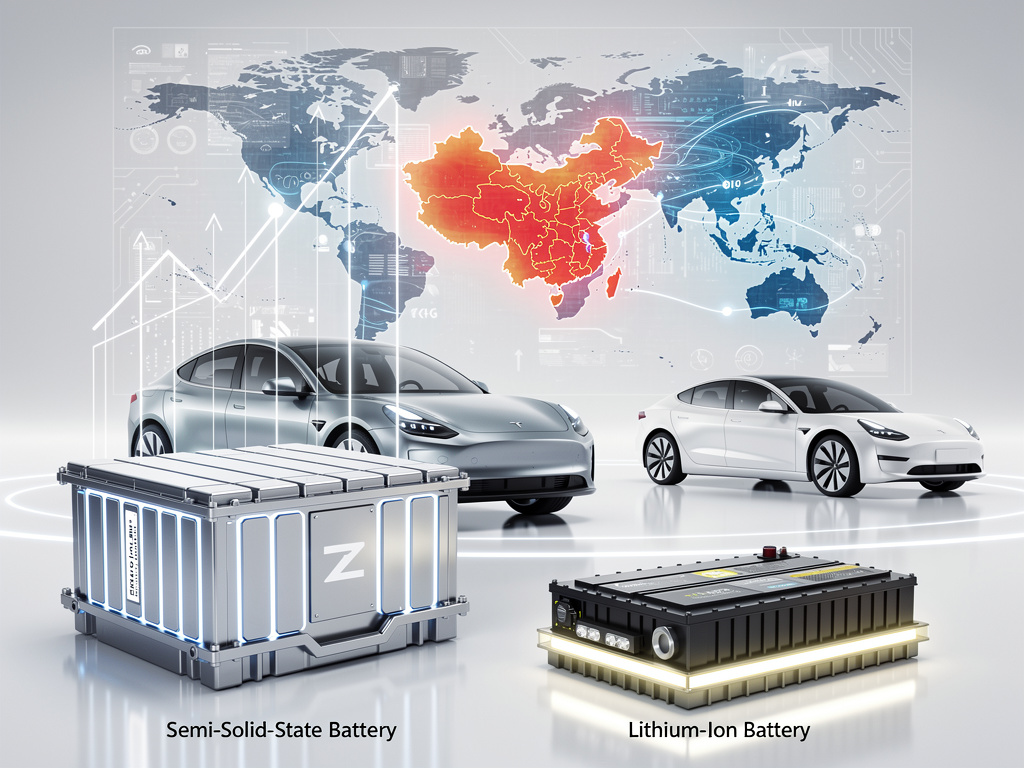
In the high-stakes global race for electric vehicle supremacy, the battle has decisively shifted from horsepower to kilowatt-hours. Now, a strategic maneuver from China is sending shockwaves through the industry, threatening to upend the established order. Geely, the sprawling automotive conglomerate and parent to Volvo and Polestar, has announced that its premium EV brand, Zeekr, is set to deploy a semi-solid-state battery in a production vehicle, effectively firing a starting gun on the next generation of power storage long before many Western rivals believed possible.
The technology will debut in the Zeekr 001 FR, a high-performance shooting brake designed to challenge the likes of the Tesla Model S Plaid. The automaker claims the advanced battery pack can deliver a staggering 1,000 kilometers (about 621 miles) of range on a single charge. While this figure is based on China’s generous CLTC testing cycle, a more conservative EPA-equivalent estimate would still likely land in the formidable 450- to 500-mile territory, as reported by TechRadar. This leap in performance places immense pressure on competitors, including market leader Tesla, whose longest-range vehicle, the Model S, currently tops out at an official 405 miles.
A Crucial Distinction in the Battery Arms Race
The key to Zeekr’s announcement lies in a critical technical distinction: the battery is “semi-solid-state,” not the fully solid-state technology often hailed as the industry’s holy grail. Traditional lithium-ion batteries use a liquid electrolyte to move ions between the anode and cathode. Full solid-state batteries, as their name implies, replace this flammable liquid with a solid material, promising greater energy density, improved safety, and longer lifespans. Semi-solid-state batteries represent a pragmatic intermediate step, utilizing a hybrid electrolyte that is mostly solid with a small amount of gel or liquid. This approach delivers many of the benefits of solid-state—notably higher energy density allowing for more range without a larger pack—while relying on more mature manufacturing processes.
This move by Geely isn’t just a laboratory experiment; it signals a deliberate strategy to commercialize advanced technology faster than its rivals. While the Zeekr 001 FR is a limited-run, high-priced halo car, its role as a technology demonstrator is a powerful statement of intent. It proves the viability of the chemistry in a demanding, real-world application and serves as a crucial stepping stone for integrating it into more mainstream vehicles. This puts Geely and Zeekr at the forefront of a movement that could redefine consumer expectations for EV range and charging.
China’s Accelerating Commercialization Strategy
Geely is not alone in this pursuit. Its Chinese rival, Nio, has already made significant strides with its own 150-kWh semi-solid-state battery pack, supplied by Beijing-based WeLion New Energy Technology. In a widely publicized test, Nio’s founder and CEO William Li drove an ET7 sedan for over 1,000 kilometers on a single charge, a feat that Electrek detailed as a major milestone for the technology’s real-world application. While the Nio battery pack is currently available through a costly leasing or purchase program, its existence underscores a broader trend: Chinese automakers are aggressively leveraging their domestic supply chain dominance to bring next-generation batteries to market now, rather than waiting for a perfect, full solid-state solution.
This rapid deployment stands in stark contrast to the more cautious timelines of Western and Japanese automakers. The strategy appears to be one of iterative, real-world deployment, using premium models to absorb the initial high costs and gather invaluable performance data. This allows companies like Geely and Nio to refine the technology in public view, building both consumer confidence and manufacturing expertise simultaneously. It is a bold approach that prioritizes market presence and technological leadership over a protracted, behind-the-scenes research and development cycle.
Tesla’s Calculated Focus vs. Geely’s Leap
The development puts a spotlight on Tesla’s own battery strategy, which has centered on its 4680 cylindrical cells. Rather than a radical chemistry change, the 4680 cell is an innovation in form factor and manufacturing process, designed to reduce costs, improve thermal management, and streamline vehicle assembly. Tesla is playing a long game focused on economies of scale, betting that making good-enough batteries cheaper and faster is the key to mass-market adoption. The company recently celebrated the production of its 50 millionth 4680 cell at its Texas Gigafactory, a testament to its focus on manufacturing scale, as covered by InsideEVs.
However, the launch of production-ready semi-solid-state technology by competitors challenges this narrative. While Tesla focuses on optimizing the current paradigm, Chinese firms are taking a leap toward the next one. Geely’s move suggests a belief that a significant jump in performance and range, even at a higher initial cost, can capture the lucrative premium end of the market and establish a brand reputation for cutting-edge innovation. It creates a strategic divergence: Tesla is digging a deeper, more efficient trench with current technology, while Geely is attempting to fly over it with what comes next.
The Shifting Timelines of Legacy Automakers
This acceleration also puts legacy automakers in a difficult position, particularly Toyota. The Japanese giant has long been one of the most vocal proponents of solid-state technology, holding a vast portfolio of patents and promising a revolutionary breakthrough for years. Recently, Toyota announced it had simplified the production of the material used for solid-state batteries, aiming for commercialization between 2027 and 2028, a development that Reuters reported as a significant step forward. Yet, that timeline, once seen as ambitious, now appears increasingly distant as Chinese brands begin shipping cars with a functional, if not perfect, version of the technology today.
The risk for companies like Toyota, Volkswagen, and General Motors is one of perception. While they invest billions in R&D for a future solid-state solution, they may be seen as laggards by consumers who can purchase a semi-solid-state-equipped vehicle from a competitor. Geely’s move effectively shrinks the technology gap, transforming a theoretical, future advantage into a present-day competitive threat. It forces every major automaker to re-evaluate not just their long-term research goals, but their immediate product roadmaps.
From Supercars to Sedans: The Path to Mass Adoption
The initial deployment of semi-solid-state batteries in an ultra-exclusive supercar like the Zeekr 001 FR—which saw its first batch of deliveries begin in late 2023, according to CNEVPost—is just the opening chapter. The critical question for the industry is how quickly this technology can be scaled and its costs reduced to a point where it can be integrated into mainstream sedans and SUVs. The manufacturing hurdles for any new battery chemistry are immense, involving complex supply chains for raw materials, new tooling for production lines, and rigorous safety validation.
For now, the semi-solid-state battery remains a premium offering. But as production volumes increase and manufacturing techniques are refined, costs are expected to fall. The path forward will likely see the technology trickle down from flagship performance models to high-end luxury vehicles and, eventually, into the mass market. The timeline for this transition will be the defining factor in the next phase of the EV competition. Geely has signaled its ambition to lead that charge, turning a futuristic promise into a tangible product and challenging the entire automotive world to keep pace.


 WebProNews is an iEntry Publication