
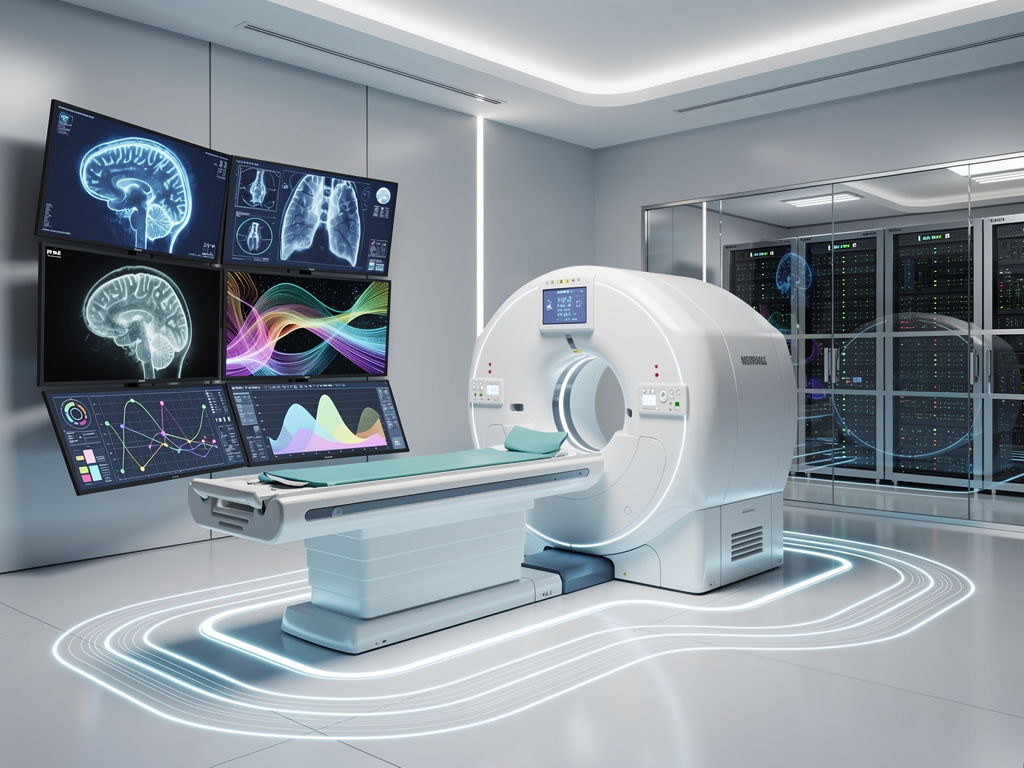
In the high-stakes world of medical imaging, where patient backlogs stretch into months and radiologists battle burnout, GE HealthCare’s top executive has issued a stark proclamation: artificial intelligence is no longer a luxury but a survival tool. “There is tremendous interest and growing trust [in AI]. There is an openness from healthcare practitioners, but also healthcare systems to say without AI, I cannot imagine running my operation,” declared Roland Rott, CEO and President of Imaging at GE HealthCare, in a recent interview with Healthcare IT Today.
Hospitals face mounting pressures from staffing shortages, surging imaging volumes driven by aging populations, and chronic underutilization of data. Rott highlighted that 97% of healthcare data sat unused until AI unlocked its potential. “The beauty of AI is that it is able to deal with large amounts of data,” he said, pointing to tools that analyze DICOM images and patient histories to optimize appointment scheduling and exam durations without adding headcount.
These AI-driven efficiencies promise to expand capacity, shorten wait times, and ease clinician workloads amid a radiology technologist vacancy rate that hit 18% in 2024—triple the level from three years prior, according to GE HealthCare Insights.
Radiology’s Acute Labor Crunch
The U.S. radiology workforce crisis deepens, with projections of a 37,800 to 124,000 physician shortfall by 2034, as noted in an analysis by AInvest. In the UK, radiologist shortfalls reached 30% in recent years, forcing departments to divert patients or rely on costly travel technologists. GE HealthCare attributes this to rising chronic diseases like cancer and dementia, compounded by post-pandemic attrition where radiologist departure rates surged 50% since 2020, per The Imaging Wire.
Administrative burdens exacerbate the strain, with a Radiological Society of North America survey revealing 60% of radiologists citing bureaucracy as their top burnout trigger. AI steps in here, automating routine tasks like protocol selection and image rotation, allowing technologists to focus on patient care. “Radiology teams need to save time,” Rott emphasized. “As a leader, I cannot do nothing. It is imperative that I give my users the tools to help them care for patients faster.”
GE’s AI Arsenal Targets Bottlenecks
GE HealthCare’s suite leverages the Edison platform, which hosts applications for automated image acquisition and decision support. New tools parse DICOM data to predict optimal scan times, preventing rushed exams for complex cases and freeing slots for simpler ones. This directly counters inefficiencies where departments operate near 100% capacity yet struggle with waitlists, as detailed in GE HealthCare reports on workflow optimization.
Recent advancements include on-device X-ray AI that flags critical findings like pneumothorax immediately post-acquisition, triaging urgent cases. For MRI, deep-learning reconstruction cuts scan times while enhancing detail, addressing the quality-speed trade-off. These innovations align with FDA trends, where GE leads with 96 cleared radiology AI tools, part of over 1,000 approvals dominated by imaging, according to Applied Radiation Oncology.
Strategic Bets Fuel Expansion
To scale these capabilities, GE HealthCare announced a $2.3 billion acquisition of Intelerad in late 2025, set to close in the first half of 2026. The deal merges GE’s AI prowess with Intelerad’s cloud platforms for radiology and cardiology, targeting outpatient networks strained by volume spikes. “Our acquisition of Intelerad will bring additional cloud-enabled and intelligent solutions… enabling care teams to be more efficient,” stated CEO Peter Arduini, as reported by MedTech Dive.
Partnerships amplify this push: NVIDIA collaboration develops autonomous X-ray and ultrasound systems using physical AI to capture and analyze images, easing sonographer strain from repetitive motions. “GE HealthCare is committed to developing innovative technologies… to improve patient access and address the challenges of growing workloads and staffing shortages,” Rott told NVIDIA Newsroom. Meanwhile, the MyBreastAI Suite integrates iCAD apps, boosting mammography sensitivity by 8% and slashing reading time 52%, per Diagnostic Imaging.
Proven Gains Amid Skepticism
Real-world results validate the shift. Duke Health used GE’s predictive tools to halve temporary labor reliance and lift productivity 6%. Studies in Health and Technology affirm AI mitigates shortages by handling repetitive tasks, though ethical hurdles like bias and oversight persist. A systematized review notes AI improves resilience but calls for diverse trials to ensure broad efficacy.
Market dynamics underscore urgency: the AI radiology sector grows at 22.4% CAGR, per AInvest, as 60% of U.S. departments adopt tools. Yet, as Radiology Business reports, fears of job displacement linger, tempered by evidence that AI augments rather than replaces—demand for radiologists rose 17% despite permeation, echoing Nvidia’s Jensen Huang at Davos.
Regulatory Momentum and Future Horizons
FDA clearances surged in 2025, adding 56 radiology AIs in December alone. GE’s leadership positions it for 2026’s “governance year,” where EU AI Act mandates high-risk compliance, as forecasted by IntuitionLabs. Vendors like Siemens and Philips compete with end-to-end AI workflows showcased at RSNA 2025.
X discussions reflect industry buzz: John Lynn of Healthcare IT Today amplified Rott’s comments, while experts debate AI’s role in triage and diagnostics. A medRxiv preprint predicts no job losses soon, given static workforce and volume growth. GE’s vision—autonomous imaging extending access to underserved areas—could redefine operations, proving Rott right: without AI, running radiology becomes unimaginable.


 WebProNews is an iEntry Publication