
Intel’s next server and client processors promise bigger leaps in instruction capabilities. Advanced Performance Extensions, known as APX, and the latest iteration of vector instructions under AVX10.2 stand ready to accelerate everything from artificial intelligence training loops to media codecs and cryptographic routines. Yet raw hardware means little without software that can actually tap those features without breaking compatibility for older systems.
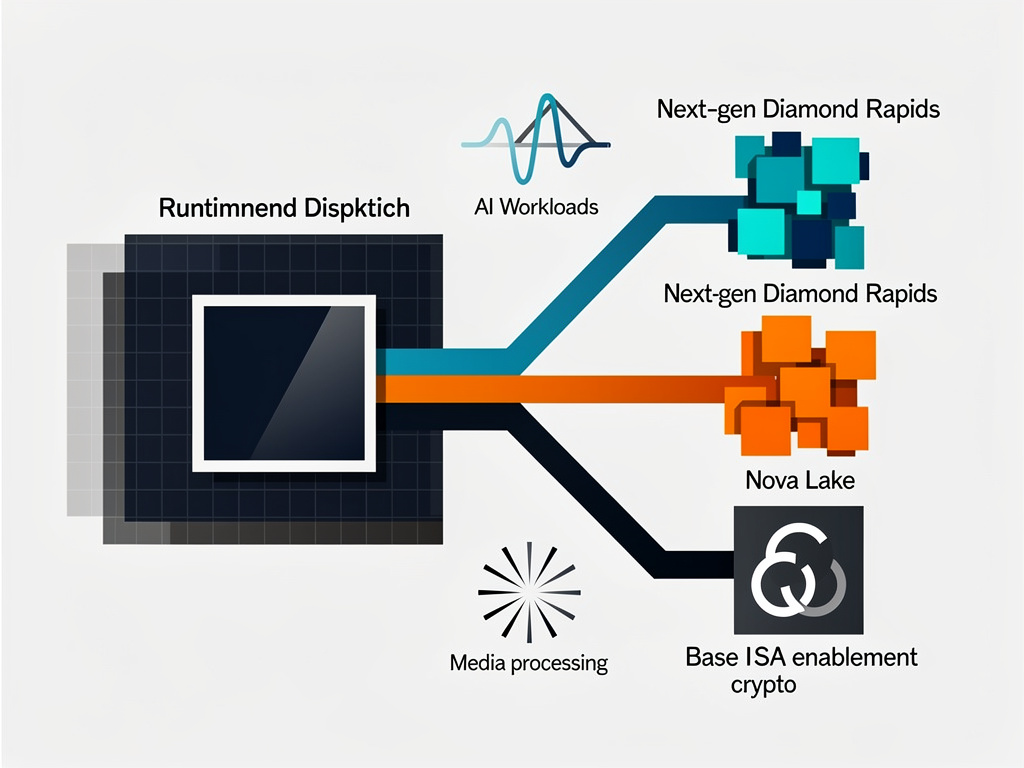
Enter a quiet but significant update now merged into the GCC codebase. Function multi-versioning, a mechanism that lets programmers define several implementations of the same routine and lets the runtime pick the right one based on detected CPU features, just gained explicit support for these forthcoming Intel extensions. The change landed barely two days ago. It prepares GCC 17, due next year, to generate binaries that adapt more intelligently to Diamond Rapids Xeon parts and the Nova Lake client chips expected to follow.
Developers already rely on FMV for AVX-512 paths, SSE4 variants, and other established targets. They annotate functions with target attributes. The compiler emits multiple copies. A resolver function checks CPUID bits at startup and wires up the best match. The process avoids the maintenance headache of separate binaries or complex build matrices. But until now the newest Intel extensions sat outside that convenient framework.
That gap closes with four fresh targets. Code can now specify “avx10.2”, “apxf”, “arch=diamondrapids”, or “arch=novalake” directly in __attribute__((target())) clauses. The first two allow fine-grained selection of the vector generation or the push-extension subset. The latter two bundle the full platform capabilities of each processor codename. Phoronix first reported the merge, noting the work builds on patches Intel contributed earlier this month.
APX itself brings modest but useful changes to the x86-64 baseline. It adds sixteen more general-purpose registers. It introduces new data destination forms that turn many two-operand instructions into three-operand variants, reducing register pressure. Conditional moves, loads, and stores gain companion forms that avoid setting flags. These tweaks matter most in scalar integer code and in tight loops where every saved register or avoided dependency counts. AVX10.2, by contrast, extends the vector side. It standardizes on 256-bit vectors by default while permitting 512-bit operation. New instructions target artificial intelligence workloads, accelerate media processing, expand WebAssembly vector support, and add fresh cryptography primitives.
Intel detailed much of this support already in GCC 15. The company published an article last year explaining how -march=diamondrapids pulls in APX_F, AVX10.2, expanded AMX matrix instructions, and a long list of smaller extensions such as AVX-IFMA, SHA512, and SM3/SM4. That earlier compiler release also delivered measurable gains. Auto-vectorization at -O2 improved SPECrate 2017 scores by more than 11 percent compared with GCC 14, the Intel team reported. Tuning for Sierra Forest E-core parts added another three percent in targeted workloads. Intel’s technical article on GCC 15 optimizations lays out the instruction list and benchmark lifts in plain terms.
But support inside the compiler for static compilation differs from dynamic selection at runtime. Many production environments ship a single binary that must run well on everything from decade-old Xeon processors to the latest silicon. FMV solves that tension. A hot compression routine, for example, can ship a baseline version, an AVX2 variant, an AVX-512 path, and now an AVX10.2 edition that also uses APX registers for better scalar fallback inside the vector loop. The resolver does the rest.
Microsoft added parallel support in its toolchain. Visual Studio 2026 introduced /arch:AVX10.2 with a default 256-bit vector length that can scale to 512 bits through a separate flag. The documentation notes that certain artificial intelligence instructions appear only through intrinsics because the compiler lacks native data types for them. Microsoft’s compiler reference page spells out the differences and the Visual Studio version that brought the option online.
Library maintainers have taken notice. A recent GitHub issue in Google’s Highway vector library discusses how to fold APX into the AVX10_2 target. Contributors point out that APX remains 64-bit only, unlike the vector extensions. They debate whether it should be opt-in to avoid surprising users on older kernels or virtual machines that might not expose the new CPUID leaves. Such conversations show the feature’s arrival ripples beyond GCC itself.
Practical impact will vary. Hot functions that spend most of their time in vector math stand to gain the most. AI inference engines, video encoders, and scientific codes that already chase every new instruction set will likely adopt the new targets first. General-purpose applications may see smaller lifts, especially if their bottlenecks lie elsewhere. Still, the option costs almost nothing in compile time and adds no runtime overhead beyond the initial CPUID dispatch that most projects already perform.
The commit that brought the support carries hash e935b1e43469dd33d9c242b81c4f1822fc398b16. It updates the necessary tables inside GCC’s configuration for x86. No dramatic rewrite was required. The infrastructure for FMV had been in place for years. Intel simply extended the list of recognized feature strings and ensured the resolver could test for them. That incremental approach reflects how modern compiler development often proceeds. Small, targeted patches accumulate until a capability crosses a usability threshold.
Downstream distributions will pick up the change once GCC 17 enters testing. Red Hat, SUSE, and Debian maintainers already track Intel’s contributions closely because their enterprise customers run the very server chips that benefit. Toolchain teams at Intel and AMD continue to coordinate on feature parity where it makes sense, even as competitive pressures push each vendor to expose unique extensions first.
Of course, hardware must arrive before the new paths see wide use. Diamond Rapids Xeon processors have appeared in roadmaps for some time. Nova Lake client parts remain further out. Until systems with these features ship in volume, the new FMV targets will serve mostly as insurance for forward-looking libraries and as a signal that the open-source toolchain stays aligned with silicon plans.
Even so, the merge marks a concrete step. It tells developers they can begin experimenting with APX and AVX10.2 today inside a single binary. They no longer need to wait for static -march flags or maintain separate shared objects. The resolver will do the heavy lifting when the right CPU appears. That flexibility has proven valuable for every prior generation of vector extensions. Expect the same pattern to repeat.
Library authors and performance engineers should review their hottest functions. Adding a few target attributes costs little. The payoff arrives the moment compatible hardware lands. In an industry where every percentage point of throughput matters at cloud scale, such quiet compiler improvements accumulate into substantial gains over time.
Recent coverage reinforces the momentum. Discussions on Hacker News and Linux forums highlight the patch’s arrival and debate its interaction with existing code size concerns around excessive multi-versioning. One technical blog post from earlier this month examined how FMV interacts with RISC-V vector extensions and warned that careless use can bloat binaries if applied to too many routines. The advice remains sound: confine the new targets to proven hot paths. Measure first.


 WebProNews is an iEntry Publication