
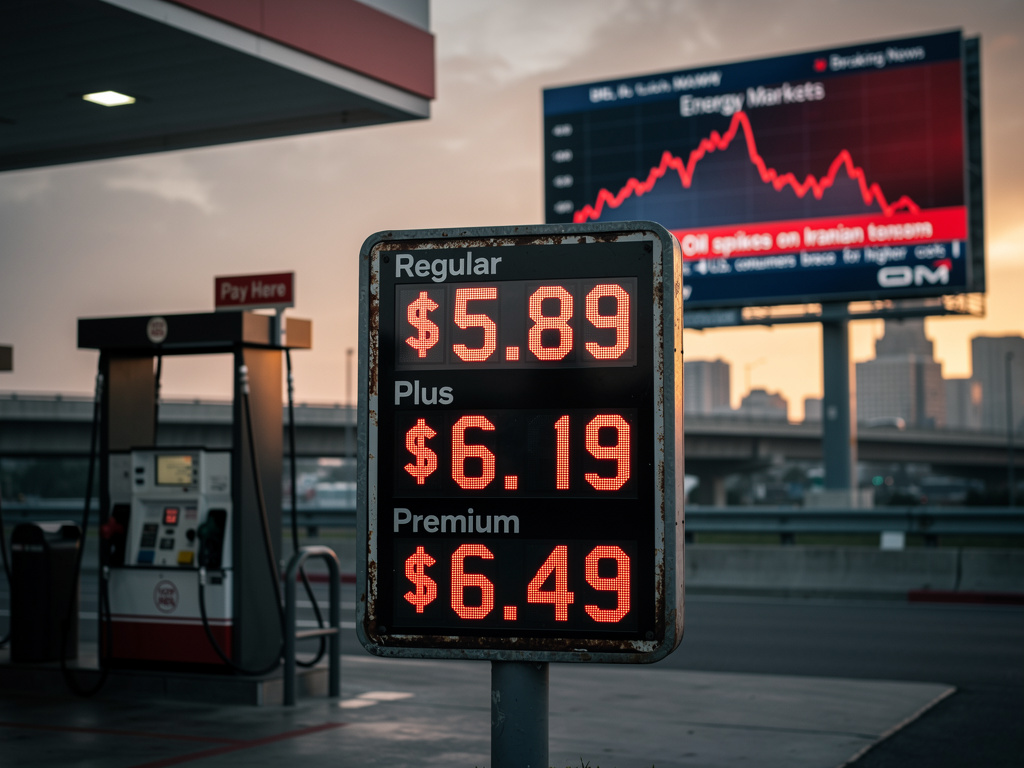
American drivers woke up to a jarring reality this week as gasoline prices surged in what analysts are calling the largest single-day jump in recent memory, triggered by escalating military tensions involving Iran. The spike sent shockwaves through energy markets and raised fresh concerns about the fragility of global oil supply chains at a time when consumers were already grappling with elevated costs across the economy.
According to Business Insider, the national average price of gasoline recorded its steepest single-day increase following reports of Iranian military actions that threatened to disrupt oil flows through one of the world’s most critical energy chokepoints. The sudden price movement underscored how geopolitical instability in the Middle East continues to hold outsized influence over what Americans pay at the pump, despite years of efforts to boost domestic energy production and reduce reliance on foreign oil.
The Strait of Hormuz Factor and Why It Still Matters
The catalyst for the price surge was rooted in Iran’s military posture, which raised the specter of disruptions in the Strait of Hormuz — the narrow waterway through which roughly 20% of the world’s daily oil supply passes. Any credible threat to shipping through the strait has historically triggered immediate and significant reactions in crude oil futures markets, and this episode proved no different. West Texas Intermediate crude jumped sharply in overnight trading, and the effects cascaded quickly to retail gasoline prices across the United States.
Energy market veterans noted that the speed of the price transmission — from geopolitical event to gas station price boards — has accelerated in recent years due to algorithmic trading in commodities markets and the increasing transparency of wholesale fuel pricing. Patrick De Haan, head of petroleum analysis at GasBuddy, has frequently pointed out that gas prices tend to rise like a rocket and fall like a feather, a dynamic that was on full display during this latest episode. Wholesale gasoline futures spiked within hours of the initial reports, and retailers began adjusting prices almost immediately.
How Much Prices Actually Moved — And Where They Could Go
The national average price of regular unleaded gasoline jumped by several cents per gallon in a single day, a move that, while it may sound modest in isolation, represents billions of dollars in additional costs when spread across the roughly 390 million gallons of gasoline Americans consume daily. As reported by Business Insider, this marked the largest single-day increase in the national average in a significant period, catching many consumers and analysts off guard given that prices had been relatively stable in the weeks prior.
The American Automobile Association (AAA) confirmed the sharp upward movement, noting that certain regions — particularly the West Coast and Northeast — experienced even steeper increases due to their greater dependence on imported crude and refined products. California, which consistently maintains the highest gasoline prices in the continental United States due to its unique fuel blend requirements and higher state taxes, saw prices push further above the $5-per-gallon mark in several metropolitan areas.
The Broader Economic Implications of a Pump Price Shock
For the broader U.S. economy, a sustained increase in gasoline prices acts as a regressive tax on consumers, disproportionately affecting lower-income households that spend a larger share of their budgets on transportation fuel. Economists at major Wall Street banks have long modeled the relationship between gas prices and consumer spending, generally estimating that every one-cent increase in the national average price of gasoline extracts roughly $1 billion annually from consumer wallets that might otherwise be spent on goods and services.
The timing of this spike is particularly unwelcome for the Federal Reserve, which has been carefully monitoring inflation indicators as it weighs the path of interest rate policy. Energy prices feed into both the Consumer Price Index and the Personal Consumption Expenditures index — the Fed’s preferred inflation gauge — and a sustained increase could complicate the central bank’s calculus. Fed Chair Jerome Powell has repeatedly acknowledged the role of energy prices as a volatile but important component of the inflation picture, and a geopolitically driven oil shock is precisely the kind of supply-side disruption that monetary policy is poorly equipped to address.
Domestic Production Is High, But Global Markets Still Dictate Prices
One of the persistent paradoxes of American energy policy is that the United States is now the world’s largest producer of crude oil, pumping more than 13 million barrels per day, yet domestic gasoline prices remain tightly linked to global crude oil benchmarks. This is because oil is a globally traded commodity, and American producers sell their output at world market prices. When geopolitical events push up the price of Brent crude — the international benchmark — the cost of oil for American refiners rises in tandem, regardless of how much oil is being extracted from the Permian Basin or the Bakken formation.
This dynamic has frustrated policymakers on both sides of the aisle for years. Republican leaders have generally argued for expanded drilling and pipeline construction as a means of insulating consumers from price shocks, while Democrats have pushed for accelerated adoption of electric vehicles and renewable energy to reduce dependence on fossil fuels altogether. Neither approach offers a short-term solution when prices spike overnight due to military tensions thousands of miles away. The Strategic Petroleum Reserve, which was drawn down significantly in 2022 during the last major energy price crisis, remains at historically low levels, limiting the administration’s ability to use emergency releases to tamp down prices.
What Oil Traders Are Watching Next
In the days following the initial spike, energy traders have been closely monitoring diplomatic channels for any signs of de-escalation. The price of crude oil tends to incorporate a “geopolitical risk premium” during periods of heightened tension in the Middle East, and that premium can dissipate quickly if the situation stabilizes. However, analysts at Goldman Sachs and JPMorgan have both noted in recent research that the current risk environment is more complex than previous Iran-related flare-ups, given the overlapping conflicts in the region and the uncertain posture of major powers including the United States, Russia, and China.
OPEC+ production decisions add another layer of complexity. The cartel and its allies have been managing output carefully to support prices, and any disruption to Iranian supply — whether through military action or tightened sanctions enforcement — would remove barrels from an already carefully balanced market. Saudi Arabia, the group’s de facto leader, has shown limited willingness to rapidly increase production to offset potential shortfalls, preferring to maintain the pricing power that comes with disciplined output management.
What Consumers Can Expect in the Weeks Ahead
For American motorists, the immediate outlook depends heavily on whether the geopolitical situation escalates or subsides. If tensions cool, analysts expect the price spike to partially reverse within one to two weeks, though the full retreat to pre-crisis levels could take longer given the asymmetric nature of gasoline price movements. If the situation worsens — particularly if there is any actual disruption to oil shipments through the Strait of Hormuz — prices could surge significantly further, with some worst-case scenarios projecting national averages above $4.50 or even $5.00 per gallon.
The episode serves as a stark reminder that despite America’s energy abundance, the nation’s transportation system — still overwhelmingly powered by petroleum — remains vulnerable to events far beyond its borders. As Business Insider reported, the single-day price jump was a record-setting event that caught the attention of both Wall Street and Main Street. Whether it becomes a footnote or the beginning of a prolonged price crisis will depend on decisions made in Tehran, Riyadh, and Washington in the days and weeks ahead.
For now, drivers would be wise to fill up sooner rather than later if they suspect further escalation, and to keep a close eye on developments in a region that, despite all the talk of energy independence, still holds remarkable sway over the American economy.


 WebProNews is an iEntry Publication